Counting Rankings of Tree-Child Networks
Qiang Zhang, Mike Steel

TL;DR
This paper explores how to count the number of ways to order evolutionary events in a specific type of phylogenetic network called a tree-child network.
Contribution
The paper introduces a method to count rankings of tree-child networks and derives an asymptotic expression for the expected number of rankings.
Findings
An explicit asymptotic formula for the expected number of rankings of a random tree-child network is derived.
The relationship between rankable tree-child networks and normal networks is investigated.
A method for counting rankings on binary or semi-binary tree-child networks is presented.
Abstract
Rooted phylogenetic networks allow biologists to represent evolutionary relationships between present-day species by revealing ancestral speciation and hybridization events. A convenient and well-studied class of such networks are ‘tree-child networks’ and a ‘ranking’ of such a network is a temporal ordering of the ancestral speciation and hybridization events. In this short note, we investigate the question of counting such rankings on any given binary (or semi-binary) tree-child network. We also investigate the relationship between rankable tree-child networks and the class of ‘normal’ networks. Finally, we provide an explicit asymptotic expression for the expected number of rankings of a tree-child network chosen uniformly at random.
Genes, proteins, chemicals, diseases, species, mutations and cell lines named across the full text — each resolved to its canonical identifier and authoritative record.
Click any figure to enlarge with its caption.
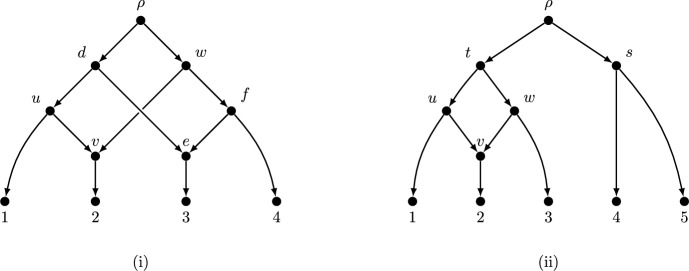 Figure 1
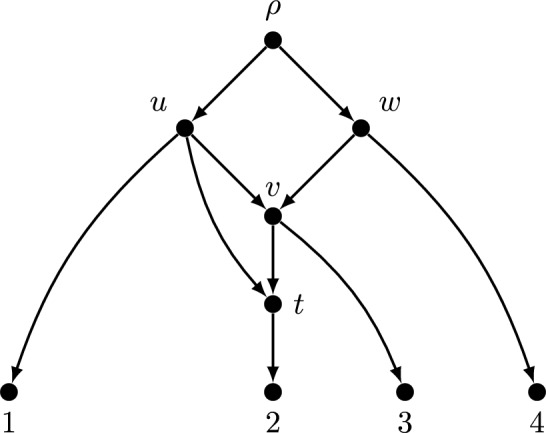 Figure 2
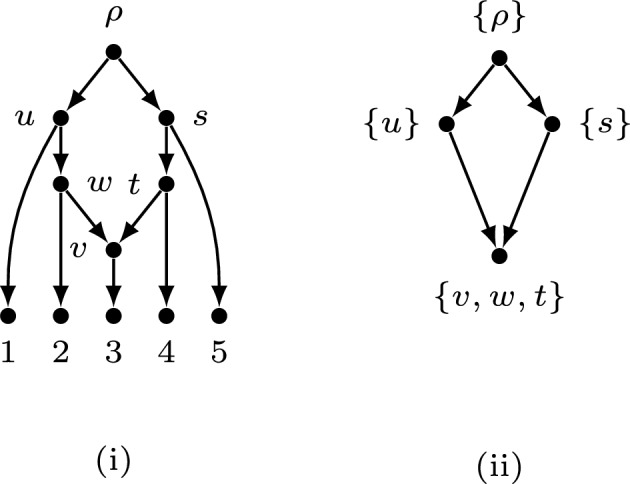 Figure 3
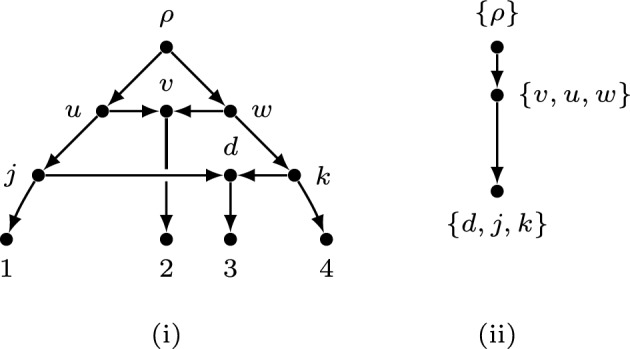 Figure 4
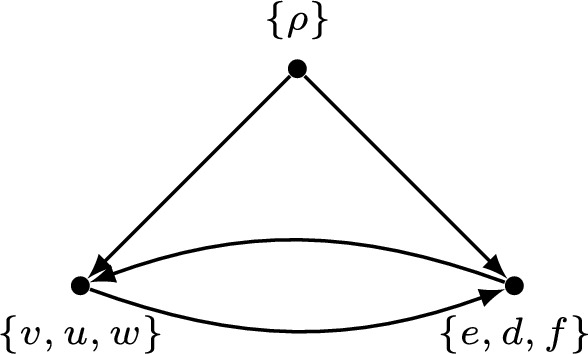 Figure 5
Peer Reviews
No public reviews on file for this paper yet. If you reviewed it on a platform where reviews are public (OpenReview, ICLR, NeurIPS, ICML), you can paste yours below so the community can read it here.
Videos
No videos yet. Explain this paper in a talk, walkthrough, or lecture? Add one.
Taxonomy
TopicsEvolution and Paleontology Studies · Genomics and Phylogenetic Studies · Plant and animal studies