Regulation of sebaceous gland homeostasis and sebum secretion by the ERBB receptor family
Theresa Hommel, Marlon R. Schneider, Maik Dahlhoff

TL;DR
This paper reviews how ERBB receptors regulate sebaceous glands and sebum, linking their function to skin health and disease.
Contribution
The paper highlights the role of ERBB receptors in sebaceous gland function and suggests their potential as therapeutic targets.
Findings
ERBB receptors regulate sebocyte proliferation and lipid production.
Impaired ERBB signaling is linked to acne and sebaceous gland hyperplasia.
ERBB signaling could be a target for treating skin conditions.
Abstract
ERBB receptors are underappreciated regulators of cellular processes in the sebaceous gland (SG). They control sebocyte proliferation, differentiation, and lipid production - mechanisms that are essential for SG homeostasis, sebum secretion, and skin health. Also, impaired ERBB signaling is associated with diseases such as acne, SG hyperplasia, or skin adverse effects to some cancer therapies. By addressing current findings and unsolved aspects of ERBB signaling in the SG, this review aims to encourage deeper investigation to identify potential therapeutic strategies for common and chronic skin conditions. Biomolecules; Molecular mechanism of gene regulation; Cell biology
Genes, proteins, chemicals, diseases, species, mutations and cell lines named across the full text — each resolved to its canonical identifier and authoritative record.
Click any figure to enlarge with its caption.
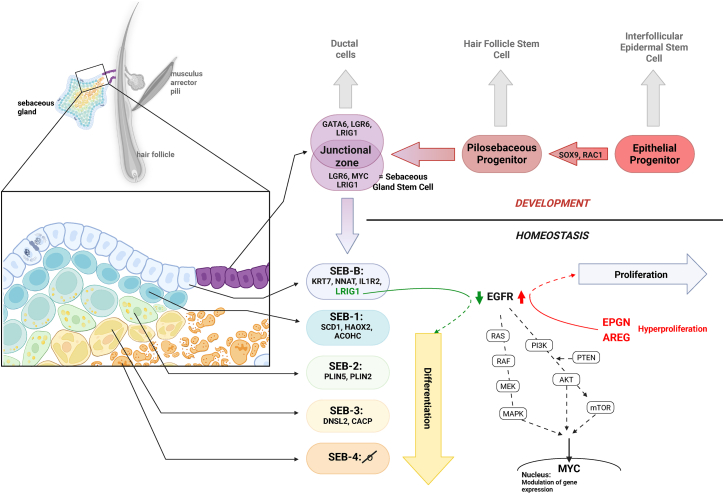 Figure 1
Peer Reviews
No public reviews on file for this paper yet. If you reviewed it on a platform where reviews are public (OpenReview, ICLR, NeurIPS, ICML), you can paste yours below so the community can read it here.
Videos
No videos yet. Explain this paper in a talk, walkthrough, or lecture? Add one.
Taxonomy
TopicsAcne and Rosacea Treatments and Effects · Dermatology and Skin Diseases · Leprosy Research and Treatment