Acute endocrine responses to snouted cobra (Naja annulifera) and African puffadder (Bitis arietans) envenomation in dogs
Noeline Fourie-Viljoen, Amelia Goddard, Peter N Thompson, Sylvie Daminet, Johan P Schoeman

TL;DR
This study examines how snake bites from two African species affect hormone levels in dogs, finding significant drops in thyroxine linked to inflammation.
Contribution
The first study to investigate endocrine responses in dogs envenomed by Naja annulifera and Bitis arietans, linking thyroid hormone suppression to systemic inflammation.
Findings
Dogs envenomed by snouted cobra or puffadder showed significantly lower serum thyroxine (TT4) compared to healthy controls.
TT4 levels remained suppressed for up to 36 hours, with a negative correlation observed between TT4 and C-reactive protein (CRP).
Neurological cobra envenomation was associated with the lowest TT4 levels and highest cortisol concentrations at admission.
Abstract
The endocrine response to snake envenomation in dogs remains unexplored. To compare the endocrine response in dogs envenomated by snouted cobra (Naja annulifera) and African puffadder (Bitis arietans) with healthy control dogs, to evaluate the change over time of specific hormones, and to investigate the correlation of these changes with C-reactive protein (CRP). This study included 17 client-owned dogs naturally envenomed by either a snouted cobra (N annulifera) (n = 9) or a puffadder (B arietans) (n = 8). Two control groups (n = 10 and n = 12) consisted of client-owned dogs in good health. In this prospective longitudinal observational study, serum samples were collected at admission, and at 12, 24, and 36 h after envenomation. At each time point, the serum total thyroxine (TT4), thyrotropin, total cortisol, and CRP concentrations were measured. The median serum TT4 concentrations…
Genes, proteins, chemicals, diseases, species, mutations and cell lines named across the full text — each resolved to its canonical identifier and authoritative record.
Click any figure to enlarge with its caption.
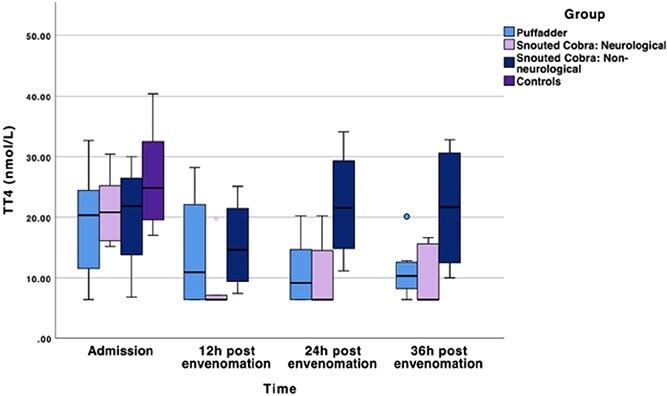 Figure 1
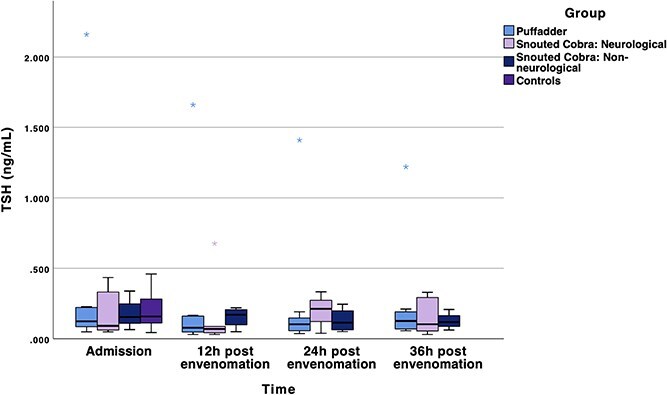 Figure 2
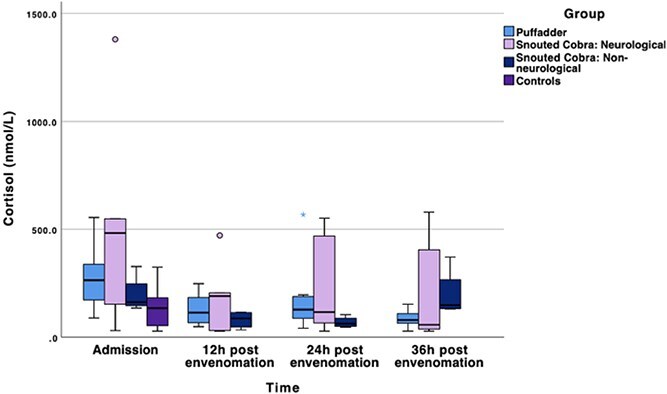 Figure 3
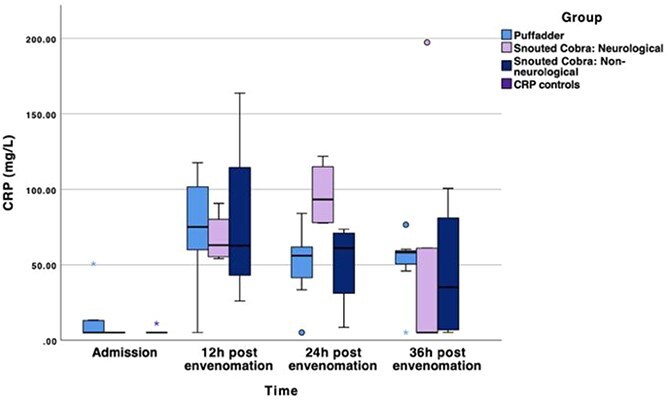 Figure 4
Peer Reviews
No public reviews on file for this paper yet. If you reviewed it on a platform where reviews are public (OpenReview, ICLR, NeurIPS, ICML), you can paste yours below so the community can read it here.
Videos
No videos yet. Explain this paper in a talk, walkthrough, or lecture? Add one.
Taxonomy
TopicsVenomous Animal Envenomation and Studies · Marine Invertebrate Physiology and Ecology · Amphibian and Reptile Biology