Duration of progesterone exposure before frozen embryo transfer impacts live birth rates following single vitrified-thawed day 6 blastocyst transfer: a multicenter cohort study
He Cai, Zhiqiang Wang, Ying Fang, Zan Shi, Danmeng Liu, Xiaokui Yang, Yali Ni, Juanzi Shi

TL;DR
Extending progesterone exposure to six days before frozen embryo transfer improves live birth rates compared to five days when using day 6 blastocysts.
Contribution
Demonstrates that a six-day progesterone protocol before frozen embryo transfer increases live birth rates for day 6 blastocysts.
Findings
Six days of progesterone priming before FET significantly increased live birth rates compared to five days.
Biochemical and clinical pregnancy rates were also higher with six days of progesterone exposure.
No significant differences in miscarriage rates or neonatal outcomes were observed between the groups.
Abstract
Does administering progesterone for 6 days prior to frozen embryo transfer (FET) improve live birth rate (LBR) compared to 5 days of progesterone exposure when transferring blastocysts expanded on Day 6 (D6)? This multicenter retrospective cohort study included 1,639 single FET cycles using D6 blastocysts under hormone replacement therapy (HRT) between January 2018 and December 2023. Cycles were stratified by duration of progesterone priming: 6 days (P6 group, n = 1,122) or 5 days (P5 group, n = 517). The primary outcome was LBR; secondary outcomes included biochemical and clinical pregnancy rates, miscarriage rate, and neonatal outcomes (birth weight and gestational age at delivery). Generalized estimating equation (GEE) regression models were used to adjust for potential confounders. Subgroup analyses by PGT status and sensitivity analyses restricted to first FET cycles or…
Genes, proteins, chemicals, diseases, species, mutations and cell lines named across the full text — each resolved to its canonical identifier and authoritative record.
Click any figure to enlarge with its caption.
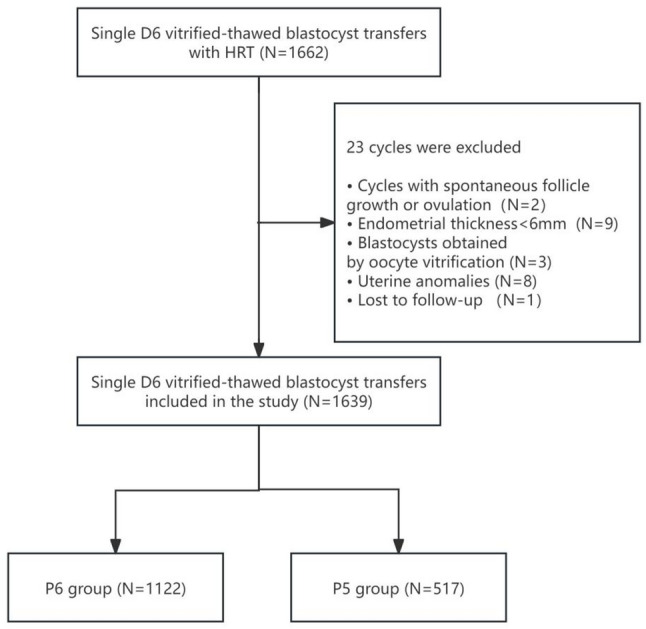 Figure 1
Peer Reviews
No public reviews on file for this paper yet. If you reviewed it on a platform where reviews are public (OpenReview, ICLR, NeurIPS, ICML), you can paste yours below so the community can read it here.
Videos
No videos yet. Explain this paper in a talk, walkthrough, or lecture? Add one.
Taxonomy
TopicsOvarian function and disorders · Reproductive Biology and Fertility · Reproductive Health and Technologies