Renal function during tenofovir‑based antiretroviral therapy among people living with HIV in Lilongwe, Malawi: findings from the prospective LighTen cohort study
Melani R. Mahanani, Florian Neuhann, Ethel Rambiki, Angelina Nhlema, Hannock Tweya, Myo Chit, Jane Chiwoko, Thom Chaweza, Claudia Wallrauch, Tom Heller, Volker Winkler, Gerd Fätkenheuer, Hans-Michael Steffen

TL;DR
This study found that tenofovir-based HIV treatment in Malawi did not harm kidney function and may have even improved it over three years.
Contribution
The study provides real-world evidence that TDF-based ART can be safely used without pre-treatment kidney tests in resource-limited settings.
Findings
Tenofovir-based ART was not associated with a decline in estimated glomerular filtration rate (eGFR) over 36 months.
An unexpected trend of improved renal function was observed in people living with HIV.
Baseline eGFR and WHO clinical stage were significant factors influencing changes in kidney function.
Abstract
Most first-line antiretroviral therapy (ART) regimes in Sub-Saharan Africa contain tenofovir disoproxil fumarate (TDF) which has a nephrotoxic potential. Baseline renal function assessment is not feasible in many settings and therefore not required prior to starting ART according to Malawian guidelines. We assessed renal function over 36 months in people living with HIV (PLHIV) starting TDF-based ART at Lighthouse Clinic, Lilongwe, Malawi. Data on demographics, medical history, laboratory values, WHO stage, and anthropometric measures were collected at study entry and during visits at 1, 3, 6 months, and every 6 months until month 36. The main outcome of the study was renal function, defined by the estimated glomerular filtration rate (eGFR) calculated using the CKD-EPI equation. Descriptive statistics and multivariable linear regression analysis were performed. A baseline creatinine…
Genes, proteins, chemicals, diseases, species, mutations and cell lines named across the full text — each resolved to its canonical identifier and authoritative record.
Click any figure to enlarge with its caption.
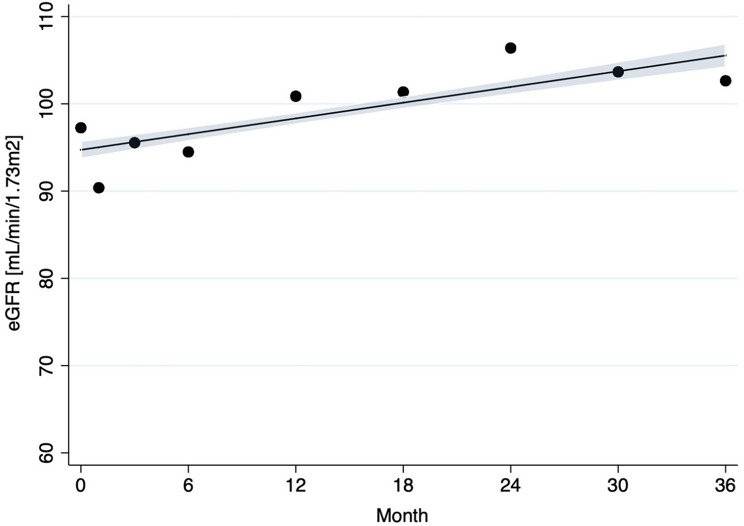 Figure 1
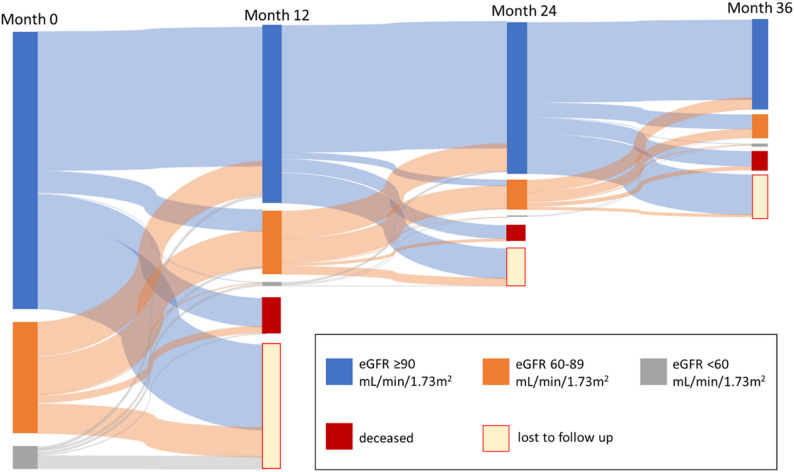 Figure 2
Peer Reviews
No public reviews on file for this paper yet. If you reviewed it on a platform where reviews are public (OpenReview, ICLR, NeurIPS, ICML), you can paste yours below so the community can read it here.
Videos
No videos yet. Explain this paper in a talk, walkthrough, or lecture? Add one.
Taxonomy
TopicsHIV/AIDS drug development and treatment · HIV/AIDS Research and Interventions · HIV-related health complications and treatments