Vesicovaginal fistula repair: comparative analysis of perioperative outcomes and predictors of success in open, laparoscopic, and robotic approaches
Zeyuan Wang, Gaurab Pokhrel, Shuanbao Yu, Haoke Zheng, Jin Tao, Yafeng Fan, Yunlong Liu, Jinjin Feng, Biao Dong, Tengfei Li, Xuanyi Ren, Xuepei Zhang

TL;DR
This study compares open, laparoscopic, and robotic surgeries for repairing vesicovaginal fistulas, finding that minimally invasive methods offer better perioperative outcomes but open surgery is better for complex cases.
Contribution
The study provides a comparative analysis of surgical approaches for vesicovaginal fistula repair, identifying predictors of success and perioperative advantages of minimally invasive techniques.
Findings
Minimally invasive techniques reduced operative time and blood loss compared to open surgery.
Post-hysterectomy fistulas had the highest success rate, while radiation-induced and trigonal fistulas had poorer outcomes.
Surgical approach was not an independent predictor of closure rates, but minimally invasive methods offered better perioperative results.
Abstract
To compare perioperative outcomes and evaluate predictors of successful repair in vesicovaginal fistula (VVF) cases among open, laparoscopic, and robotic-assisted approaches. This retrospective cohort study included 78 patients who underwent transabdominal VVF repair between December 2015 and July 2024 at a tertiary referral center. Patients were categorized based on surgical approach: open (n = 31), laparoscopic (n = 31), or robotic-assisted (n = 16). Data collected included demographics, fistula etiology and location, prior radiation exposure, operative time, blood loss, use of interposition flaps, and 3-month postoperative closure status. Minimally invasive techniques (laparoscopic and robotic) demonstrated reduced operative time (P = 0.014) and blood loss (P < 0.001) compared to open surgery. Time to repair (P = 0.001) and previous repair attempts (P = 0.007) varied significantly…
Genes, proteins, chemicals, diseases, species, mutations and cell lines named across the full text — each resolved to its canonical identifier and authoritative record.
Click any figure to enlarge with its caption.
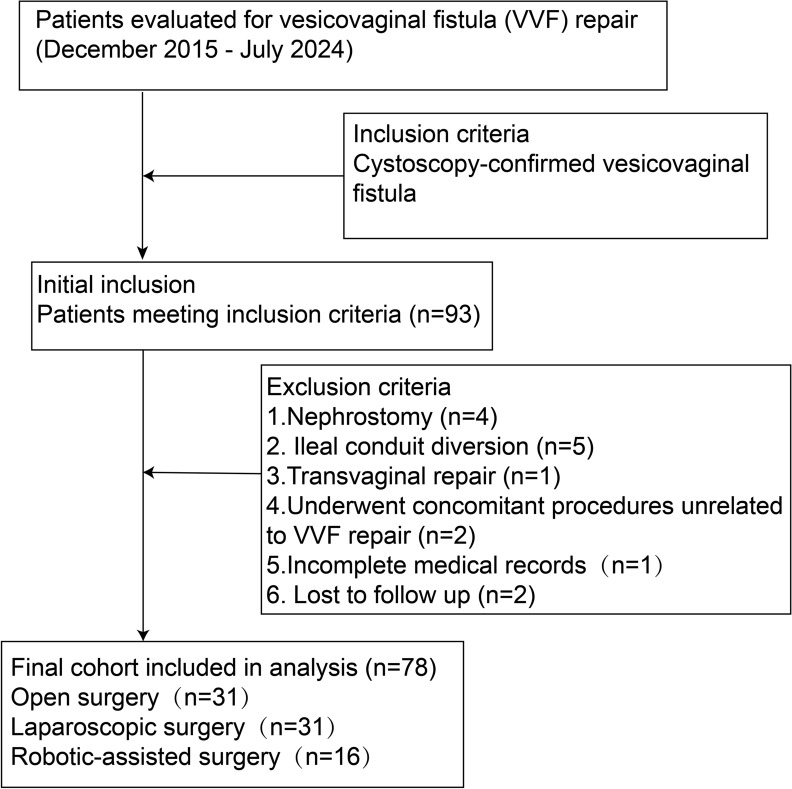 Figure 1
 Figure 2
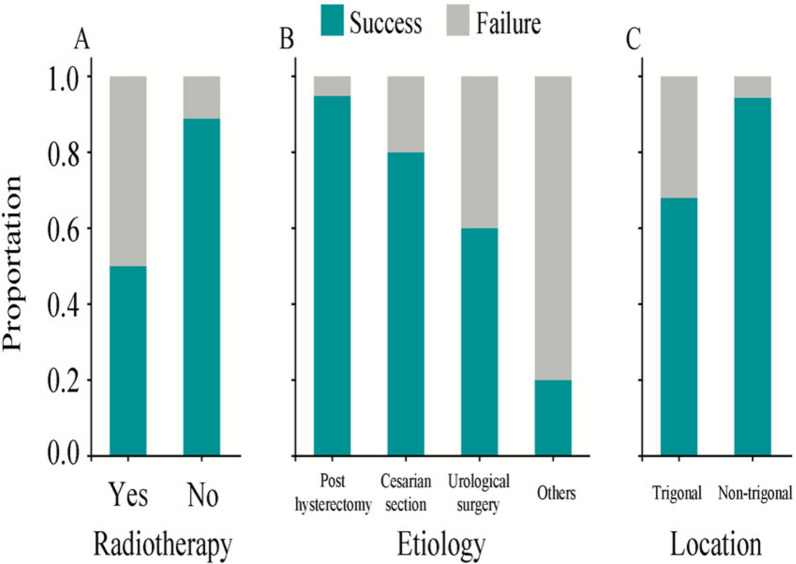 Figure 3
Peer Reviews
No public reviews on file for this paper yet. If you reviewed it on a platform where reviews are public (OpenReview, ICLR, NeurIPS, ICML), you can paste yours below so the community can read it here.
Videos
No videos yet. Explain this paper in a talk, walkthrough, or lecture? Add one.
Taxonomy
TopicsUreteral procedures and complications · Diverticular Disease and Complications · Anorectal Disease Treatments and Outcomes