Copy numbers of the S-adenosylmethionine synthetase (METK) gene in 14 dogs with active Leishmania infantum infection
Kathrin Sigel, Andreas Moritz, Melanie Hamann, Carlo Palizzotto, Eric Zini, Annabel Dalmau López, Britta Beck, Alexandra Kehl, Elisabeth Müller, Torsten J. Naucke, Yaarit Nachum-Biala, Gad Baneth, Ingo Schäfer

TL;DR
This study examines the copy numbers of the METK gene in dogs with active Leishmania infantum infection to understand allopurinol resistance and its clinical implications.
Contribution
The study investigates the clinical relevance of METK gene copy numbers in dogs with Leishmania infantum, linking them to allopurinol resistance and disease relapse.
Findings
Most dogs with clinical suspicion of resistance had METK gene copy numbers below 3.0.
All dogs showed clinicopathological signs of active leishmaniasis.
Resistant strains may be transmitted by sand flies, highlighting the zoonotic risk.
Abstract
Relapses of canine leishmaniasis during allopurinol treatment are common and complicate the course of disease. S-adenosylmethionine synthetase (METK) gene copy numbers (CN) < 3.0 have been demonstrated in allopurinol-resistant Leishmania infantum strains in vitro, but its clinical impact in vivo is still unclear. This study included 14 dogs divided into two cohorts (C): Cohort one (CI): nine dogs (64%) with signs of disease relapse under allopurinol treatment; Cohort two (CII): five dogs (36%) recently diagnosed with active leishmaniasis prior to treatment. Leishmania infantum infection was confirmed by positive PCR testing. METK gene CN was quantified by droplet digital PCR. Complete blood counts and biochemical profiles were performed where suitable samples were available. METK gene CN ranged from 0.7 to 3.4 [CN < 3.0 (n = 13), 93%; CN = 3.4 (n = 1), 7%; CI: CN = 1.2–3.4; CII: CN <…
Genes, proteins, chemicals, diseases, species, mutations and cell lines named across the full text — each resolved to its canonical identifier and authoritative record.
Click any figure to enlarge with its caption.
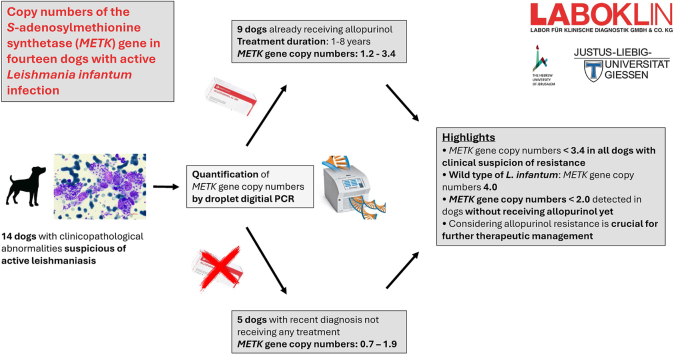 Figure 1
Peer Reviews
No public reviews on file for this paper yet. If you reviewed it on a platform where reviews are public (OpenReview, ICLR, NeurIPS, ICML), you can paste yours below so the community can read it here.
Videos
No videos yet. Explain this paper in a talk, walkthrough, or lecture? Add one.
Taxonomy
TopicsResearch on Leishmaniasis Studies · Trypanosoma species research and implications · Biochemical and Molecular Research