Viability of Dugesia dorotocephala Planaria with the Senolytic Drug ARV-825
Abbie Wells, William H. Munroe

TL;DR
This study tests the effect of the drug ARV-825 on planaria and finds that higher concentrations reduce their survival.
Contribution
The study introduces planaria as a potential model organism for testing the senolytic drug ARV-825.
Findings
Planaria survival decreased from 91.7% at 1µM ARV-825 to 25% at 10µM.
ARV-825, a PROTAC targeting BRD4, affects planaria viability in a concentration-dependent manner.
Abstract
Planaria ( Dugesia dorotocephala ) are being utilized as a model system to test the effectiveness of ARV-825. ARV-825 belongs to the drug class proteolysis targeting chimeras (PROTACs), which targets and degrades the protein Bromodomain-containing protein 4 (BRD4) via the proteasome. To examine the impact of ARV-825 on the planaria, planaria viability was tested at different ARV-825 concentrations. This demonstrated a concentration-dependent reduction in viability, 91.7% survival with 1µM ARV-825 reduced to 25% survival in 10 µM ARV-825. This suggests ARV-825 has an effect on Dugesia dorotocephala , and indicates that this may be a suitable model organism for studying ARV-825.
Genes, proteins, chemicals, diseases, species, mutations and cell lines named across the full text — each resolved to its canonical identifier and authoritative record.
Click any figure to enlarge with its caption.
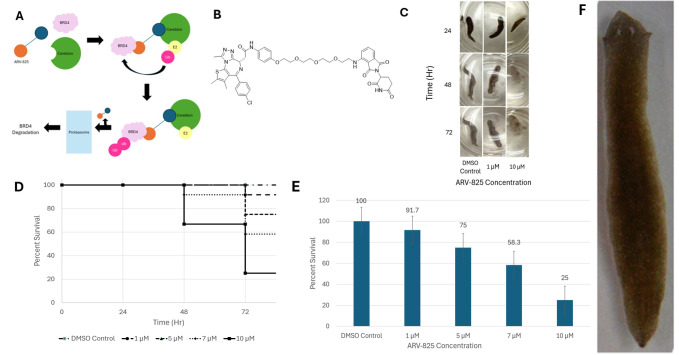 Figure 1
Peer Reviews
No public reviews on file for this paper yet. If you reviewed it on a platform where reviews are public (OpenReview, ICLR, NeurIPS, ICML), you can paste yours below so the community can read it here.
Videos
No videos yet. Explain this paper in a talk, walkthrough, or lecture? Add one.
Taxonomy
TopicsCellular Mechanics and Interactions · Planarian Biology and Electrostimulation · Viral Infectious Diseases and Gene Expression in Insects