Establishing a standard surgery for esophagogastric junction cancer: Final results from the JGCA-JES nationwide prospective study
Yukinori Kurokawa, Hiroya Takeuchi, Yuichiro Doki, Shinji Mine, Masanori Terashima, Takushi Yasuda, Kazuhiro Yoshida, Hiroyuki Daiko, Shinichi Sakuramoto, Takaki Yoshikawa, Chikara Kunisaki, Yasuyuki Seto, Shigeyuki Tamura, Toshio Shimokawa, Takeshi Sano, Yuko Kitagawa

TL;DR
This study identifies specific lymph node regions that significantly improve survival in esophagogastric junction cancer surgery, guiding tailored dissection based on tumor spread.
Contribution
The study provides evidence for targeted lymph node dissection in esophagogastric junction cancer based on tumor involvement length.
Findings
Proximal perigastric and suprapancreatic nodes show high therapeutic efficacy index (TEI).
TEIs in mediastinal stations 108 and 110 increase with longer esophageal tumor involvement.
Distal perigastric and paraaortic nodes have low TEIs and minimal survival impact.
Abstract
The optimal surgical approach and extent of lymph node dissection for esophagogastric junction (EGJ) cancer remains uncertain. We conduct a nationwide multicenter prospective study in patients with resectable cT2–T4 adenocarcinoma or squamous cell carcinoma with the tumor epicenter located within 2 cm of the EGJ. Patients undergo subtotal or lower esophagectomy with dissection of all regional lymph nodes. Of 1,065 patients screened, 371 are enrolled before surgery. Final analysis shows that proximal perigastric and suprapancreatic nodes exhibit a high therapeutic efficacy index (TEI), strongly supporting their dissection for improved long-term survival. TEIs in middle and lower para-esophageal stations are higher when esophageal involvement exceeds 3 and 2 cm, respectively. Conversely, all other stations, including distal perigastric and paraaortic nodes, have low TEIs, indicating…
Genes, proteins, chemicals, diseases, species, mutations and cell lines named across the full text — each resolved to its canonical identifier and authoritative record.
Click any figure to enlarge with its caption.
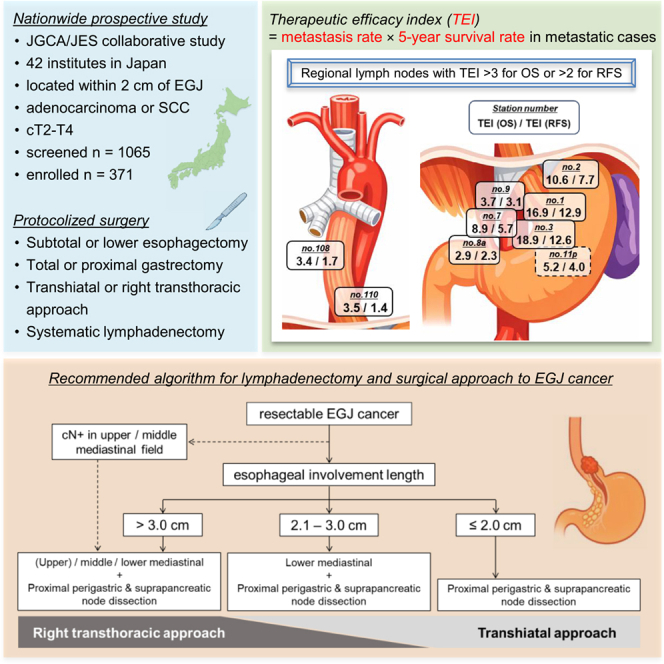 Figure 1
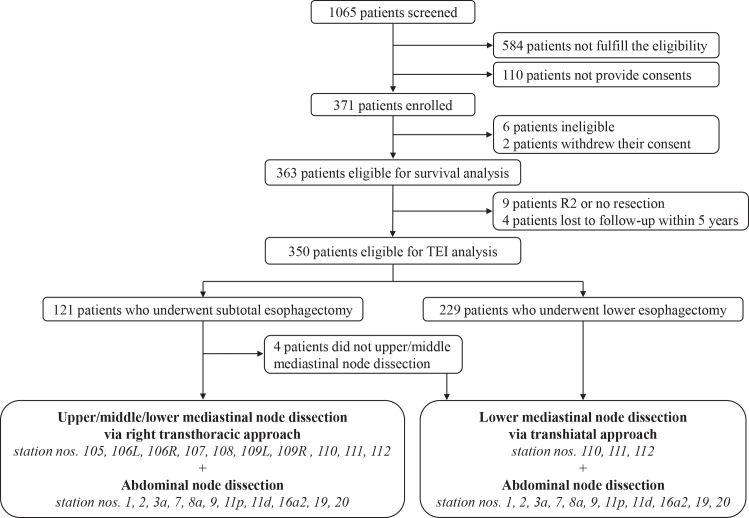 Figure 2
 Figure 3
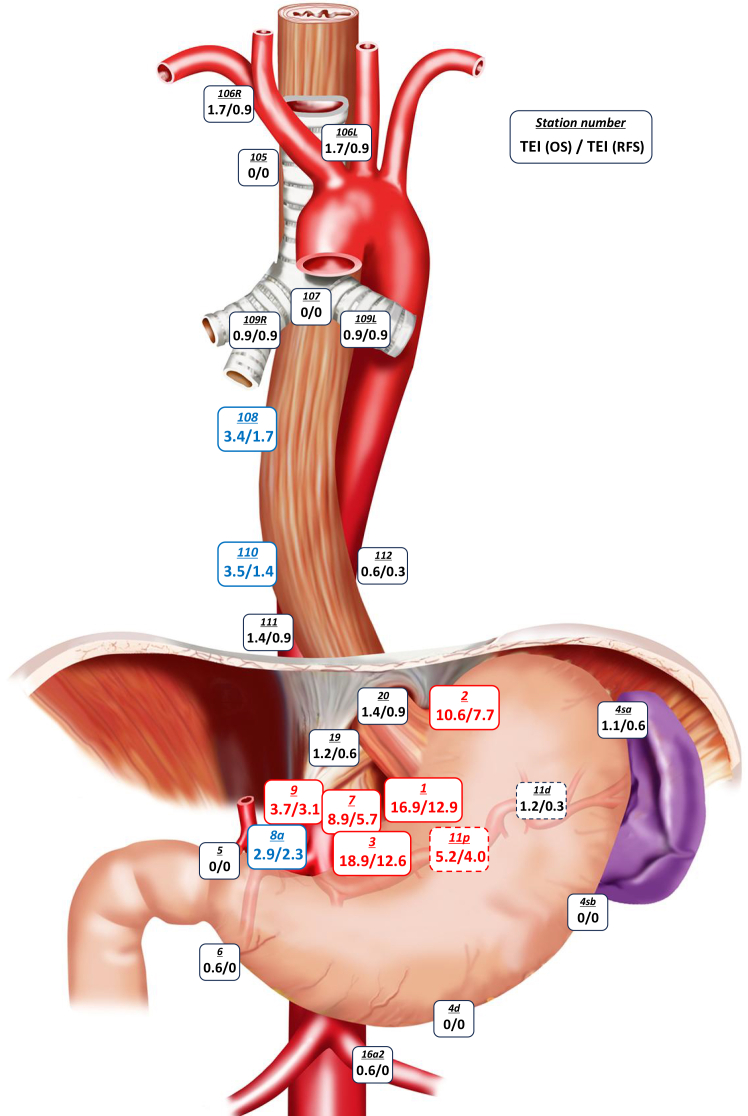 Figure 4
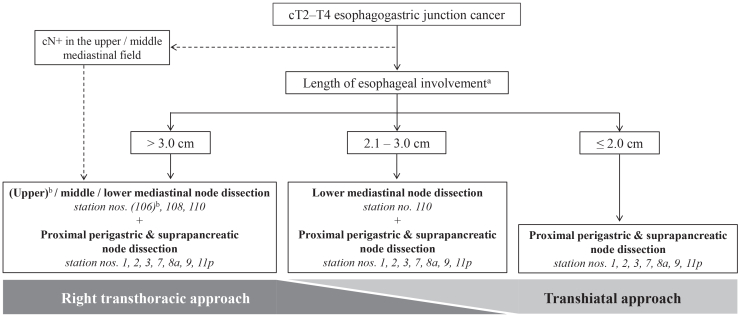 Figure 5
Peer Reviews
No public reviews on file for this paper yet. If you reviewed it on a platform where reviews are public (OpenReview, ICLR, NeurIPS, ICML), you can paste yours below so the community can read it here.
Videos
No videos yet. Explain this paper in a talk, walkthrough, or lecture? Add one.
Taxonomy
TopicsEsophageal Cancer Research and Treatment · Gastric Cancer Management and Outcomes · Pancreatic and Hepatic Oncology Research