Scalable and programmable topological transitions in plasmonic Moiré superlattices
Bo Tian, Xi Zhang, Ruitao Wu, Yuquan Zhang, Luping Du, Xiaocong Yuan

TL;DR
Researchers show that plasmonic Moiré superlattices enable scalable and tunable topological transitions, offering a new platform for studying topological phenomena in physics.
Contribution
The work introduces a programmable platform for large-range topological transitions using plasmonic Moiré superlattices and reveals a symmetry-based selection rule for topological invariants.
Findings
Topological invariants in the system range from -58 to +58 and can be extended by adjusting the Moiré angle.
Symmetry constraints exclude integer multiples of 3/2 from the topological invariants, linking symmetry to quantization.
The platform enables real-space topological control for applications in photonic computing and condensed matter physics.
Abstract
Topological transitions are fundamental phenomena in electronics, photonics, and quantum technologies. However, their scalability and tunability are constrained by material properties or structural rigidities. Here, we demonstrate that plasmonic Moiré superlattices offer a platform for programmable, large-range topological transitions via wavefront engineering. By tailoring the phases of elementary evanescent waves in hexagonal systems, we create Moiré lattices of optical skyrmions, whose topological invariants evolution is programmable and scalable. Theoretical calculations indicate that the topological invariants span a range of values going from −58 to +58, extendable by tuning the Moiré angle. Remarkably, these values are constrained by symmetry to exclude integer multiples of 3/2, revealing an intrinsic link between symmetry and topological quantization. Our work establishes a…
Genes, proteins, chemicals, diseases, species, mutations and cell lines named across the full text — each resolved to its canonical identifier and authoritative record.
Click any figure to enlarge with its caption.
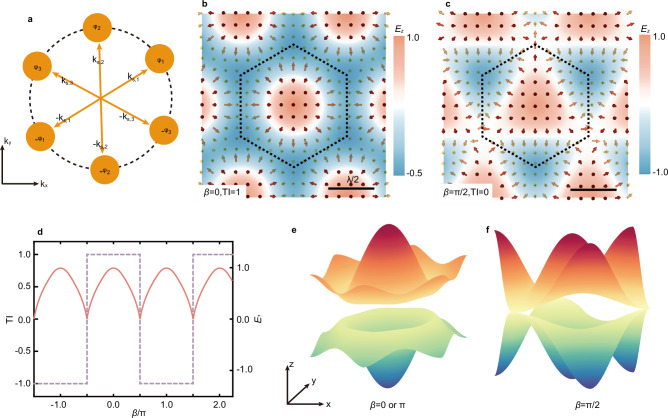 Figure 1
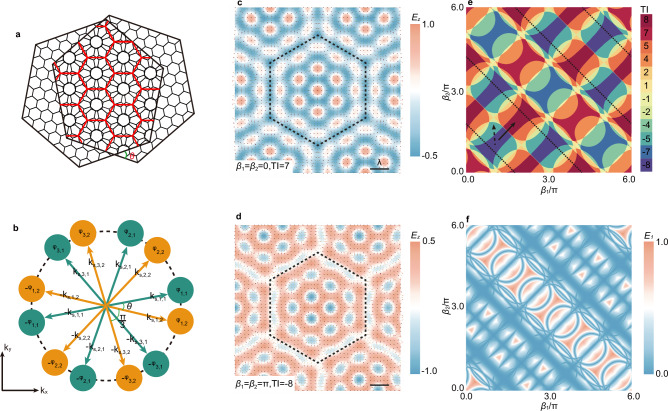 Figure 2
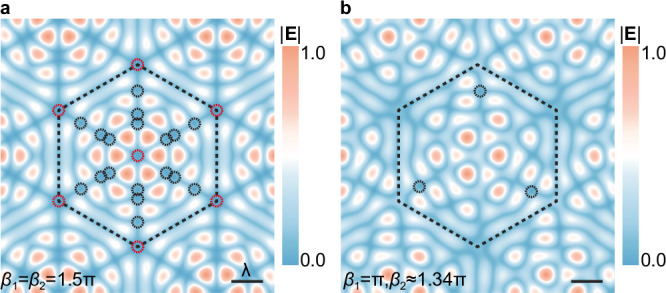 Figure 3
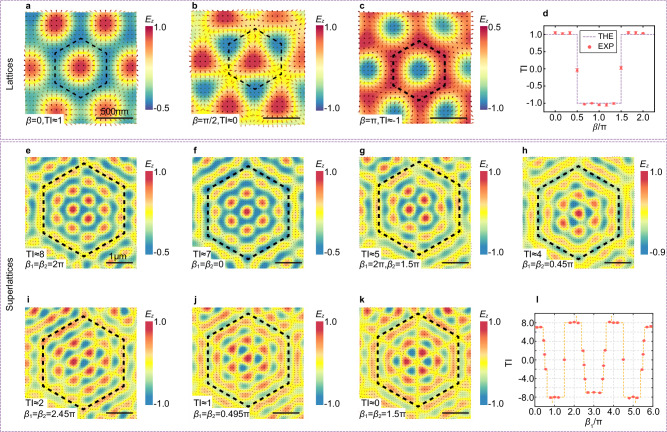 Figure 4
Peer Reviews
No public reviews on file for this paper yet. If you reviewed it on a platform where reviews are public (OpenReview, ICLR, NeurIPS, ICML), you can paste yours below so the community can read it here.
Videos
No videos yet. Explain this paper in a talk, walkthrough, or lecture? Add one.
Taxonomy
TopicsTopological Materials and Phenomena · Metamaterials and Metasurfaces Applications · Quantum Mechanics and Non-Hermitian Physics