Quantitative Kernel estimation from traffic signs using slanted edge spatial frequency response as a sharpness metric
Amit Pandey, Mohd. Zubair Akhtar, Nandana Kappuva Veettil, Bernhard Wunderle, Gordon Elger

TL;DR
This paper introduces a method to estimate blurring in automotive cameras using traffic sign images and spatial frequency response, aiming to monitor camera sharpness over time.
Contribution
A novel PCA-based kernel estimation method using synthetic and real data for automotive camera sharpness monitoring.
Findings
The proposed method achieves SSIM values between 0.808 and 0.945 for estimated and true blurred regions.
Validation on real-life camera images showed SSIM > 0.82, indicating promising accuracy for in-field monitoring.
Abstract
Sharpness is a critical optical property of automotive cameras, measured by the spatial frequency response (SFR) within the end-of-line (EOL) test after manufacturing. This work presents a method to estimate the blurring kernel of an automotive camera, which could be the first step toward state monitoring of automotive cameras. To achieve this, Principal Component Analysis (PCA) was performed, using synthetic kernels generated by Zemax. The PCA model was built with approximately 1300 base kernels representing spatially variant point spread functions (PSFs). This model generates kernel samples during the estimation process. Synthetic images were created by convolving the synthetic kernels with reference traffic sign images and compared with real-life data captured by an automotive camera. These synthetic data were utilized for algorithm development, and later on, validation was performed…
Genes, proteins, chemicals, diseases, species, mutations and cell lines named across the full text — each resolved to its canonical identifier and authoritative record.
Click any figure to enlarge with its caption.
 Figure 10
 Figure 1
 Figure 2
 Figure 3
 Figure 4
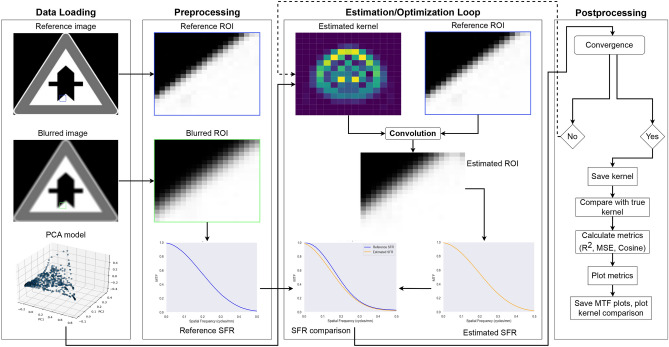 Figure 5
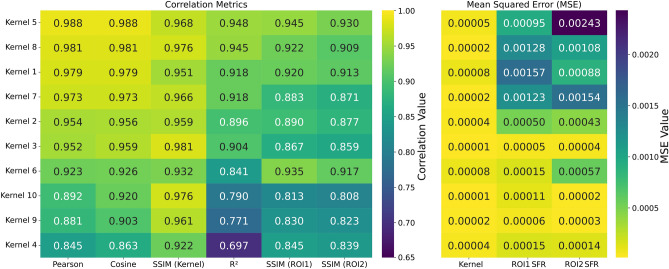 Figure 6
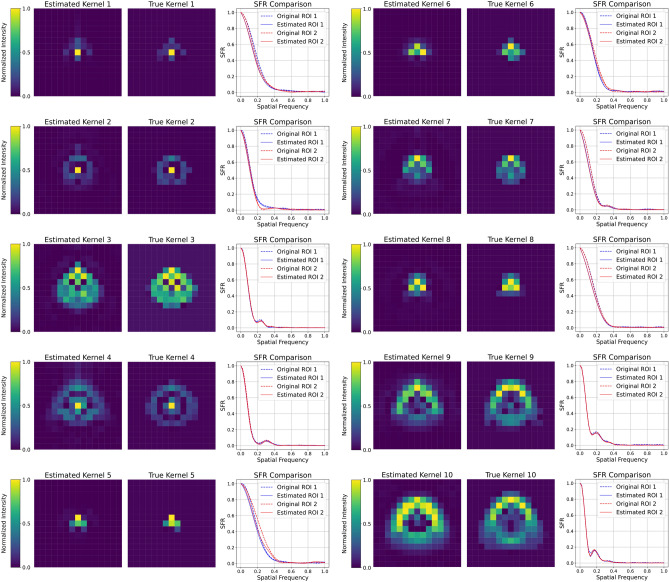 Figure 7
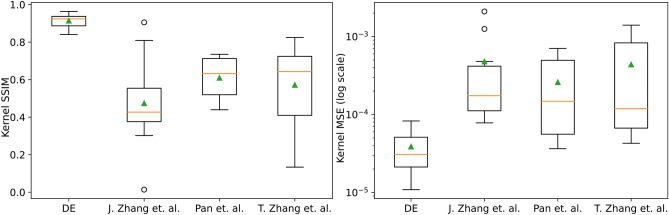 Figure 8
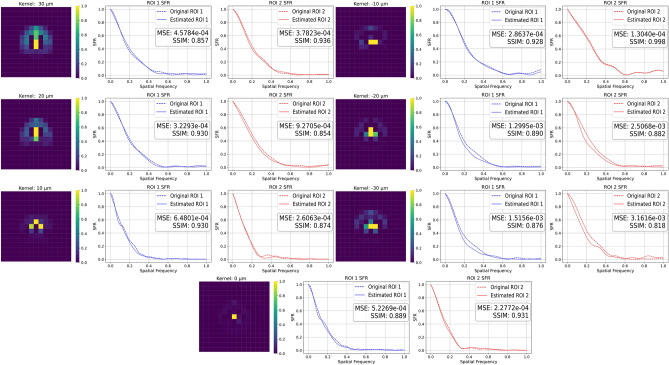 Figure 9
Peer Reviews
No public reviews on file for this paper yet. If you reviewed it on a platform where reviews are public (OpenReview, ICLR, NeurIPS, ICML), you can paste yours below so the community can read it here.
Videos
No videos yet. Explain this paper in a talk, walkthrough, or lecture? Add one.
Taxonomy
TopicsImage and Video Quality Assessment · Advanced Image Processing Techniques · Image Processing Techniques and Applications