Postpartum Psychosis: could genetic vulnerability to insomnia or short sleep duration be protective?
Chiara Petrosellini, Sofia H. Eriksson, Nicholas Meyer, Olivia Protti, Nicholas Bass, Karoline Kuchenbaecker, Dimitrios Siassakos, Andrew McQuillin

TL;DR
This study explores how genetic factors related to sleep patterns might protect against postpartum psychosis in women with bipolar disorder.
Contribution
The study identifies that genetic vulnerability to insomnia or short sleep may be protective against postpartum psychosis.
Findings
Higher polygenic risk scores for insomnia and short sleep were associated with reduced risk of postpartum psychosis.
Individuals with lower insomnia and short sleep PRS had approximately double the risk of developing postpartum psychosis.
Integrating polygenic risk scores with bipolar subtype improved prediction accuracy for postpartum psychosis.
Abstract
Postpartum Psychosis (PP) is a severe and understudied perinatal mental illness which disproportionately affects women with bipolar disorder (BD). A relationship between sleep disturbance and PP is often assumed, but is poorly understood. From a cohort of 2099 individuals with BD, 343 parous women were identified and screened for perinatal psychiatric complications. We compared 117 women who developed PP with 226 who did not. Polygenic Risk Scores (PRS) for BD, schizophrenia, insomnia, short sleep, long sleep, sleep efficiency and sleep duration were computed using PRS-CS. Logistic regression was used to model the effect of each PRS on PP. Higher PRS for insomnia and short sleep were associated with reduced risk of PP. Individuals in the lowest decile for insomnia PRS (RR 1.96, 95% CI 1.25-3.07, p = 3.50 × 10⁻³) and short sleep PRS (RR 2.23, 95% CI 1.40-3.54, p = 7.94 × 10⁻⁴) had…
Genes, proteins, chemicals, diseases, species, mutations and cell lines named across the full text — each resolved to its canonical identifier and authoritative record.
Click any figure to enlarge with its caption.
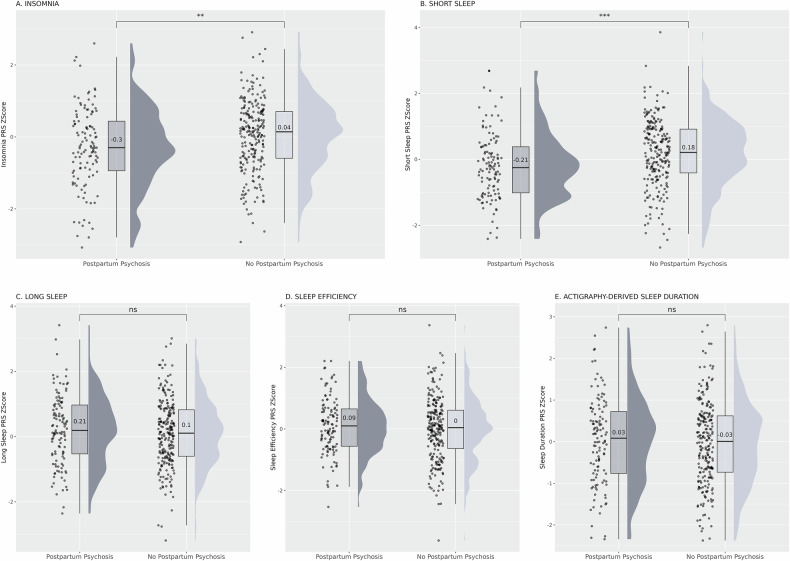 Figure 1
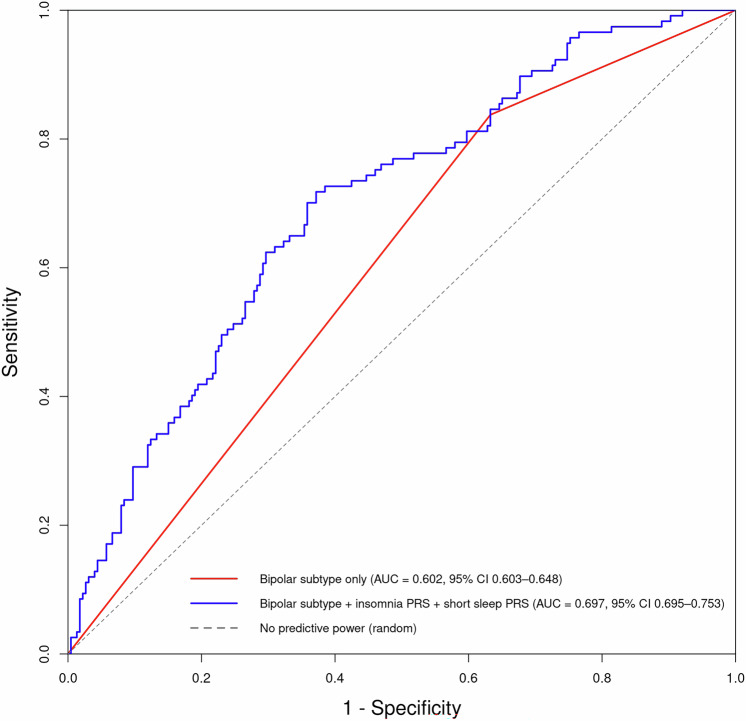 Figure 2
Peer Reviews
No public reviews on file for this paper yet. If you reviewed it on a platform where reviews are public (OpenReview, ICLR, NeurIPS, ICML), you can paste yours below so the community can read it here.
Videos
No videos yet. Explain this paper in a talk, walkthrough, or lecture? Add one.
Taxonomy
TopicsSleep and related disorders · Maternal Mental Health During Pregnancy and Postpartum · Genetic Associations and Epidemiology