A Causal and interpretable machine learning framework for postcranioplasty risk prediction and surgical decision support
Wenbo Li, Bao Wang, Tianzun Li, Yiwen Ma, Haoyong Jin, Jiangli Zhao, Zhiwei Xue, Nan Su, Yanya He, Jiaqi Shi, Xuchen Liu, Xiaoyang Liu, Tianzi Wang, Jiwei Wang, Chao Li, Can Yan, Yang Ma, Qichao Qi, Xinyu Wang, Weiguo Li, Bin Huang, Donghai Wang, Xuelian Wang, Yan Qu, Xingang Li

TL;DR
This study creates a machine learning tool to predict and reduce post-surgery risks in cranioplasty patients.
Contribution
A novel causal and interpretable machine learning framework for surgical decision support and risk prediction in cranioplasty.
Findings
Random forest model achieved high performance (AUROC = 0.949) in predicting postoperative complications.
Subcutaneous negative-pressure drainage and titanium mesh were found to reduce complication risks (ATE = -0.241 and -0.191).
The model was validated across spatial and temporal external cohorts with consistent performance.
Abstract
Cranioplasty is associated with a substantial burden of postoperative complications. In this multicenter study, we developed a machine learning–based clinical decision-support tool to predict the risk of postoperative complications following cranioplasty. A set of nine features was selected for model development. Among the 15 algorithms evaluated, the random forest model demonstrated the best overall performance and was validated on data from both spatial and temporal external cohorts (AUROC = 0.949, internal cross-validation; 0.930, geographical validation; and 0.932, temporal validation). Subgroup analyses by age and sex demonstrated consistently high discriminative performance (lowest AUROC = 0.927) and good calibration (O/E ratio = 1.16, 95% CI: 0.97–1.40). Analysis of causal effects of modifiable intraoperative variables on postoperative complications, with diverse counterfactual…
Genes, proteins, chemicals, diseases, species, mutations and cell lines named across the full text — each resolved to its canonical identifier and authoritative record.
Click any figure to enlarge with its caption.
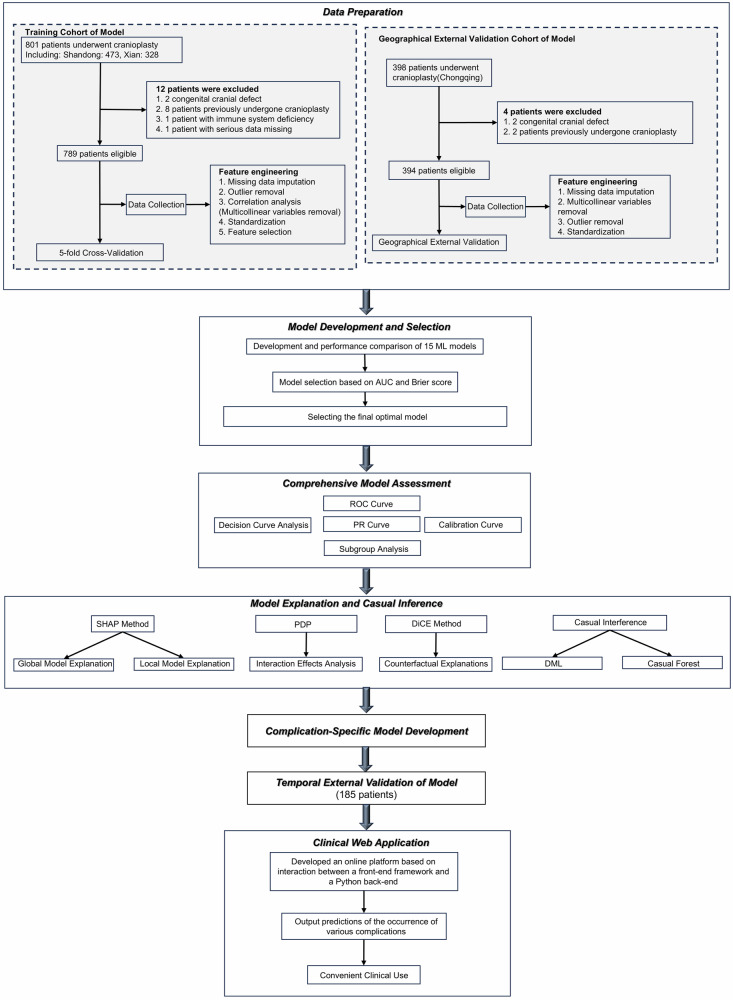 Figure 1
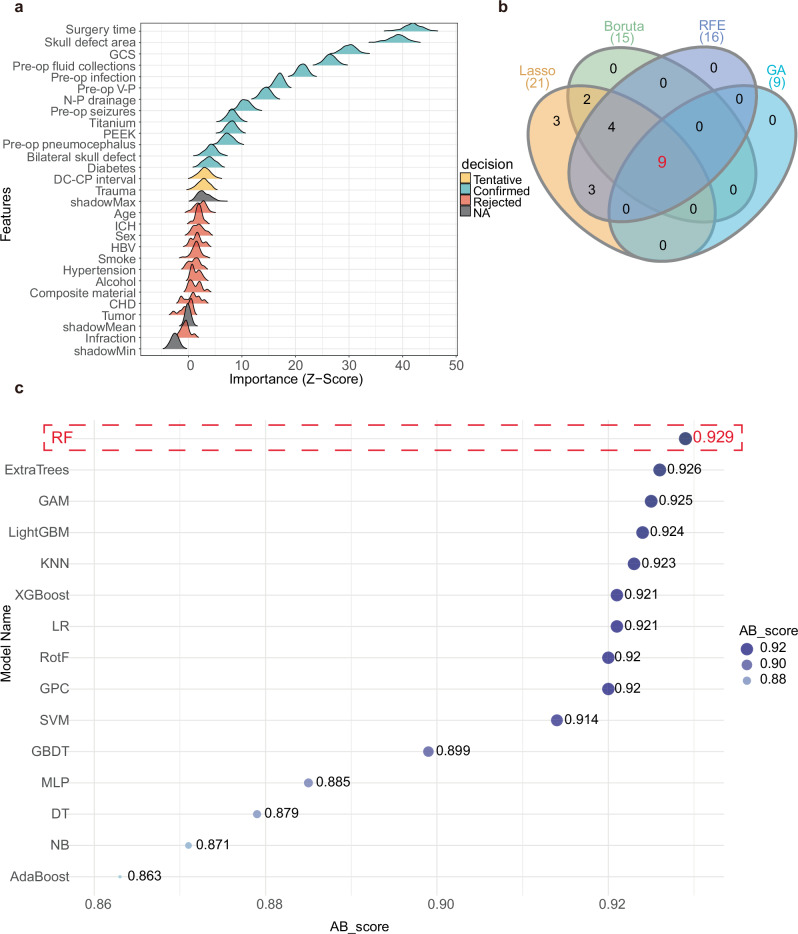 Figure 2
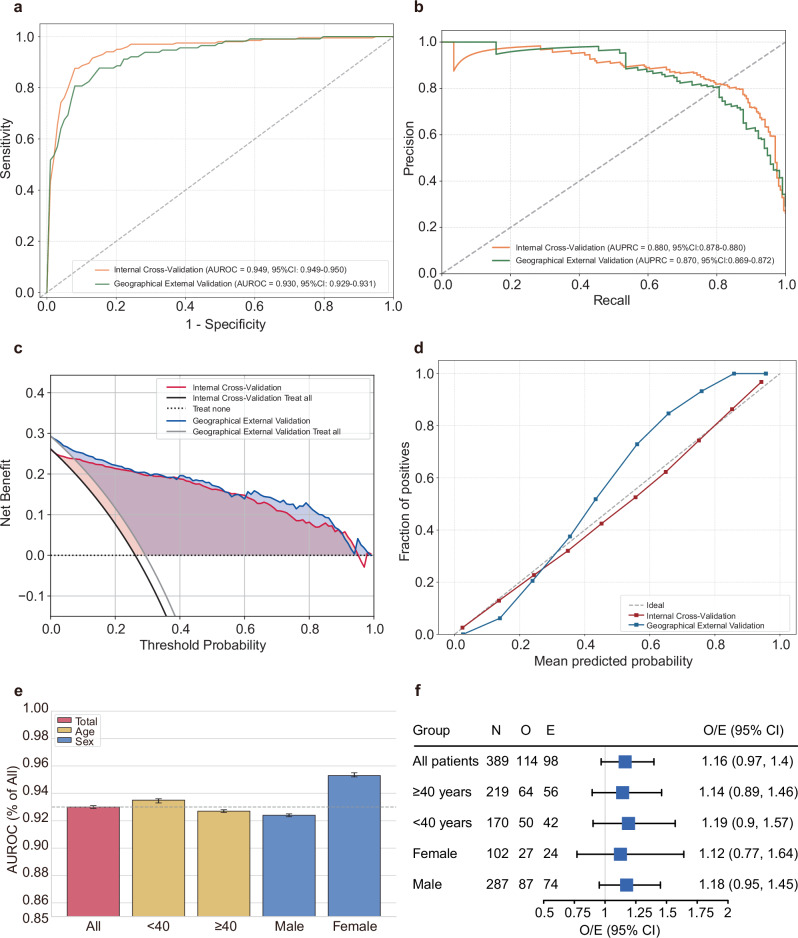 Figure 3
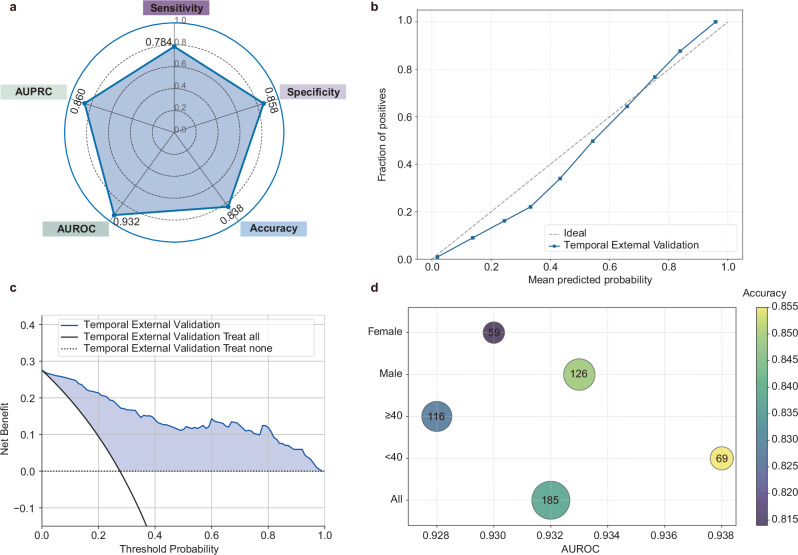 Figure 4
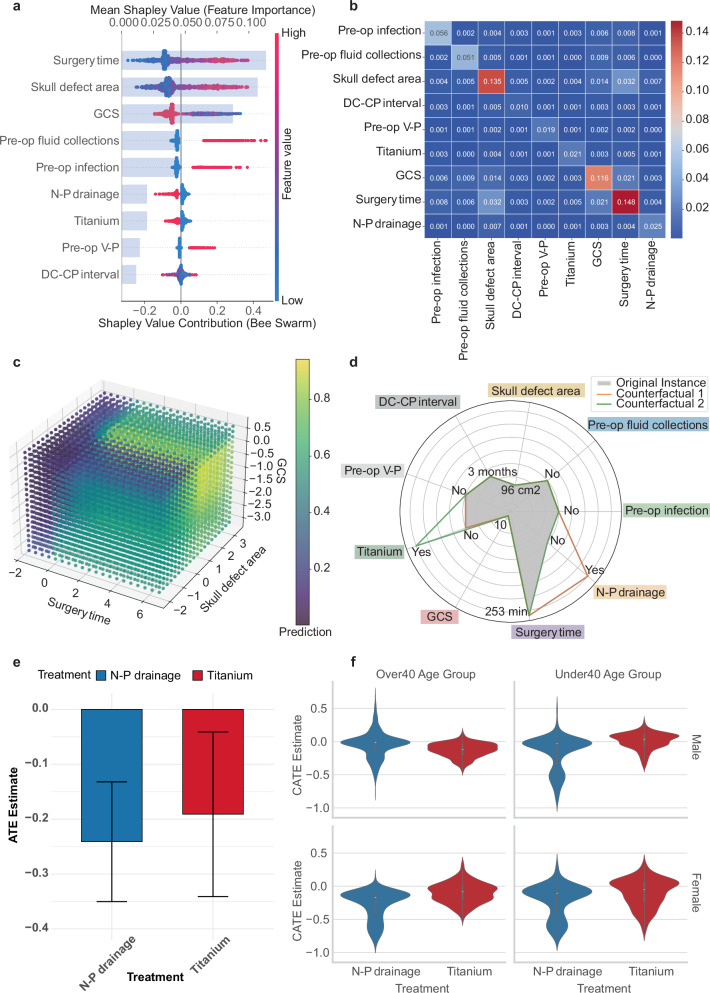 Figure 5
Peer Reviews
No public reviews on file for this paper yet. If you reviewed it on a platform where reviews are public (OpenReview, ICLR, NeurIPS, ICML), you can paste yours below so the community can read it here.
Videos
No videos yet. Explain this paper in a talk, walkthrough, or lecture? Add one.
Taxonomy
TopicsTraumatic Brain Injury and Neurovascular Disturbances · Trauma, Hemostasis, Coagulopathy, Resuscitation · Artificial Intelligence in Healthcare and Education