Profiles of parent–teacher discrepancy on autistic children’s adaptive functioning
Rachel Lees Thorne, Nicky Wright, Andres De Los Reyes, Isabel M Smith, Anat Zaidman-Zait, Lonnie Zwaigenbaum, Tracy Vaillancourt, Peter Szatmari, Teresa A Bennett, Eric Duku, Annie E Richard, Connor Kerns, Rachael Bedford

TL;DR
The study finds that autistic children's adaptive functioning is rated differently by parents and teachers, which can help clinicians better understand and support these children.
Contribution
The study introduces a novel method to classify autistic children based on parent-teacher discrepancies in adaptive functioning ratings.
Findings
Four distinct profiles of parent-teacher discrepancies in adaptive functioning were identified.
Children in the 'higher adaptive functioning-teacher higher' profile had fewer executive function challenges and higher IQ.
Discrepancies in ratings are linked to differences in IQ, autistic traits, and executive functioning.
Abstract
Clinical guidelines recommend collecting reports from multiple informants when identifying and diagnosing challenges in children. The current study examined parent–teacher discrepancies in rating of autistic children’s adaptive functioning and how these related to children’s executive functions. Participants (n = 194) were a subsample of autistic children (mean age = 9.2 years; 86% male) from the Pathways in ASD cohort. We used latent profile analysis to characterise profiles based on both parent and teacher reports of adaptive functioning levels. We tested links between these profiles and indices of children’s executive function and other clinical correlates. Four profiles were characterised: a lower adaptive functioning-parent higher profile, in which parents reported relatively higher scores than teachers (n = 45), an intermediate adaptive functioning profile (n = 70) and a higher…
Genes, proteins, chemicals, diseases, species, mutations and cell lines named across the full text — each resolved to its canonical identifier and authoritative record.
Click any figure to enlarge with its caption.
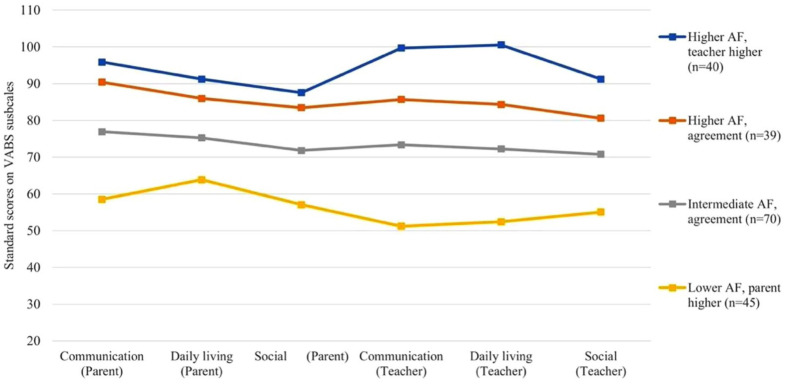 Figure 1
 Figure 2
 Figure 3
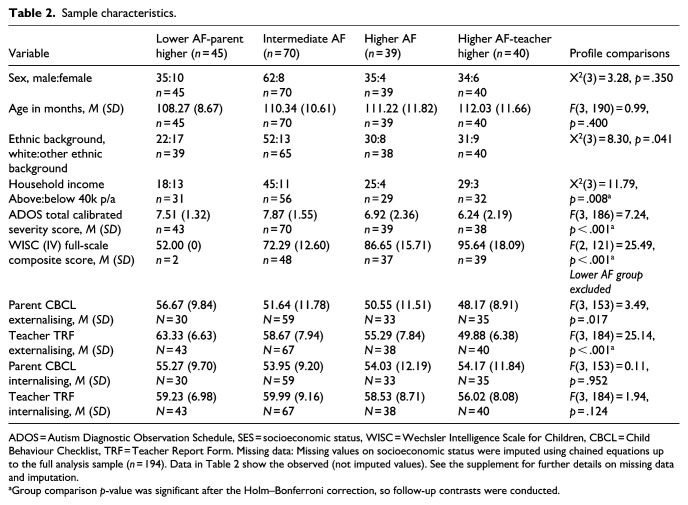 Figure 4
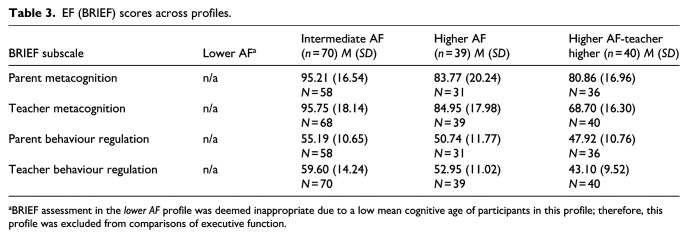 Figure 5
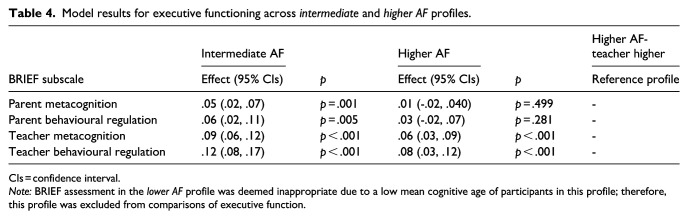 Figure 6
Peer Reviews
No public reviews on file for this paper yet. If you reviewed it on a platform where reviews are public (OpenReview, ICLR, NeurIPS, ICML), you can paste yours below so the community can read it here.
Videos
No videos yet. Explain this paper in a talk, walkthrough, or lecture? Add one.
Taxonomy
TopicsAutism Spectrum Disorder Research · Family and Disability Support Research · Child and Adolescent Psychosocial and Emotional Development