Scoping review: Facilitators, barriers, and cultural adaptations in the caregiver skills training program for children with developmental concerns
Cecilia Montiel-Nava, Maria C Montenegro, Ana C Ramirez, Victoria Villarreal, Lucia Murillo Chacko, Pamela Dixon, Sarah Dababnah

TL;DR
The Caregiver Skills Training program helps families of children with developmental concerns by teaching caregivers practical skills, adapting to local cultures, and using non-specialists to deliver training.
Contribution
This scoping review identifies cultural adaptations, facilitators, and barriers to implementing Caregiver Skills Training in diverse global settings.
Findings
Cultural adaptations included language translation, simplified materials, and visual aids to improve accessibility.
Non-specialist facilitators and community partnerships helped increase program feasibility and reach.
Barriers such as stigma, logistical challenges, and lack of resources highlight the need for tailored support systems.
Abstract
Autism interventions are predominantly developed in high-income countries, limiting access for families in low- and middle-income countries due to systemic, cultural, and logistical barriers. The Caregiver Skills Training program aims to address this disparity by equipping caregivers with practical skills. This scoping review examines the cultural adaptations, facilitators, and barriers to the implementation of Caregiver Skills Training, focusing on its accessibility, feasibility, and acceptability. A comprehensive search of ERIC, PsycINFO, PubMed, and Web of Science identified eligible studies that reported cultural or linguistic adaptations of Caregiver Skills Training. Forward searches and manual reference checks supplemented the review. Data were extracted using the Cultural Adaptation Checklist framework and analyzed for patterns in adaptation, training, barriers, and facilitators.…
Genes, proteins, chemicals, diseases, species, mutations and cell lines named across the full text — each resolved to its canonical identifier and authoritative record.
Click any figure to enlarge with its caption.
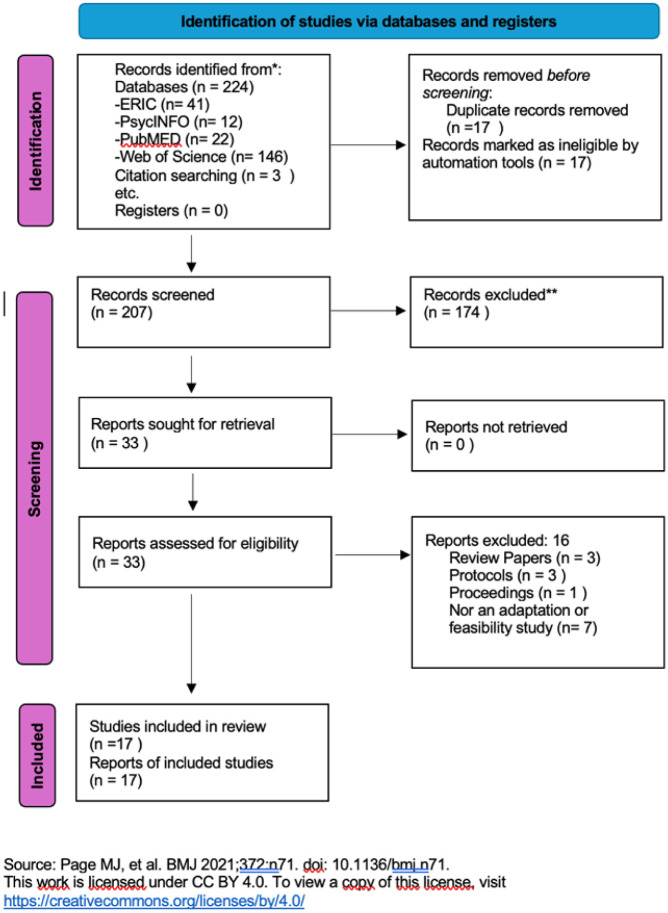 Figure 1
 Figure 2
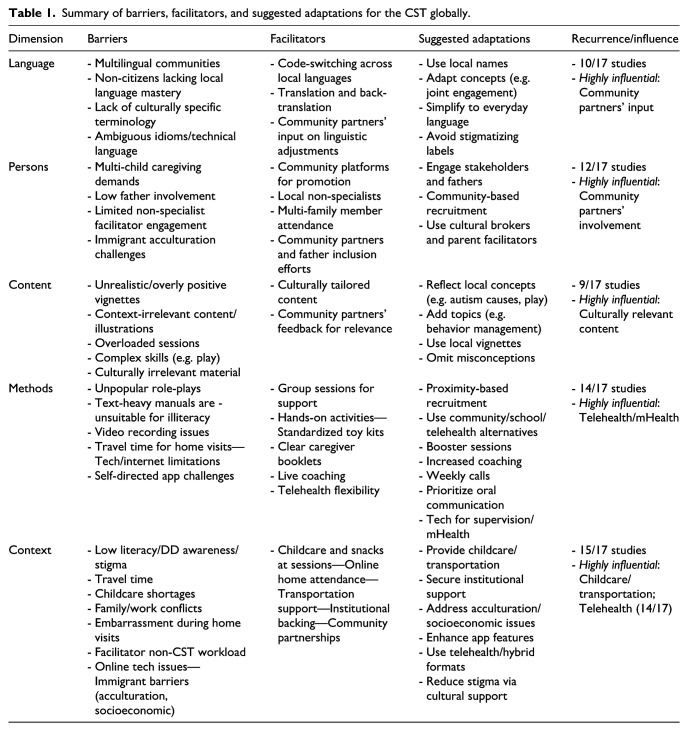 Figure 3
Peer Reviews
No public reviews on file for this paper yet. If you reviewed it on a platform where reviews are public (OpenReview, ICLR, NeurIPS, ICML), you can paste yours below so the community can read it here.
Videos
No videos yet. Explain this paper in a talk, walkthrough, or lecture? Add one.
Taxonomy
TopicsFamily and Disability Support Research · Autism Spectrum Disorder Research · Assistive Technology in Communication and Mobility