A bacterial defense system targeting modified cytosine of phage genomic DNA
Rui Liu, Dongmei Tang, Mingze Niu, Shikun Lei, Zhiyong Zong, Qiang Chen, Yamei Yu

TL;DR
Scientists discovered a bacterial defense system that targets modified cytosine in phage DNA, which could be useful for studying epigenetics and disease.
Contribution
The study identifies and characterizes a new single-component bacterial defense system called CMoRE that specifically targets modified cytosine in phage DNA.
Findings
CMoRE is a type IV modification-dependent restriction endonuclease that degrades DNA containing 5hmC or 5ghmC modifications.
The crystal structure of CMoRE reveals a unique GIY-YIG nuclease domain and a modification-sensing domain.
CMoRE has potential applications in detecting 5hmC modifications in mammalian genomics and disease diagnostics.
Abstract
The evolutionary arms race between bacteria and phages drives the development of bacterial antiviral defense systems and phage counter-defense strategies. Restriction–modification (RM) systems protect bacteria by methylating ‘self’ DNA and cleaving unmodified phage DNA. Phages like T-even coliphages evade RM systems by substituting cytosine with 5-hydroxymethyl cytosine (5hmC) or 5-glucosylated hmC (5ghmC). Here, we characterize a single-component antiviral defense system featuring a GIY-YIG endonuclease domain. Biochemical and structural analyses demonstrate that this defense system is a type IV modification-dependent restriction endonuclease that specifically degrades 5hmC- or 5ghmC-modified DNA, and we accordingly name it CMoRE (Cytosine Modification Restriction Endonuclease). The crystal structures reveal an N-terminal GIY-YIG nuclease domain and a C-terminal modification-sensing…
Genes, proteins, chemicals, diseases, species, mutations and cell lines named across the full text — each resolved to its canonical identifier and authoritative record.
Click any figure to enlarge with its caption.
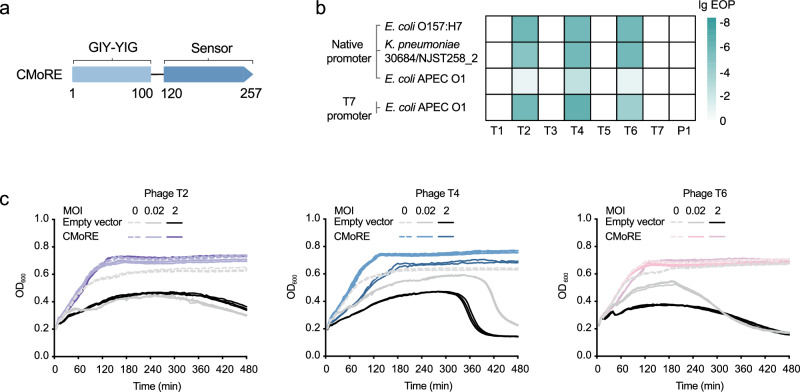 Figure 1
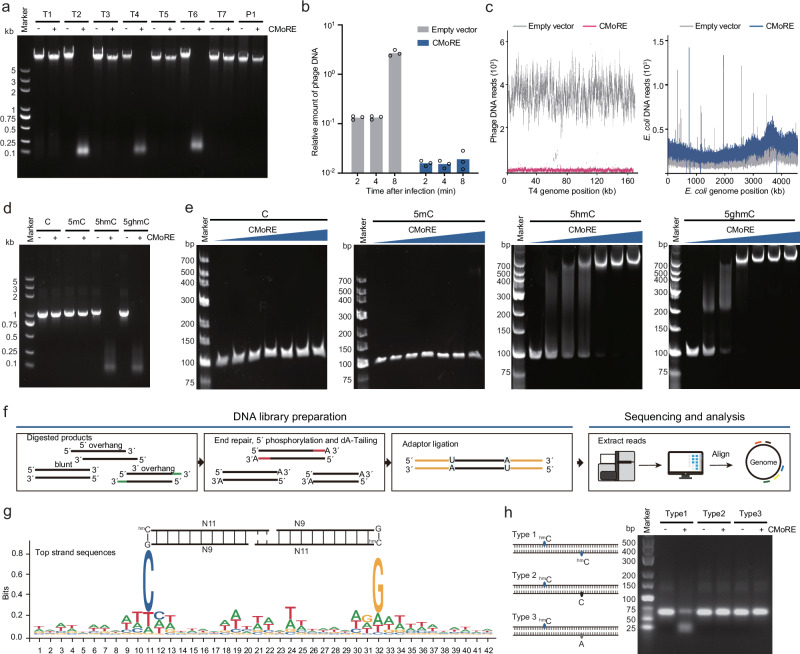 Figure 2
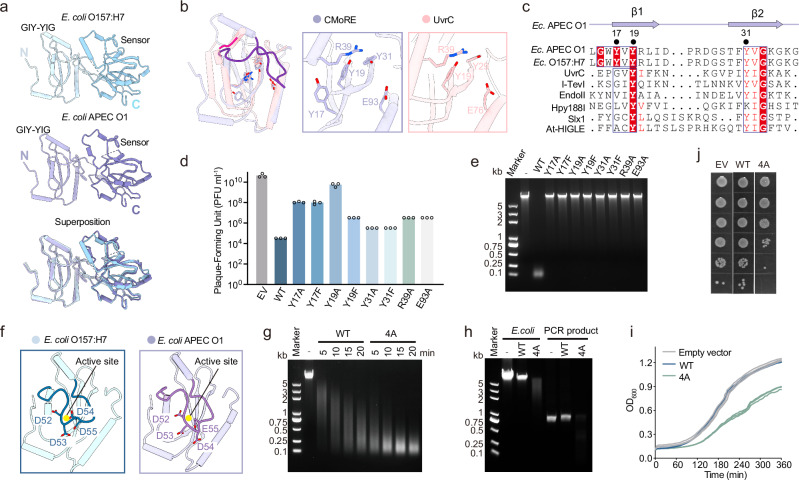 Figure 3
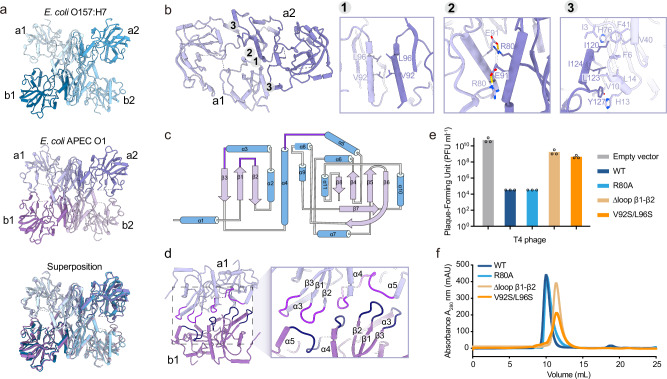 Figure 4
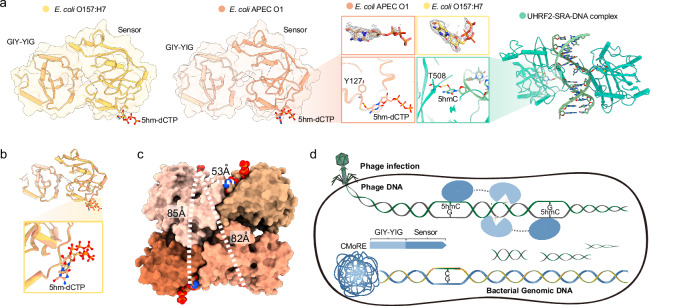 Figure 5
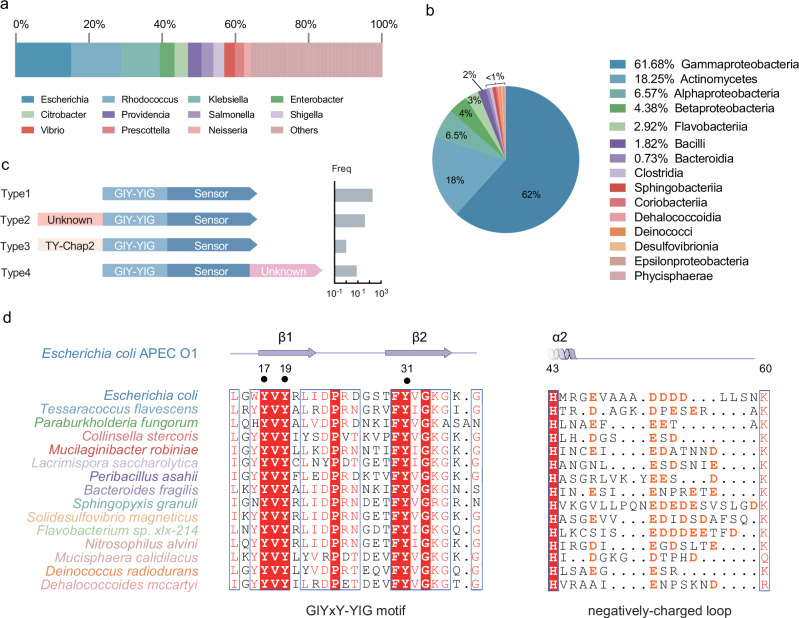 Figure 6
Peer Reviews
No public reviews on file for this paper yet. If you reviewed it on a platform where reviews are public (OpenReview, ICLR, NeurIPS, ICML), you can paste yours below so the community can read it here.
Videos
No videos yet. Explain this paper in a talk, walkthrough, or lecture? Add one.
Taxonomy
TopicsBacteriophages and microbial interactions · interferon and immune responses · RNA and protein synthesis mechanisms