Bridging Neural Topology and Affective Computing: Graph Attention for EEG Emotion Recognition
Wenyang Yang, Jingrui Yuan, Bingnan Duan, Steven Kwok Keung Chow

TL;DR
This paper reviews how graph attention networks improve emotion recognition from EEG data by modeling brain connectivity patterns.
Contribution
The paper introduces a standardized framework to improve reproducibility in graph-based EEG emotion recognition models.
Findings
Graph attention mechanisms preserve brain topology while emphasizing emotion-relevant regions.
Standardized preprocessing and validation protocols enhance model performance and reproducibility.
Future research should focus on model efficiency and multimodal integration for better generalization.
Abstract
Electroencephalography (EEG) offers high temporal resolution and strong physiological validity for emotion recognition. However, complex spatial organization and inter-subject variability present major modeling challenges. Graph-based spatial attention mechanisms have emerged as a key solution, preserving brain topological priors while adaptively emphasizing emotion-relevant regions and connections. This review summarizes advances in graph convolutional networks (GCN) and graph attention networks (GAT), covering representative studies under both subject-dependent and subject-independent settings. In architectural innovations, this paper critically evaluates the implicit impact of experimental factors, including preprocessing pipelines and validation protocols, on performance, and proposes a standardized framework to enhance reproducibility. Existing research demonstrates progressive…
Genes, proteins, chemicals, diseases, species, mutations and cell lines named across the full text — each resolved to its canonical identifier and authoritative record.
Click any figure to enlarge with its caption.
 Figure 1
 Figure 2
 Figure 3
 Figure 4
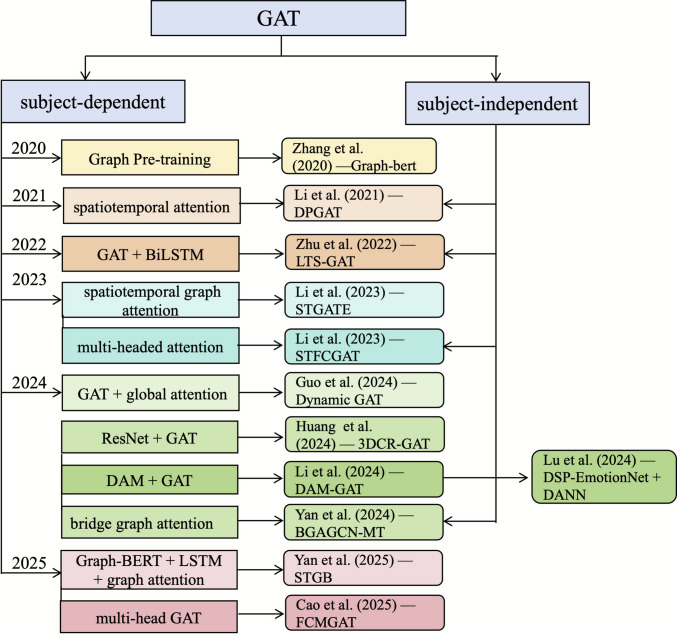 Figure 5
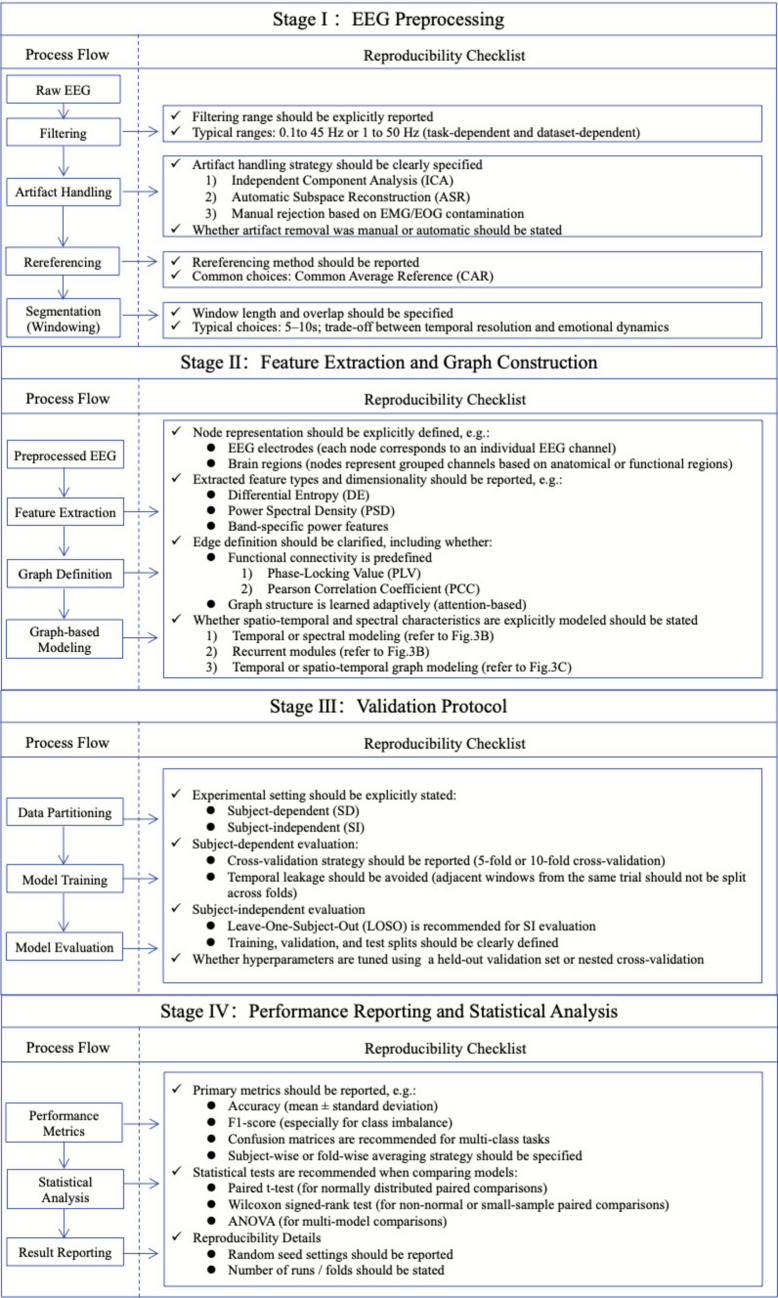 Figure 6
Peer Reviews
No public reviews on file for this paper yet. If you reviewed it on a platform where reviews are public (OpenReview, ICLR, NeurIPS, ICML), you can paste yours below so the community can read it here.
Videos
No videos yet. Explain this paper in a talk, walkthrough, or lecture? Add one.
Taxonomy
TopicsEmotion and Mood Recognition · EEG and Brain-Computer Interfaces · Functional Brain Connectivity Studies