First report of ‘Candidatus Anaplasma camelii’ and high molecular prevalence of Anaplasma marginale in dromedary camels (Camelus dromedarius) from Somalia
Aamir M. Osman, Abdalla M. Ibrahim, Ahmed A. Hassan-Kadle, Marcos R. André, Flávia C. M. Collere, Anna C. B. Mongruel, Daniel Lee, Caroline Tostes Secato, Thállitha S. W. J. Vieira, Rosangela Z. Machado, Rafael F. C. Vieira

TL;DR
This study reports the first detection of 'Candidatus Anaplasma camelii' and high prevalence of Anaplasma marginale in dromedary camels in Somalia, using molecular and serological methods.
Contribution
The first report of 'Candidatus Anaplasma camelii' and high molecular prevalence of A. marginale in Somali dromedaries, revealing new insights into anaplasmosis in the region.
Findings
Molecular prevalence of Anaplasma marginale was 75.5% in dromedaries from Somalia.
'Candidatus Anaplasma camelii' was detected for the first time in Somali dromedaries.
A significant association was found between A. marginale infection and tick infestation.
Abstract
Anaplasmosis, a zoonotic disease caused by Anaplasma species, threatens Somalia’s dromedary population, crucial to the nation’s economy and society. This study examines its occurrence in dromedaries from two Somali bioclimatic regions using molecular and serological methods. A total of 155 blood and serum samples from dromedaries in Benadir and Lower Shabelle were analyzed. Serum samples underwent rMSP5-based ELISA for anti-Anaplasma marginale IgG antibodies. DNA was extracted from dromedary blood samples followed by molecular screening included nested PCR for the 16S rRNA gene of Anaplasma spp. and qPCR for the msp1β gene of A. marginale. Positive samples underwent further PCR and sequencing targeting five additional genes for definitive species confirmation and phylogenetic analysis. Of 155 dromedaries tested, 30 (19.4%) were seropositive for Anaplasma marginale by iELISA, and 117…
Genes, proteins, chemicals, diseases, species, mutations and cell lines named across the full text — each resolved to its canonical identifier and authoritative record.
Click any figure to enlarge with its caption.
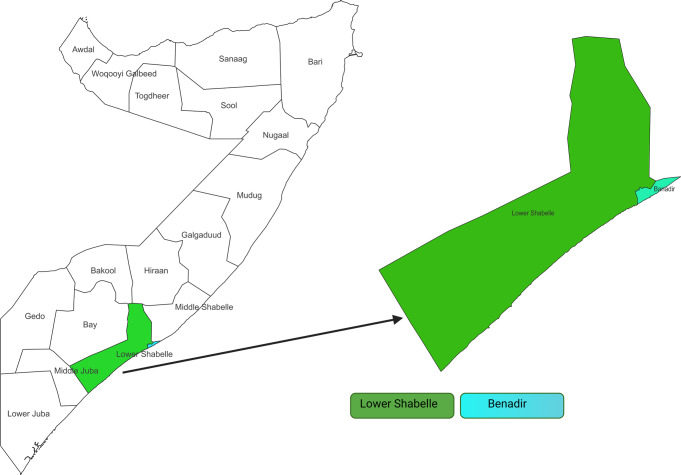 Figure 1
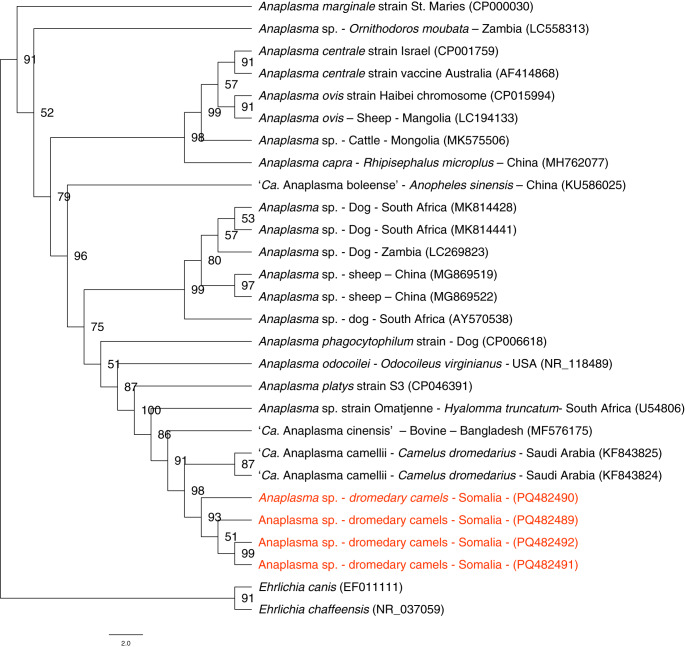 Figure 2
Peer Reviews
No public reviews on file for this paper yet. If you reviewed it on a platform where reviews are public (OpenReview, ICLR, NeurIPS, ICML), you can paste yours below so the community can read it here.
Videos
No videos yet. Explain this paper in a talk, walkthrough, or lecture? Add one.
Taxonomy
TopicsVector-borne infectious diseases · Bartonella species infections research · Toxoplasma gondii Research Studies