Diagnostic Performance of a Novel AI–Guided Coronary Computed Tomography Algorithm for Predicting Myocardial Ischemia (AI-QCTISCHEMIA) Across Sex and Age Subgroups
Putri Annisa Kamila, Tara Hojjati, Nick S. Nurmohamed, Ibrahim Danad, Yipu Ding, Ruurt A. Jukema, Pieter G. Raijmakers, Roel S. Driessen, Michiel J. Bom, Pepijn van Diemen, Gianluca Pontone, Daniele Andreini, Hyuk-Jae Chang, Richard J. Katz, Andrew D. Choi, Paul Knaapen

TL;DR
A new AI algorithm for coronary CT scans accurately detects heart blood flow issues in both men and women, and across different ages, outperforming traditional tests.
Contribution
The study introduces and validates a novel AI algorithm for noninvasive detection of myocardial ischemia with consistent performance across sex and age subgroups.
Findings
AI-QCTISCHEMIA outperformed SPECT in diagnosing ischemia for both men and women.
The algorithm showed comparable performance to PET scans in both age groups.
Diagnostic accuracy was consistently high across all subgroups, with AUCs above 0.85.
Abstract
AI-QCTISCHEMIA is a novel artificial intelligence algorithm that predicts myocardial ischemia using quantitative features from coronary computed tomography angiography, providing a noninvasive alternative to functional imaging. However, its diagnostic performance across key demographic subgroups, particularly by sex and age, remains underexplored. We aimed to evaluate the diagnostic performance of AI-QCTISCHEMIA for predicting myocardial ischemia across these subgroups. This post-hoc analysis included symptomatic patients with suspected coronary artery disease from the CREDENCE (Computed Tomographic Evaluation of Atherosclerotic Determinants of Myocardial Ischemia) (n = 305; 868 vessels) and PACIFIC-1 (Comparison of Coronary Computed Tomography Angiography, Single Photon Emission Computed Tomography [SPECT], Positron Emission Tomography [PET], and Hybrid Imaging for Diagnosis of…
Genes, proteins, chemicals, diseases, species, mutations and cell lines named across the full text — each resolved to its canonical identifier and authoritative record.
Click any figure to enlarge with its caption.
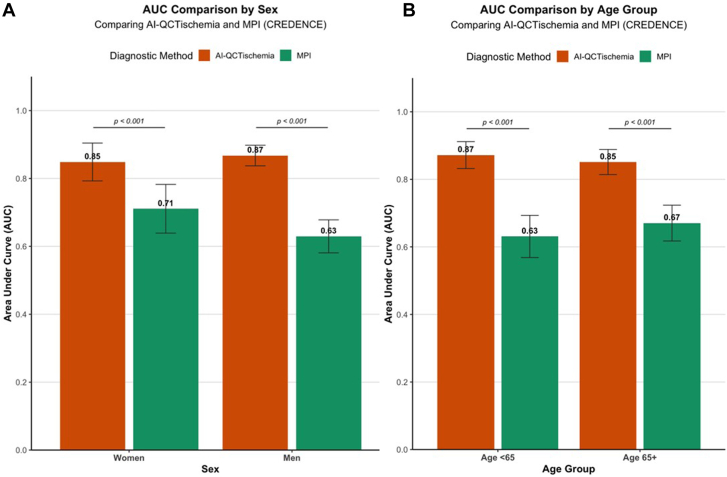 Figure 1
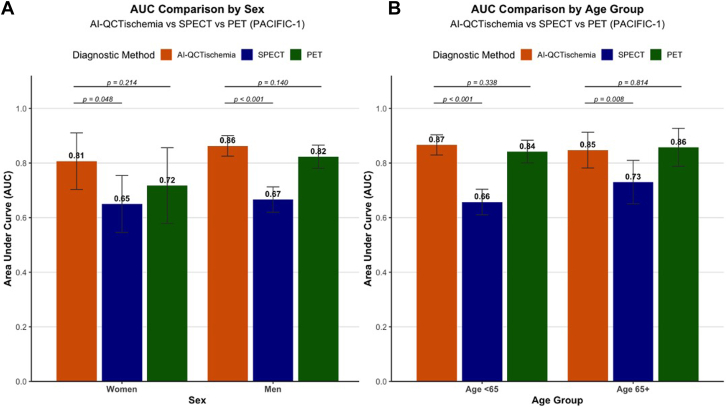 Figure 2
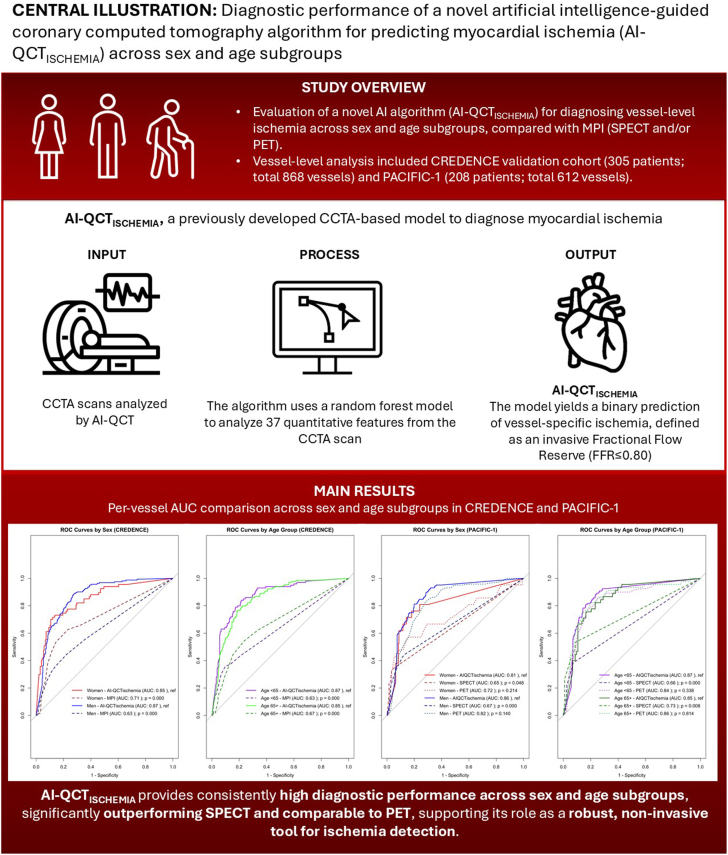 Figure 3
Peer Reviews
No public reviews on file for this paper yet. If you reviewed it on a platform where reviews are public (OpenReview, ICLR, NeurIPS, ICML), you can paste yours below so the community can read it here.
Videos
No videos yet. Explain this paper in a talk, walkthrough, or lecture? Add one.
Taxonomy
TopicsCardiac Imaging and Diagnostics · Artificial Intelligence in Healthcare and Education · Biomarkers in Disease Mechanisms