Right-Sided Extravalvular Damage: An Overlooked Driver of Risk Model Failure in Low-Flow, Low-Gradient Aortic Stenosis
Yash Prakash, Akarsh Sharma, Lakshay Chopra, Mihir Prakash, Eileen Galvani, Oludamilola Akinmolayemi, Carlo Mannina, Ranbir Singh, Jonathan L. Halperin, Samin K. Sharma, Annapoorna S. Kini, Deepak L. Bhatt, Stamatios Lerakis

TL;DR
This study shows that right-sided heart damage improves risk prediction for aortic stenosis patients undergoing TAVR, especially in moderate-risk groups.
Contribution
Identifies right-sided extravalvular damage as a novel factor improving mortality prediction in low-flow aortic stenosis patients.
Findings
Right-sided extravalvular damage is independently linked to higher 1-year mortality after TAVR.
Adding these markers improved model fit and discrimination, particularly in moderate-risk patients.
The STS-PROM score overestimates mortality, but this can be corrected with right-sided damage markers.
Abstract
The Society of Thoracic Surgeons Predicted Risk of Mortality (STS-PROM) score is guideline-endorsed for estimating procedural risk in aortic stenosis (AS) but tends to overestimate long-term mortality after transcatheter aortic valve replacement (TAVR). This study aimed to evaluate whether markers of right-sided extravalvular damage improve STS-PROM’s performance in predicting 1-year mortality post-TAVR for patients with low-flow, low-gradient AS. Four hundred ten patients with valve area ≤1.0 cm2, stroke volume index ≤35 mL/m2, and mean gradient <40 mm Hg who underwent TAVR were retrospectively stratified into low (<4%), moderate (4%-8%), and high (>8%) STS-PROM risk groups. Performance of an enhanced logistic regression model incorporating both STS-PROM and right-sided extravalvular damage (defined as moderate+ pulmonary hypertension, moderate+ tricuspid regurgitation, or right…
Genes, proteins, chemicals, diseases, species, mutations and cell lines named across the full text — each resolved to its canonical identifier and authoritative record.
Click any figure to enlarge with its caption.
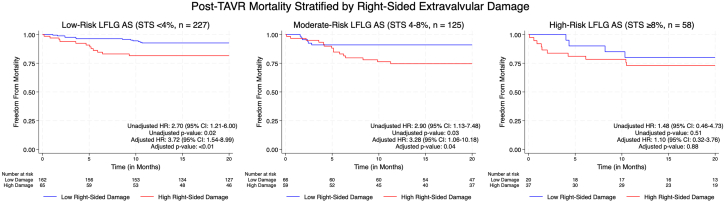 Figure 1
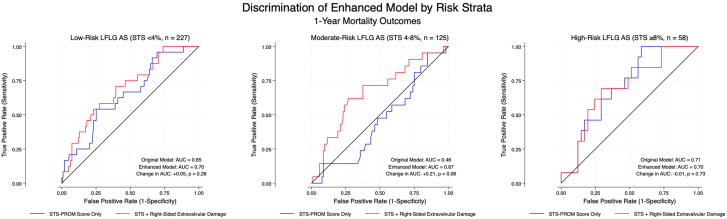 Figure 2
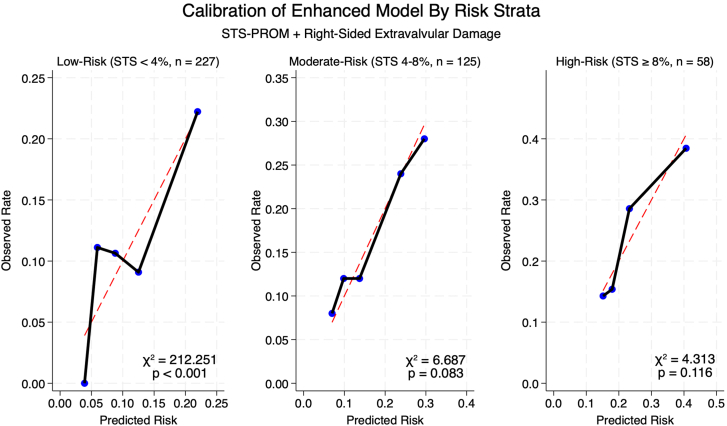 Figure 3
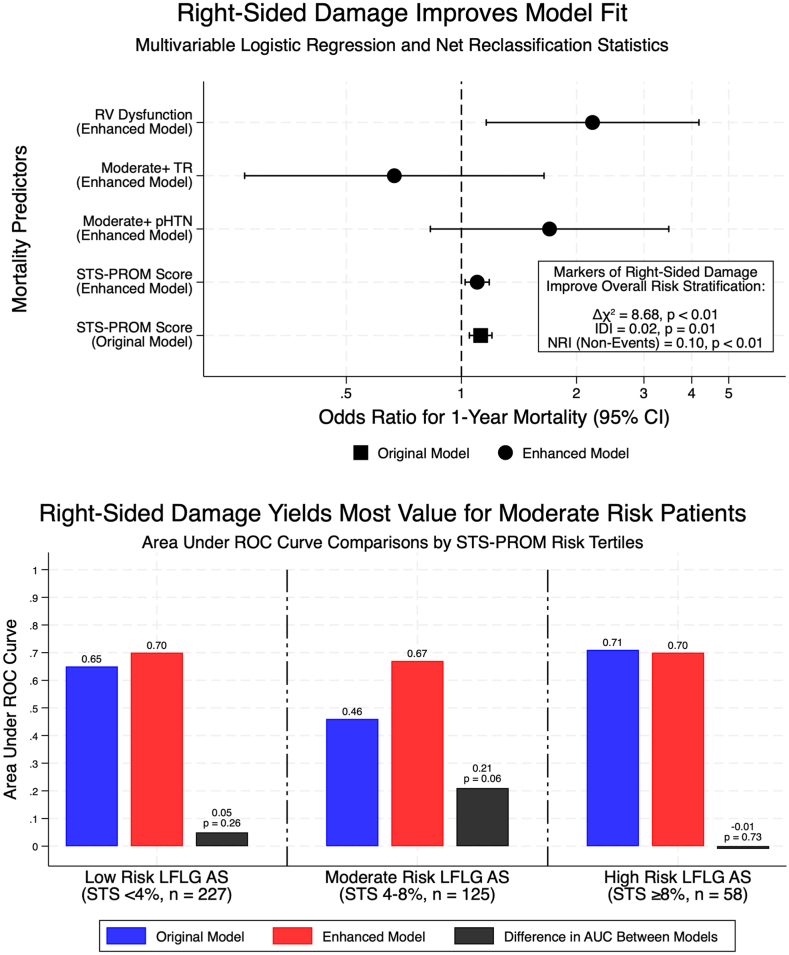 Figure 4
Peer Reviews
No public reviews on file for this paper yet. If you reviewed it on a platform where reviews are public (OpenReview, ICLR, NeurIPS, ICML), you can paste yours below so the community can read it here.
Videos
No videos yet. Explain this paper in a talk, walkthrough, or lecture? Add one.
Taxonomy
TopicsCardiac Valve Diseases and Treatments · Aortic Disease and Treatment Approaches · Cardiovascular Function and Risk Factors