Sunlight-powered photodynamic therapy for painless diabetic wound care
Yuan Lu, Ke-Bin Huang, Doron Shabat

Abstract
Genes, proteins, chemicals, diseases, species, mutations and cell lines named across the full text — each resolved to its canonical identifier and authoritative record.
Click any figure to enlarge with its caption.
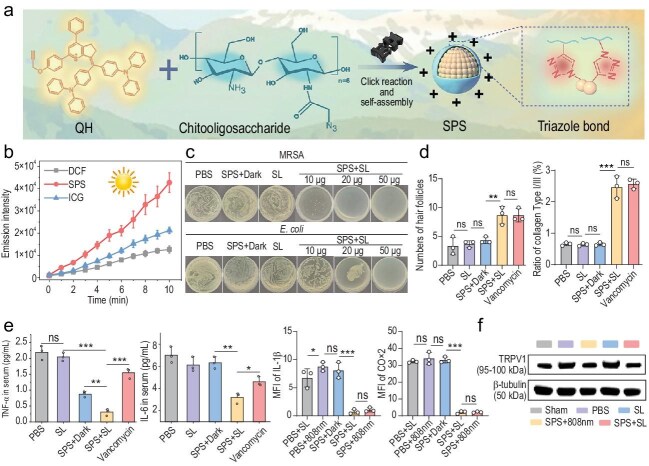 Figure 1
Peer Reviews
No public reviews on file for this paper yet. If you reviewed it on a platform where reviews are public (OpenReview, ICLR, NeurIPS, ICML), you can paste yours below so the community can read it here.
Videos
No videos yet. Explain this paper in a talk, walkthrough, or lecture? Add one.
Taxonomy
TopicsLaser Applications in Dentistry and Medicine · Photodynamic Therapy Research Studies · Medical and Biological Ozone Research
Chronic infected wounds are among the most debilitating complications of diabetes, often leading to prolonged hospitalization, antibiotic resistance, severe pain, and even limb amputation [1]. Photodynamic therapy (PDT) offers an attractive non-antibiotic strategy by generating reactive oxygen species (ROS) to eradicate pathogens, yet its clinical translation has been limited by shallow light penetration, treatment-associated pain, phototoxicity, and reliance on expensive laser equipment [2–4]. These limitations have largely confined PDT to device-dependent, clinic-based settings. In a recent study, Gong, Gu, Jiang, Kim and co-workers report a sunlight-activated nanospray that not only improves PDT performance but also suggests a more accessible mode of clinical deployment, offering a painless, portable, and multifunctional therapy for diabetic wound infections [5].
The authors introduce a chitosan oligosaccharide–coated nanoparticle system (SPS) built around a newly designed second near-infrared (NIR-II) photosensitizer (Fig. 1a). Through click chemistry–mediated self-assembly, the photosensitizer is converted into water-dispersible nanoparticles that can be applied directly to wounds as a topical spray. Unlike conventional PDT agents that require controlled laser illumination, SPS is efficiently activated by natural sunlight, producing abundant ROS even under low-intensity ambient light (Fig. 1b). This sunlight-driven activation reduces reliance on specialized instrumentation, broadening the potential contexts in which PDT may be applied.
This reliance on sunlight is more than a technical convenience. By avoiding high-intensity laser irradiation, SPS-mediated PDT substantially reduces pain and thermal damage at the treatment site, a key barrier to patient compliance. Meanwhile, the photosensitizer exhibits favorable photophysical behavior in the NIR-II window, which allows effective light penetration into deeper tissues and promotes efficient type I ROS production. As a result, robust antibacterial efficacy is achieved against both Staphylococcus aureus (including MRSA) and Escherichia coli (Fig. 1c).
Beyond its antibacterial performance, SPS displays pronounced multifunctional characteristics. The chitosan oligosaccharide coating confers inherent hemostatic capability to the nanospray, enabling rapid bleeding control in vivo. In diabetic wound models, SPS administration leads to faster wound closure, improved collagen reorganization, and increased hair follicle regeneration (Fig. 1d), collectively reflecting a shift toward scar-attenuated healing. Consistent with these regenerative outcomes, key inflammatory mediators, including IL-1β, IL-6, TNF-α, and COX-2, are significantly reduced following treatment (Fig. 1e), suggesting that sunlight-triggered PDT can effectively reshape the chronic inflammatory milieu typical of diabetic wounds.
Notably, an unexpected yet clinically relevant analgesic effect is also observed. A combination of behavioral assessments, electrophysiological measurements, and molecular analyses reveals that SPS treatment suppresses TRPV1 expression while restoring spinal neuronal excitability to near-physiological levels (Fig. 1f), thereby alleviating wound-associated pain. This finding highlights an additional therapeutic dimension of PDT beyond antimicrobial action.
By unifying antibacterial, anti-inflammatory, hemostatic, regenerative, and analgesic functions within a single sunlight-responsive nanospray, this study challenges the traditional view of PDT as a technology constrained by complex instrumentation and clinical settings. At the same time, further studies will be required to address practical considerations such as variability in natural light exposure, standardization of dosing, and long-term safety associated with repeated photodynamic activation. Nevertheless, the consistent therapeutic performance of SPS across diverse illumination conditions highlights its promise for emergency applications and use in resource-limited environments.
Taken together, these findings illustrate how rational nanomaterial engineering can extend the practical scope of PDT as a patient-friendly modality. The sunlight-driven SPS nanospray provides a compelling example of next-generation wound care systems that move beyond antibiotic dependence toward multifunctional, non-invasive therapeutic solutions.
The reference list from the paper itself. Each links out to its DOI / PubMed record.
- 1Arbona-Lampaya A, Pérez-Ojeda RA, Santos-Marrero M et al. Lancet Infect Dis 2025; doi: 10.1016/S 1473-3099(25)00720-0.10.1016/S 1473-3099(25)00720-041429139 · doi ↗ · pubmed ↗
- 2Zhao X, Liu J, Fan J et al. Chem Soc Rev 2021; 50: 4185–219.10.1039/D 0CS 00173 B 33527104 · doi ↗ · pubmed ↗
- 3Piksa M, Lian C, Samuel IC et al. Chem Soc Rev 2023; 52: 1697–722.10.1039/D 0CS 01051 K 36779328 · doi ↗ · pubmed ↗
- 4Gong Z, Dai Z. Adv Sci 2021; 8: 2002178.10.1002/advs.202002178 PMC 813215734026428 · doi ↗ · pubmed ↗
- 5Ding Q, Zhou L, Xiong T et al. Natl Sci Rev 2026; 13: nwaf 554.10.1093/nsr/nwaf 55441608042 PMC 12839536 · doi ↗ · pubmed ↗