Variant identification and genotyping strategy for the smg-1(r861) allele in Caenorhabditis elegans
Michael Zoberman, John A. Calarco

TL;DR
This paper identifies the mutation in the smg-1(r861) allele in C. elegans and provides a method to genotype it efficiently.
Contribution
The paper introduces a novel restriction digestion-based genotyping strategy for the smg-1(r861) allele.
Findings
The mutation in the smg-1(r861) allele was identified for the first time.
A restriction digestion-based method was developed to genotype the smg-1(r861) allele quickly.
Abstract
The C. elegans smg-1 gene encodes a PI3K-related kinase responsible for initiating the process of nonsense-mediated decay (NMD). The smg-1 ( r861 ) allele is a strong loss-of-function variant that disrupts NMD activity leading to the stabilization of transcripts containing premature stop codons (PTCs). This allele has been used extensively in studies of RNA surveillance, transcript stability, and transgene regulation. Despite its widespread use, the mutation in smg-1 ( r861 ) has not been reported, and identification is often based solely on phenotype. Here, we identify the underlying mutation and present a restriction digestion-based genotyping strategy that enables quick confirmation of the smg-1 ( r861 ) allele.
Genes, proteins, chemicals, diseases, species, mutations and cell lines named across the full text — each resolved to its canonical identifier and authoritative record.
Click any figure to enlarge with its caption.
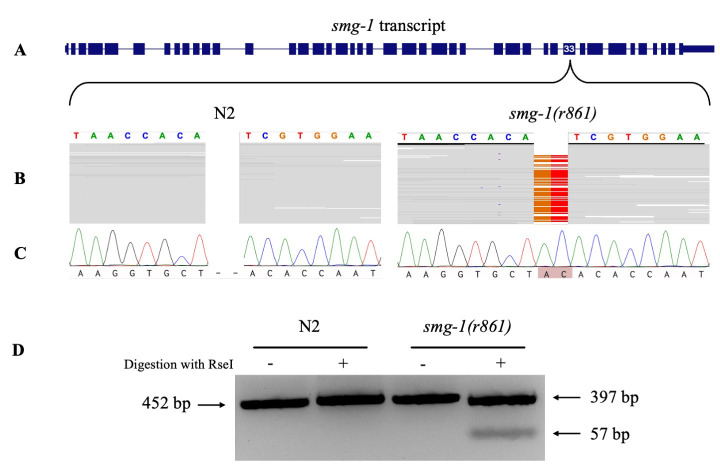 Figure 1
Peer Reviews
No public reviews on file for this paper yet. If you reviewed it on a platform where reviews are public (OpenReview, ICLR, NeurIPS, ICML), you can paste yours below so the community can read it here.
Videos
No videos yet. Explain this paper in a talk, walkthrough, or lecture? Add one.
Taxonomy
TopicsGenetics, Aging, and Longevity in Model Organisms · RNA Research and Splicing · Genetic Neurodegenerative Diseases
Description
Nonsense-mediated decay (NMD) is an evolutionarily conserved RNA surveillance system that degrades transcripts containing premature termination codons (Kurosaki et al., 2019). * C. elegans * SMG-1 , an ortholog of human SMG1, is a PI3K-related kinase and a key component of the NMD pathway. The role of SMG-1 in NMD has been well characterized; it phosphorylates the SMG-2 /UPF1 RNA helicase to promote degradation of PTC-containing transcripts (Grimson et al., 2004; Johns et al., 2007; Page et al., 1999). SMG-1 also functions in additional pathways, including DNA double-stranded break repair (González-Huici et al., 2017; Kamp et al., 2022) and regulation of lifespan through DAF-16 , the * C. elegans * ortholog of mammalian FOXO transcription factors (Masse et al., 2008).
The * smg-1 ( r861 ) * allele was originally identified in a forward genetic screen by Hodgkin et al. (1989) as a suppressor of an * unc-54 * nonsense allele. * smg-1 ( r861 ) * is a strong loss-of-function allele that is defective in NMD, allowing transcripts containing PTCs to escape degradation. Despite its frequent use in studies of RNA surveillance and transgene expression, to our knowledge, the precise mutation in * smg-1 ( r861 ) * has not previously been reported.
To identify the underlying mutation, we analyzed a publicly available RNA sequencing dataset containing both wild-type (Bristol N2 ) and * smg-1 ( r861 ) * strains (Rubio-Peña et al., 2015). Alignment of the * smg-1 * transcripts revealed a two-base pair insertion in exon 33 of the gene in * smg-1 ( r861 ) * animals that was absent in the wild-type ( Figure 1A, B). This insertion lies within the conserved PI3K/PI4K catalytic domain at residue P1846 and introduces a frameshift that results in a premature termination codon (PTC) shortly downstream of the insertion.
Interestingly, the * smg-1 * transcripts remain detectable in * smg-1 ( r861 ) * animals, consistent with a failure to trigger NMD. It is therefore likely that SMG-1 kinase function is required for degradation of its own PTC-containing transcript in * smg-1 ( r861 ) * mutants. However, a previous study found that SMG-1 protein is undetectable by Western blot in * smg-1 ( r861 ) * animals using an antibody directed against an epitope upstream of the PTC (Grimson et al., 2004), suggesting that the truncated transcript is either not efficiently translated or the resulting protein is rapidly degraded.
To validate the identified mutation, we amplified a 452 bp region of genomic DNA from the * smg-1 * gene surrounding the predicted insertion site in wild-type and * smg-1 ( r861 ) * animals. Sanger sequencing of the PCR products confirmed the presence of an AC dinucleotide insertion at Chromosome I:6,903,692 in * smg-1 ( r861 ) * , which was absent in wild-type ( Figure 1C ).
Notably, this insertion creates a unique RseI restriction site that is not present in the wild-type sequence. To develop a simple genotyping assay, we digested the 452 bp PCR product with RseI. Digestion of the * smg-1 ( r861 ) * amplicon produced two fragments of 397 bp and 57 bp, while the wild-type amplicon remained undigested. This approach therefore provides a rapid and reliable method for identifying the * smg-1 ( r861 ) * allele based on restriction fragment length polymorphism ( Figure 1D ). We anticipate that our assay will be useful for future experiments involving crossing the * r861 * allele into other relevant genetic backgrounds.
Methods
RNA seq analysis
SRA files from the GEO dataset GSE72952 were aligned to the WBcel235 reference genome using STAR (Dobin et al., 2013).
Worm maintenance
C. elegans * strains were maintained under standard conditions as described by Brenner (1974).
The following strains were used: Bristol N2 and TR1331 * smg-1 ( r861 ) * I.
All strains were provided by the CGC, which is funded by the NIH Office of Research Infrastructure Programs (P40 OD010440).
Amplification, sequencing, and digestion
Genomic DNA was extracted using a protocol based on Williams et al. (1992). Briefly, a worm lysis buffer was prepared with 50 mM Tris-HCl pH 8.0, 50 mM KCl, 2.5 mM MgCl 2 , 0.45% NP-40, 0.45% Tween 20, and 68 μg/mL proteinase K. Single adult worms were added to 6 μl lysis buffer and incubated at 65 °C for 1 hr 5 min, then 95 °C for 15 min.
Amplicons were generated with Vazyme Rapid Taq (Cat. no. P222) using 1 μl of lysed worm solution with the forward primer 5′-GTTATTCCACTTGGACCACG-3′ and reverse primer 5′-CATCCAAAGCTCACGACTG-3′. PCR was performed with an annealing temperature of 55.7 °C, 10 seconds extension, and 35 cycles. Amplicons were cleaned with Zymo Research DNA Clean & Concentrator (Cat. no. D4014).
Sanger sequencing of cleaned amplicons was performed by The Centre for Applied Genomics, The Hospital for Sick Children, Toronto, Canada.
Amplicons were digested using ThermoFisher RseI (Cat. no. ER2001) by incubating for 3 hrs at 37 °C. A 2% agarose gel in 1x TAE was run at 120 V for 60 min with the digested DNA. The gel was imaged after 500 ms UV light exposure using a Bio-Rad Gel Doc XR+ imaging system (Universal Hood II) and Image Lab software (version 6.0.1).
The reference list from the paper itself. Each links out to its DOI / PubMed record.
- 1Brenner S 197451 The genetics of Caenorhabditis elegans.Genetics 7710016-6731719410.1093/genetics/77.1.714366476 PMC 1213120 · doi ↗ · pubmed ↗
- 2Dobin A Davis CA Schlesinger F Drenkow J Zaleski C Jha S Batut P Chaisson M Gingeras TR 20121025 STAR: ultrafast universal RNA-seq aligner.Bioinformatics 2911367-4803152110.1093/bioinformatics/bts 63523104886 PMC 3530905 · doi ↗ · pubmed ↗
- 3González-Huici V Wang B Gartner A 2017620 A Role for the Nonsense-Mediated m RNA Decay Pathway in Maintaining Genome Stability in Caenorhabditis elegans.Genetics 20640016-67311853186410.1534/genetics.117.20341428634159 PMC 5560793 · doi ↗ · pubmed ↗
- 4Grimson Andrew O'Connor Sean Newman Carrie Loushin Anderson Philip 200491 SMG-1 Is a Phosphatidylinositol Kinase-Related Protein Kinase Required for Nonsense-Mediated m RNA Decay in Caenorhabditis elegans Molecular and Cellular Biology 24171098-55497483749010.1128/mcb.24.17.7483-7490.200415314158 PMC 506987 · doi ↗ · pubmed ↗
- 5Hodgkin J Papp A Pulak R Ambros V Anderson P 1989101 A new kind of informational suppression in the nematode Caenorhabditis elegans.Genetics 12320016-673130131310.1093/genetics/123.2.3012583479 PMC 1203802 · doi ↗ · pubmed ↗
- 6Johns L Grimson A Kuchma SL Newman CL Anderson P 2007611 Caenorhabditis elegans SMG-2 selectively marks m RN As containing premature translation termination codons.Mol Cell Biol 27160270-73065630563810.1128/MCB.00410-0717562857 PMC 1952128 · doi ↗ · pubmed ↗
- 7Kamp JA Lemmens BBLG Romeijn RJ González-Prieto R Olsen JV Vertegaal ACO van Schendel R Tijsterman M 2022624 THO complex deficiency impairs DNA double-strand break repair via the RNA surveillance kinase SMG-1.Nucleic Acids Res 50110305-10486235625010.1093/nar/gkac 47235670662 PMC 9226523 · doi ↗ · pubmed ↗
- 8Kurosaki T Popp MW Maquat LE 201971 Quality and quantity control of gene expression by nonsense-mediated m RNA decay.Nat Rev Mol Cell Biol 2071471-007240642010.1038/s 41580-019-0126-230992545 PMC 6855384 · doi ↗ · pubmed ↗