Incidental prostate cancer status in two tertiary centers in Kigali, Rwanda: insights from a retrospective review
Theophile Ndayishimye, Diane Joyeuse Mutuyimana, Sonia Ikugabire, Jean Luc Mwizerwa, Emmanuel Byakagaba, Edouard Ngendahayo, Afrika Guido Gasana, Emmanuel Muhawenimana

TL;DR
This study finds a 4% incidental prostate cancer rate in BPH surgical specimens in Rwanda, with some cases being high-grade and requiring careful preoperative evaluation.
Contribution
The first reported data on incidental prostate cancer rates in Rwanda, highlighting clinical implications for preoperative assessment.
Findings
Incidental prostate cancer was diagnosed in 4% of BPH surgical specimens.
Symptoms like hematuria and low back pain were strongly associated with incidental cancer diagnosis.
One case was upstaged to T3b postoperatively, indicating potential for more aggressive disease.
Abstract
prostate cancer is reported in 16.7% of benign prostate hyperplasia (BPH) surgical specimens. This incidental prostate cancer (IPCa) is usually low grade. While incidence rates vary widely across regions, no published data exist from Rwanda, thus motivating this study. this was a retrospective cross-sectional analysis of Trans-Urethral Resection of Prostate (TURP) and open simple prostatectomy specimens from two tertiary hospitals between January 2015 and October 2022 to identify IPCa rate. The clinical characteristics and pathology reports were retrieved. Independent t-test, Fisher´s exact test, and logistic regression were performed to assess associations between clinical characteristics and occurrence of IPCa. we included 153 patients, mean age 70 years (SD: ±10). 140/153 patients had Lower Urinary Tract Symptoms (LUTS), macrohematuria 4/153, and low back pain 1/153. IPCa was…
Genes, proteins, chemicals, diseases, species, mutations and cell lines named across the full text — each resolved to its canonical identifier and authoritative record.
Click any figure to enlarge with its caption.
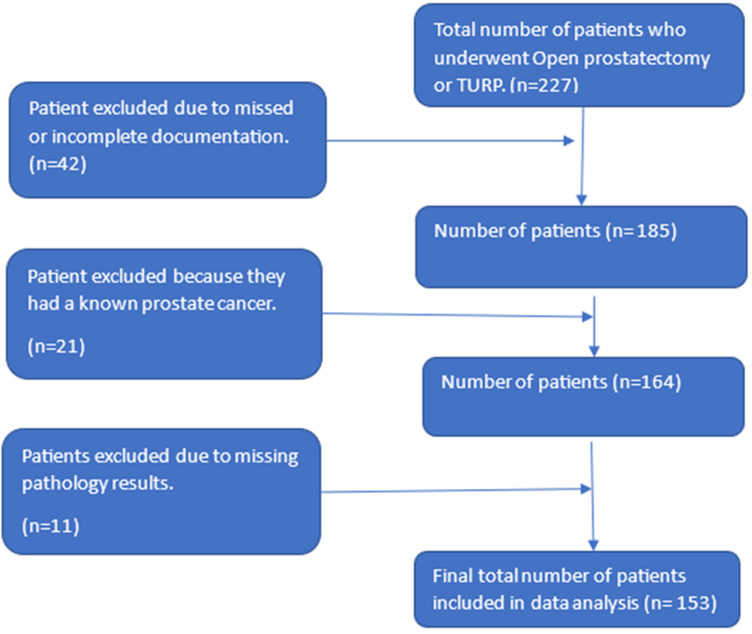 Figure 1
| Incidental prostate cancer | |||
|---|---|---|---|
| No (N=147) | Yes (N=6) | ||
| N (%) | N (%) | P value | |
|
| |||
| ≤ 65 | 49 (33.3) | 0 (0.0) | 0.178 |
| > 65 | 98 (66.7) | 6 (100.0) | |
|
| |||
|
| |||
| No | 7 (4.7) | 1 (16.7) | 0.279 |
| Yes | 140 (95.3) | 5 (83.3) | |
|
| |||
| No | 144 (98) | 5 (83.3) | 0.149 |
| Yes | 3 (2) | 1 (16.7) | |
|
| |||
| No | 146 (99.4) | 5 (83.3) | 0.077 |
| Yes | 1 (0.6) | 1 (16.7) | |
|
| |||
| No | 124 (84.3) | 4 (66.7) | 0.254 |
| Yes | 23 (15.7) | 2 (33.3) | |
|
| |||
| ≤ 4 ng/mL | 54 (36.8) | 0 (0.0) | |
| > 4 ng/mL | 93 (63.2) | 6 (100.0) | 0.09 |
|
| |||
| ≤ 40 g | 40 (39.6) | 1 (25) | |
| > 40 g | 61 (60.4) | 3 (75) | 1 |
|
| |||
| ≤ 0.15 | 97 (66) | 2 (33.3) | |
| > 0.15 | 50 (34) | 4 (66.7) | 0.186 |
|
| |||
| No | 118 (80.3) | 4 (66.7) | |
| Yes | 29 (19.7 | 2 (33.3) | 0.602 |
| Incidental prostate cancer | |||||
|---|---|---|---|---|---|
| No | Yes | ||||
| N (%) | Mean ± SD | N (%) | Mean± SD | P Value | |
|
| |||||
| Normal | 99 (67.3) | 2 (33.3) | |||
| Abnormal | 48 (32.7) | 4 (66.7) | 0.109 | ||
|
| |||||
| Smooth | 105 (71.4) | 3 (50.0) | |||
| Hard | 31 (21.1) | 2 (33.3) | |||
| Induration | 11 (7.5) | 1 (16.7) | |||
|
| |||||
| No | 127 (86.4) | 4 (66.7) | 0.199 | ||
| Yes | 20 (13.6) | 2 (33.3) | |||
| Unadjusted OR (95% CI) | P value | Adjusted OR (95% CI) | P value | |
|---|---|---|---|---|
|
| ||||
| > 65 | 0 - | 0.997 | ||
|
| ||||
| LUTS | 0.250 (0.026 - 2.438) | 0.233 | ||
| Hematuria | 9.6 (0.843 - 109.315) | 0.068 | 16.407 (1.141 - 235.928) | 0.04 |
| Low back pain | 29.2 (1.588 - 536.887) | 0.023 | 38.838 (1.540 - 881.220) | 0.026 |
| Acute urinary retention | 2.696 (0.466 - 15.586) | 0.268 | ||
|
| ||||
| Abnormal | 4.125 (0.730 - 23.315) | 0.109 | ||
|
| ||||
| Yes | 3.175 (0.545 - 18.495) | 0.199 | ||
|
| ||||
| > 4ng | 0 - | 0.997 | ||
|
| ||||
| > 40 g | 1.967 (0.198 - 19.583) | 0.564 | ||
|
| ||||
| > 0.15 | 3.880 (0.687 - 21.915) | 0.125 |
| S/N | PSA | Gleason | Stage | Volume in % | Type of cancer | PNI | Management |
|---|---|---|---|---|---|---|---|
| Case 1 | 9.8 | 3+3=6 | T1b | 20% | Prostatic acinar adenocarcinoma | No | Active surveillance |
| Case 2 | 35 | 3+4=7 | T1a | NA | Prostate adenocarcinoma | Yes | Watchful waiting |
| Case 3 | 5.6 | 3+4=7 | T1b | 10% | Prostate adenocarcinoma | No | Watchful waiting |
| Case 4 | 9.1 | 4+4=8 | T1b | 20% | Invasive acinar adenocarcinoma | No | ADT |
| Case 5 | 28 | 4+3=7 | T1b | 60% | Prostate adenocarcinoma | No | ADT |
| Case 6 | 10.9 | 4+5=9 | T1b upstaged to T3bN1M0 | 40% | Acinar adenocarcinoma | No | ADT |
Peer Reviews
No public reviews on file for this paper yet. If you reviewed it on a platform where reviews are public (OpenReview, ICLR, NeurIPS, ICML), you can paste yours below so the community can read it here.
Videos
No videos yet. Explain this paper in a talk, walkthrough, or lecture? Add one.
Taxonomy
TopicsProstate Cancer Diagnosis and Treatment · Bladder and Urothelial Cancer Treatments · Urinary Bladder and Prostate Research
Introduction
Prostate cancer is the second most common and fifth leading cause of cancer-related deaths in men [1,2]. In 2018, prostate cancer accounted for 7.1% of worldwide cancer diagnoses in men [1,3] with variable regional incidences. It is the most frequent cancer in Europeans (24%), the second most common in Americans (9.5%) [4,5] and relatively lower rates in East and North Africa [6]. Prostate cancer is concurrent with benign prostate hyperplasia (BPH) in 83%, and incidentally, found in up to 16.7% of Transurethral Resection of Prostate (TURP) specimens [1,7]. Multiple studies have linked IPCa to older age, high Prostate Specific Antigen (PSA), abnormal Digital Rectal Examination (DRE), low prostate volume, and high BMI. Obesity trait masks cancer prior to BPH surgery due to DRE difficulties and PSA dilution effects [1,3,8-14]. Following the widespread use of PSA screening, the rate of IPCa has declined significantly from 27% to 9% [11] but is still reported in high proportions in low-resource settings (21.7%) [8,12,14].
Most IPCa are low-grade and may not require radical surgery or radiotherapy for curative purposes [8]. For example, in China, IPCa was found in 4.7% of cases, with most cases assigned a Gleason score of 3+3=6, indicating low-grade cancer [3]. This rate is similar to 5.6% found by Kizilkan et al. (2022) in their retrospective analysis of 430 patients' records [15]. Similarly, a study in Europe identified IPCa in 6.4% of patients, 91% of whom had grade 1 disease [3]. In Pakistan, IPCa among patients who underwent TURP for BPH was 10.7% and 90.9% had low-grade cancer (T1b) [16]. Despite low-risk disease being reported occasionally, intermediate and high risk may occur. For instance, in the analysis of 793 TURP specimens, one patient had a Gleason score of 3 + 4 = 7, and of the IPCa patients, one received radiotherapy, while three underwent radical prostatectomy, challenging procedures due to a prior BPH surgery [1,3,8-10].
In Rwanda, surgery for BPH-mainly TURP and simple prostatectomy-has increased markedly over the past decade, following the launch of Rwanda's first urology training program in 2014. This rise, along with PSA screening, increased the detection of low-risk cancers and reduced unnecessary biopsies. However, ruling out concurrent prostate cancer before BPH surgery remains crucial, as radical prostatectomy or radiotherapy afterward is technically difficult and associated with more complications [2]. To date, no published data exist on the incidence of cancer among Rwandan BPH surgery patients. This study aimed to determine the rate of incidental prostate cancer and identify preoperative predictors in two tertiary hospitals.
Methods
Study design and setting: this was a cross-sectional retrospective study of prostate specimens obtained during benign prostatic surgery conducted between January 2015 and October 2022 at the University Teaching Hospital of Kigali (CHUK) and King Faisal Hospital (KFH) Kigali, Rwanda, both tertiary referral hospitals and pioneer centers for BPH surgery in Kigali, Rwanda.
Study population: the study included 153 men who underwent transurethral resection of the prostate (TURP) or open simple prostatectomy for presumed benign prostatic hyperplasia (BPH) within the study period. Patients with a known prostate cancer diagnosis before surgery (n=21), incomplete medical records (n=42), or non-detailed histopathology reports (n=11) were excluded.
Data collection: data were obtained from electronic medical records (EMR), theatre registries, and printed files using a predesigned questionnaire capturing socio-demographic, clinical, and histopathological details. PSA and prostate ultrasound results from the study hospitals were included, while results from outside facilities were excluded unless performed at one of the study sites.
Definitions: the primary outcome was incidental prostate cancer (IPCa), confirmed by histological examination of surgical specimens within each hospital's pathology laboratory. Variables analyzed included age, PSA levels, PSA density, prostate size, DRE findings, surgical technique, Gleason score, and subsequent management. Quantitative variables such as age and PSA were analyzed as both continuous and categorical (<65 vs >65 years; <4 ng/ml vs >4 ng/ml). PSA density (<0.15 vs >0.15) and prostate size (<40g vs. >40g) were also categorized, while DRE nodules were treated as binary (yes/no).
Statistical analysis: data were analyzed using SPSS version 25.0 (IBM Corp., 2017). Continuous variables were expressed as means ± standard deviation, while categorical variables were presented as frequencies and percentages. Fisher´s exact test and independent sample t-tests were applied for group comparisons. Logistic regression analyses were used to identify predictors of incidental prostate cancer, with statistical significance set at p <0.05 and a 95% confidence interval.
Ethical considerations: ethical approval was obtained from the institutional review boards of both hospitals (KFH approval No. KFH/2022/031/IRB; CHUK approval No. EC/CHUK/149/2022).
Results
Cohort characteristics: we recorded 227 eligible patients from theatre registries who had undergone TURP or open simple prostatectomy at either King Faisal Hospital (KFH) or University Teaching Hospital of Kigali (CHUK) during our study period. We had 74 patients excluded due to incomplete medical records (n=42), a known cancer diagnosis before surgery (n=21), or missing complete histopathology reports (n=11). Our final analysis included 153 patients (Figure 1) with a mean age of 70 years (SD: ± 10), younger than 65 years (49/153) and older than 65 years (104/153). Most of the patients (140/153, 95.3%) presented with lower urinary tract symptoms (LUTS), 4/153 with hematuria and 1/153 with low back pain (Table 1). Average prostate size on ultrasound was 46ml (IQR = 36 - 80) for non-cancer patients and 72ml (IQR = 41 - 99) for the IPCa patients (P=0.5), while average PSA was 5.6ng/ml (IQR = 2.8 - 9) for non-cancer and 9.9ng/ml (IQR = 6 - 28) for the IPCa patients (P=0.9). Regarding pre-operative biopsy, 79.2% (n=121) did not undergo a pre-operative prostate biopsy, while 20.8% (n=32) did. A biopsy was done due to isolated high PSA in 8/32, raised PSA (>4ng/ml) with abnormal DRE in 4/32, and solely abnormal DRE in 20/32. The common reported histology on pre-operative biopsy was BPH in 29/32 alone or combined with prostatitis in 7/32. TURP was done in 71% (109/153) and open simple prostatectomy in 29% (45/153).
selection of participants from prostatectomy and Transurethral Resection of Prostate at Centre Hospitalier Universitaire de Kigali and King Faisal Hospital, Kigali, Rwanda (Jan 2015-Oct 2022; N=227) (final cohort: 153 after exclusions)
Incidental prostate cancer and predictors: IPCa was diagnosed in 6/153 (4%). All IPCa patients were older than 65 years (P=0.9), and 5/6 had LUTS (P=0.23), one patient (1/6) had hematuria (P=0.068), 1/6 had low back pain (P=0.02) (Table 1). Cancer was diagnosed in 2/101 patients with normal DRE versus 4/52 with abnormal DRE (P=0.1) and 2/6 with the presence of nodules (P=0.2) (Table 2). Also, prostate volume did not correlate with cancer detection (P=0.5).
On the univariate logistic regression, low back pain and hematuria reached significance with P<0.05: OR 29.2, 95% CI: 1.588 - 536.887, P=0.023, and OR 9.6, 95% CI: 0.843 - 109.315, P=0.068, respectively, but the latter was borderline. Abnormal DRE (OR 4.125, 95% CI: 0.730 - 23.315, P=0.109) and PSA density (OR 3.9, 95% CI: 0.687 - 21.915, P=0.12) showed weak associations but did not reach conventional thresholds, likely due to small sample size. The age, lower urinary tract symptoms (LUTS), acute urinary retention presentation, and prostate size on ultrasound were not significant (Table 3). In multivariate analysis, hematuria and low back pain were independent predictors of incidental prostate cancer (OR 16.407, 95% CI: 1.141 - 235.928, P =0.040, and low back pain: OR 38.838, 95% CI: 1.540 - 881.220, P=0.026). These associations were observed with a small number of cases, which are likely to explain the inflated odds ratio (Table 3).
Prostate cancer T staging and management: prostate cancer histology was exclusively adenocarcinoma, and the tumor volume ranged between 10% and 60% with 1/6 presenting with perineural invasion (PNI). With regards to staging, one patient (1/6) had T1a while 5/6 had T1b disease. Based on International Society of UroPathologist (ISUP) grade groups (GG), group 2 accounted for 2/6 patients while GG 1, 3, 4, and 5 accounted for 1/6 patient each, indicating a mixture of low-grade (16.7%), intermediate (33.3%), and high-grade cancer (50% i.e.: GG 3, 4, and 5). After IPCa diagnosis, one patient was upstaged to T3b on MRI. Management included watchful waiting in 2/6, Active surveillance in 1/6, and ADT for one elderly patient who developed symptoms related to cancer and two other patients with high-grade disease (Table 4).
Discussion
Our study aimed to determine the incidence of prostate cancer in BPH specimens at the University Teaching Hospital of Kigali (CHUK) and King Faisal Hospital in Kigali, Rwanda. We detected 4% of specimens to bear prostate cancer. Preoperative macrohematuria and low back pain were potential independent predictors of incidental prostate cancer. Most patients had a grade group 2 and above, indicating the presence of intermediate and high-grade cancer in need of intervention after diagnosis and stratification.
Our observed incidence of incidental prostate cancer (IPCa) at 4% is comparable to reports from China (4.7%) and Turkey (5.6%) [3,15], but remains lower than those from Pakistan (10.7%), Tombal et al. (9%), and Mai et al. (8%) [11,12,16,17]. Previous studies identified advanced age, abnormal DRE, elevated PSA, higher PSA density, and smaller prostate volume as key predictors of IPCa [3,9,11,12,17-19]. In our cohort, all IPCa cases occurred in patients older than 65 years with PSA >4 ng/mL, although no significant association was found between IPCa and PSA, PSA density, prostate volume, and abnormal DRE. This may relate to preoperative factors such as long-term indwelling catheters, which can elevate PSA levels in both non-cancer and cancer patients, and low sensitivity of DRE, which only identifies cancer in 4 out of 10 cases [14,20]. Similar to Gunda et al. (2018), who found IPCa linked to age and PSA >10 ng/mL [14], and Sakamoto et al. (2014), who identified age >75 years as a key predictor [21], our results reinforce the role of age and PSA elevation in risk stratification before BPH surgery.
In a systematic review and meta-analysis by Hansen et al. (2022), macrohematuria was identified as a presenting symptom of prostate cancer in up to 36.4% [22], while low back pain is recognized as a sign of locally advanced or metastatic prostate cancer. This may explain our findings of higher grades of cancer in our cohort, where only one patient was a low grade, while others were grade group 2 and above, compared with low-grade cancers reported by previous studies [3,14]. However, comparable to our findings of 50% high-grade cancer are the results of Mohamed et al. (2022), who reported a high-grade incidental prostate cancer in 42.2% of the studied cohort in Somalia [8]. Low-grade prostate cancers reported in other reviews were not particularly concerning to the authors, as few required intervention; most were managed with active surveillance due to their favorable long-term survival and similar outcomes compared to those who underwent invasive treatments [3,14]. Elkoushy et al. (2015) demonstrated that the survival rates of patients with incidental prostate cancer at 5 and 10 years were 72.8% and 63.5%, respectively, by means of active surveillance [23], however, Guo et al. (2022) reported that radiotherapy is also safe for patients with a history of prostate resection, but undergoing open prostatectomy is technically challenging for this population [3] favoring active surveillance or radiotherapy in his assertions. Our findings of higher-grade cancers support these assertions on the importance of more targeted preoperative screening, particularly for patients presenting with advanced cancer symptoms beyond LUTS, those over 65 years of age, or with PSA levels exceeding 4ng/mL.
These findings are clinically significant, particularly in resource-limited settings, indicating that 4% with high-risk cancer cases could be missed in patients undergoing surgery for presumed BPH if histological evaluation of postop specimens is omitted. Clinicians should take a thorough history and prioritize targeted screening, especially in older patients, with symptoms beyond LUTS or elevated PSA, to prevent incidental detection of high-grade tumors that are more difficult to manage post-BPH surgery.
This study was designed to determine the rate of incidental prostate cancer (IPCa) in two tertiary hospitals-the first report of its kind from Rwanda. While its retrospective, cross-sectional design based on EMR data presents inherent limitations such as potential biases of incomplete records and data inconsistencies, we mitigated these by cross-checking all available sources for accuracy and completeness. Although the study does not represent the entire country, it offers valuable insights into the local burden of IPCa and establishes a foundation for future prospective studies to guide national policy and clinical practice.
Conclusion
Incidental prostate cancer among presumed benign prostatic hyperplasia cases in these tertiary hospitals is uncommon but often high risk, with no strong predictive factors identified. Men over 65 years or those presenting with hematuria, low back pain, or PSA >4 ng/mL should be carefully evaluated and considered for biopsy when it may alter management. The detection of high Gleason scores underscores the need for routine histopathologic review of surgical specimens. Given the study´s retrospective design and limited geographic scope, broader nationwide prospective research is recommended to better define preoperative predictors and guide histopathologic evaluation practices in Rwanda.
What is known about this topic
- Incidental prostate cancer shows variable incidence across populations and has been modestly reported in resource-constrained countries;
- Management is challenging, with inconsistent guidelines across clinical settings;
- Experts highlight technical difficulties with surgery post-BPH treatment and the toxicity risks of radiotherapy.
What this study adds
- This study is the first of its kind in Rwanda, to the best of our knowledge, offering insights relevant to local and similar healthcare settings;
- It establishes a low baseline incidence of incidental prostate cancer, which may increase with the current trend of prostate enucleation techniques posing new challenges in already resource-limited systems;
- In contrast with previous literature, this study shows a higher than expected proportion of high-risk tumors.
The reference list from the paper itself. Each links out to its DOI / PubMed record.
- 1Bostwick DG Cooner WH Denis L Jones GW Scardino PT Murphy GP The association of benign prostatic hyperplasia and cancer of the prostate Cancer 1992 Jul 1701 Suppl 291301137619910.1002/1097-0142(19920701)70:1+<291::aid-cncr 2820701317>3.0.co;2-4 · doi ↗ · pubmed ↗
- 2Abedi AR Ghiasy S Fallah-Karkan M Rahavian A Allameh F The Management of Patients Diagnosed with Incidental Prostate Cancer: Narrative Review Res Rep Urol 2020 Mar 16121051093221526810.2147/RRU.S 245669 PMC 7083625 · doi ↗ · pubmed ↗
- 3Guo Z He J Pan J Huang L Cao J Bai Zet al Prevalence and risk factors for incidental prostate cancer in patients after transurethral resection of the prostate with negative results on prostate biopsy: A retrospective study Investig Clin Urol 2022 Mar 63220120610.4111/icu.20210415 PMC 890242235244994 · doi ↗ · pubmed ↗
- 4Kensler KH Rebbeck TR Cancer Progress and Priorities: Prostate Cancer Cancer Epidemiol Biomarkers Prev 2020 Feb 2922672773202476510.1158/1055-9965.EPI-19-0412 PMC 7006991 · doi ↗ · pubmed ↗
- 5Heller JR The National Cancer Institute: a twenty-year retrospect J Natl Cancer Inst 1957 Aug 1921479013502713 · pubmed ↗
- 6Mc Guire S World Cancer Report 2014. Geneva, Switzerland: World Health Organization, International Agency for Research on Cancer, WHO Press, 2015 Adv Nutr 2016 Mar 157241892698082710.3945/an.116.012211 PMC 4785485 · doi ↗ · pubmed ↗
- 7Villers A Grosclaude PÉpidémiologie du cancer de la prostate. Article de revue Médecine Nucléaire 200832124
- 8Mohamed AH Abdullahi IM Warsame FF Mohamud HA Incidence and associated factors for incidental prostate cancer among patients who underwent surgery for benign prostatic hyperplasia: first report from Somalia J Cancer Res Clin Oncol 2023 Jul 1497404140463603682410.1007/s 00432-022-04319-0PMC 10314863 · doi ↗ · pubmed ↗