Dinitrogen complexes N2L2 (L = N2, CO, CS, NO+, CN−)
Yahui Li, Chengxiang Ding, Lianbin Xie, Sudip Pan, Gernot Frenking

TL;DR
This paper uses quantum chemical methods to study the structure, stability, and bonding of N2L2 complexes with various ligands, revealing insights into their dissociation and vibrational properties.
Contribution
The study provides new insights into the thermodynamic stability and bonding mechanisms of N2L2 complexes using advanced quantum chemical calculations.
Findings
N2L2 complexes with L = N2, CO, NO+, CN− are thermodynamically unstable, while N2(CS)2 is slightly stable.
The dissociation of N2L2 into N2 + 2L is energetically more favorable than into 2 NL.
Vibrational frequencies show distinct shifts for different ligands, aiding in the identification of these complexes.
Abstract
Quantum chemical calculations using ab initio methods and density functional theory have been carried out on the equilibrium structures and the vibrational spectra of the (valence) isoelectronic compounds N2L2 (L = N2, CO, CS, NO+, CN−). The molecules have a trans-periplanar arrangement of the L2 ligands at the N2 unit. The complexes with L = N2, CO, NO+, CN− are predicted as thermodynamically unstable for dissociation into N2 + 2L with ΔG298 value lying in between −257 kcal mol−1 (L = NO+) and −73 kcal mol−1 (L = CO), but the adduct N2(CS)2 is calculated as slightly stable with ΔG298 = 4 kcal mol−1. The homolytic dissociation reaction into two fragments N2L2 → 2 NL is energetically less favorable than the heterolytic fragmentation N2L2 → N2 + 2 L, which proceeds synchronously but asymmetrically. The activation barriers for the fragmentation reaction N2L2 → N2 + 2L have values between…
Genes, proteins, chemicals, diseases, species, mutations and cell lines named across the full text — each resolved to its canonical identifier and authoritative record.
Click any figure to enlarge with its caption.
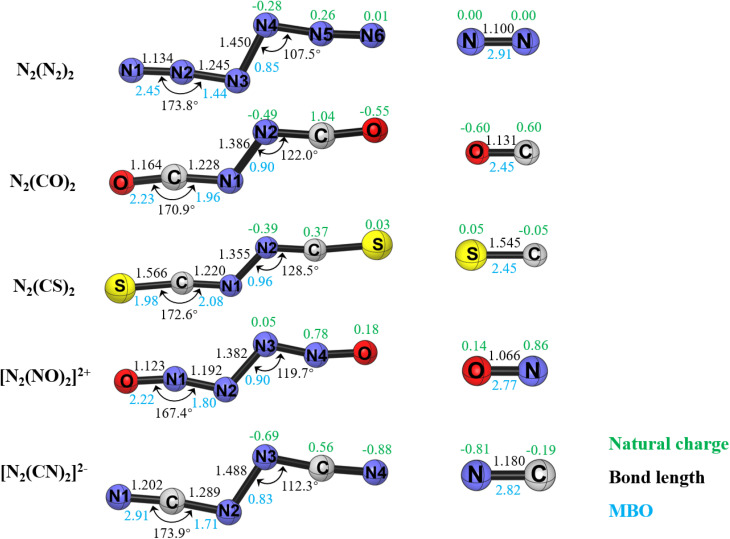 Fig. 1
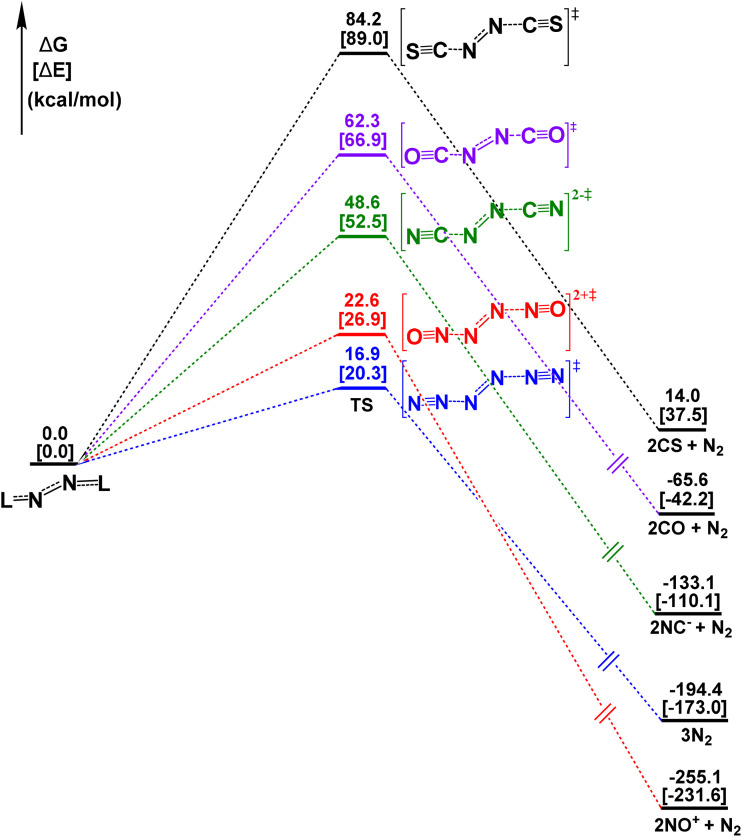 Fig. 2
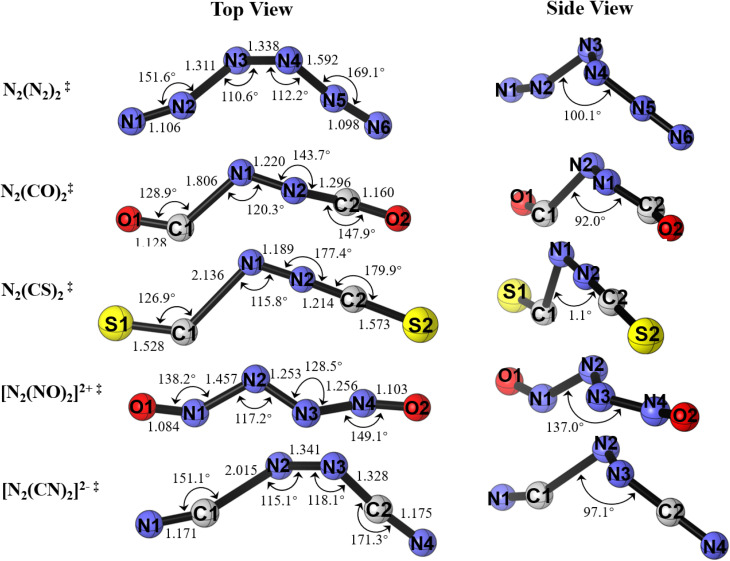 Fig. 3
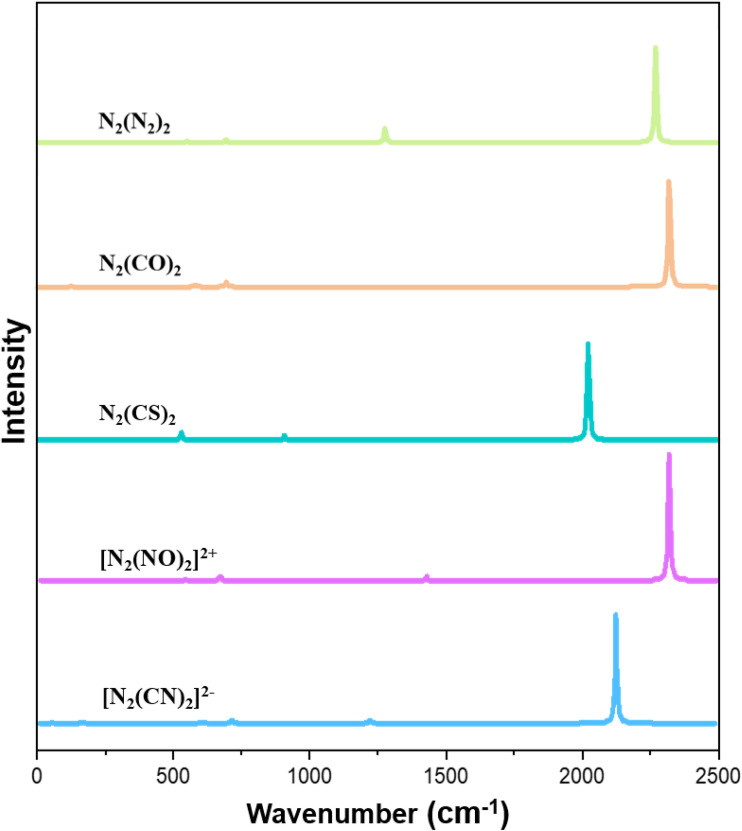 Fig. 4
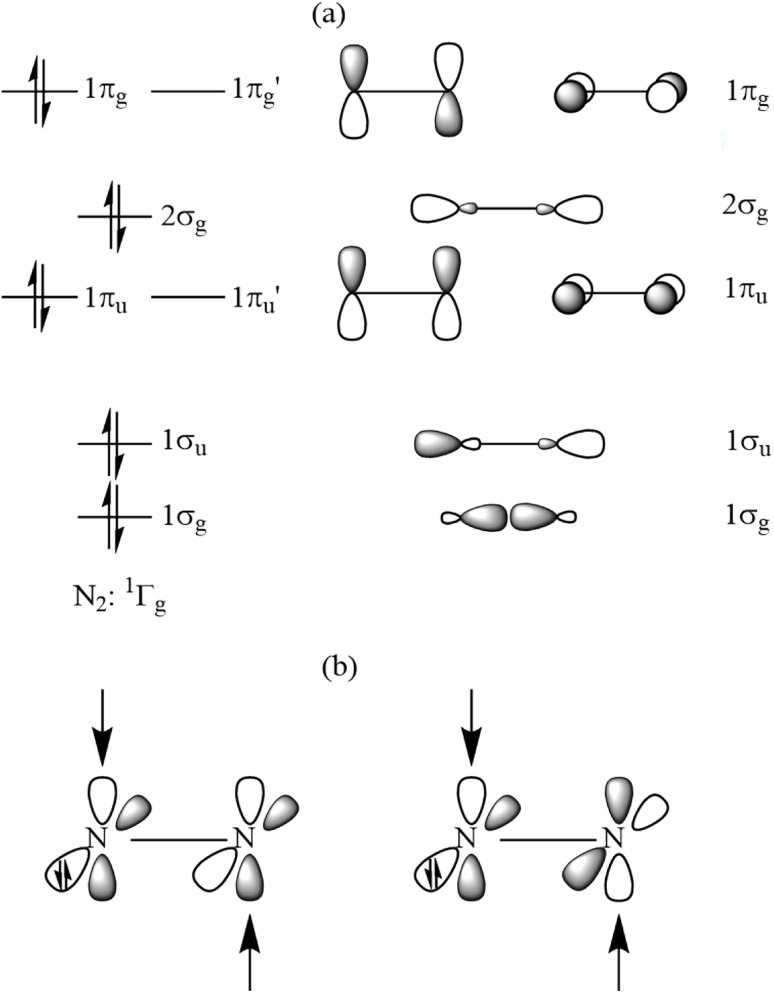 Fig. 5
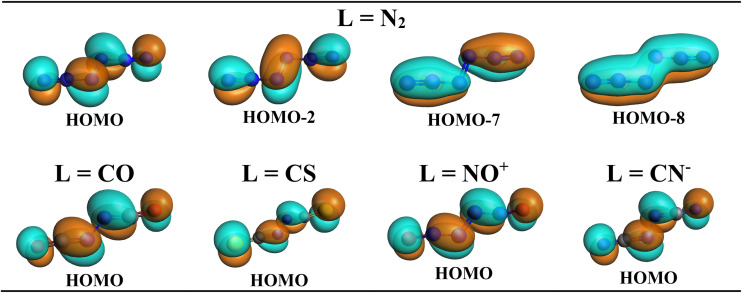 Fig. 6
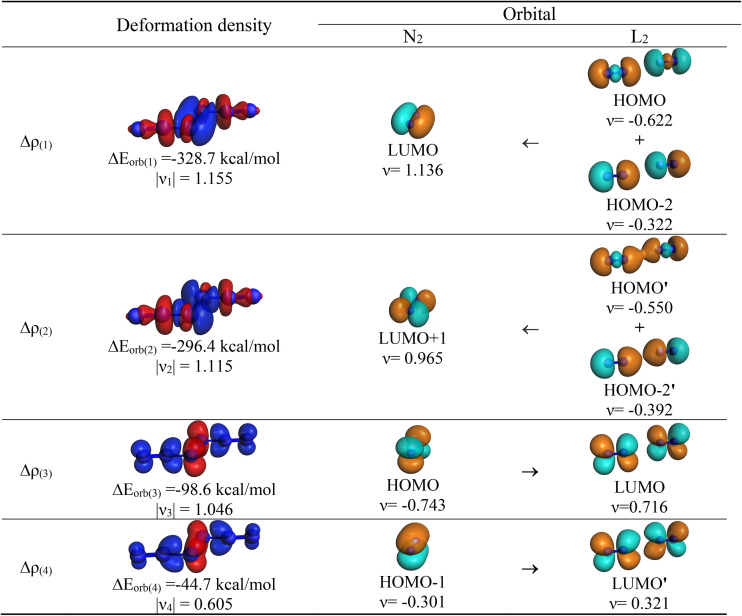 Fig. 7
| Complex |
|
| Δ | Δ |
|---|---|---|---|---|
|
| ||||
| N2(N2)2 | −179.1 | −184.1 | −182.0 | −200.7 |
| N2(CO)2 | −49.5 | −55.8 | −53.7 | −73.4 |
| N2(CS)2 | 27.7 | 21.8 | 23.6 | 3.6 |
| [N2(CN)2]2− | −116.7 | −122.2 | −120.1 | −139.7 |
| [N2(NO)2]2+ | −233.3 | −238.7 | −236.5 | −256.8 |
|
| ||||
| N2(N2)2 | 34.4 | 29.6 | 30.5 | 22.2 |
| N2(CO)2 | 62.1 | 58.5 | 59.1 | 48.9 |
| N2(CS)2 | 27.8 | 24.1 | 25.0 | 13.4 |
| [N2(CN)2]2− | −51.8 | −56.8 | −55.8 | −60.8 |
| [N2(NO)2]2+ | −70.2 | −74.5 | −73.7 | −84.6 |
| Energies | Orbital interaction | N2 (singlet) + 2L (singlet) | N2 (triplet) + 2L (triplet) | N2 (quintet) + 2L (quintet) | N2−(doublet) + 2L+(doublet) | N2−(quartet) + 2L+(quartet) |
|---|---|---|---|---|---|---|
| Δ | −165.0 | −368.7 | −401.3 | −387.3 | −519.0 | |
| Δ | 1036.0 | 1022.8 | 1028.3 | 1042.8 | 1090.1 | |
| Δ | −364.9 (30.4%) | −388.8 (27.9%) | −438.1 (30.6%) | −538.1 (37.6%) | −615.1 (38.6%) | |
| Δ | −836.1 (69.6%) | −1002.7 (72.1%) | −991.5 (69.4%) | −894.5 (62.4%) | −980.0 (61.4%) | |
| Δ | L–NN–L σ-bond (+,−) | −328.7 (39.3%) | −317.3 (31.6%) | −328.7 (33.2%) | −329.8 (36.9%) | −350.4 (35.8%) |
| Δ | L–NN–L σ-bond (+,+) | −296.4 (35.5%) | −296.9 (29.6%) | −314.1 (31.7%) | −261.4 (29.2%) | −337.7 (34.5%) |
| Δ | L–NN–L π-bond (+,−) | −98.6 (11.8%) | −174.9 (17.4%) | −151.4 (15.3%) | −123.1 (13.8%) | −90.9 (9.3%) |
| Δ | L–NN–L π-bond (+,+) | −44.7 (5.3%) | −86.5 (8.6%) | −94.8 (9.6%) | −54.0 (6.0%) | −56.2 (5.7%) |
| Δ | −67.7 (8.1%) | −127.1 (12.7%) | −102.2 (10.3%) | −126.2 (14.1%) | −144.8 (14.8%) |
| Energies | Orbital interaction | L = N2 | L = CO | L = CS | L = NO+ | L = CN− |
|---|---|---|---|---|---|---|
| Δ | −165.0 | −306.0 | −387.0 | −202.5 | −301.4 | |
| Δ | 1036.0 | 1400.4 | 1542.2 | 1242.3 | 1155.6 | |
| Δ | −364.9 (30.4%) | −530.8 (31.1%) | −595.4 (30.9%) | −356.9 (24.7%) | −484.9 (33.3%) | |
| Δ | −836.1 (69.6%) | −1175.7 (68.9%) | −1333.8 (69.1%) | −1088.0 (75.3%) | −972.1 (66.7%) | |
| Δ | L–NN–L in-plane(σ)-bond (+,−) | −328.7 (39.3%) | −483.0 (41.1%) | −536.4 (40.2%) | −373.2 (34.3%) | −405.8 (41.7%) |
| Δ | L–NN–L in-plane(σ)-bond (+,+) | −296.4 (35.5%) | −434.3 (37.4%) | −493.4 (37.0%) | −322.3 (29.6%) | −400.0 (41.1%) |
| Δ | L–NN–L out-of-plane(π)-bond (+,−) | −98.6 (11.8%) | −76.1 (6.5%) | −134.6 (10.1%) | −182.1 (16.7%) | −70.4 (7.2%) |
| Δ | L–NN–L out-of-plane(π)-bond (+,+) | −44.7 (5.3%) | −45.2 (3.8%) | −48.0 (3.6%) | −75.5 (6.9%) | −34.6 (3.6%) |
| Δ | −67.7 (8.1%) | −137.1 (11.7%) | −121.4 (9.1%) | −134.9 (12.4%) | −61.3 (6.3%) |
- —Nanjing Tech University10.13039/501100008256
Peer Reviews
No public reviews on file for this paper yet. If you reviewed it on a platform where reviews are public (OpenReview, ICLR, NeurIPS, ICML), you can paste yours below so the community can read it here.
Videos
No videos yet. Explain this paper in a talk, walkthrough, or lecture? Add one.
Taxonomy
TopicsAdvanced Chemical Physics Studies · Chemical Reactions and Mechanisms · Advanced Physical and Chemical Molecular Interactions
Introduction
In 1964, Appel and Schöllhorn reported that triphenylphosphinazine, which was sketched with the formula Ph_3_PN–NPPh_3,_ is a thermally stable diamagnetic species that has a melting point of 184°.^1^ However, neither precise structural information about the compound was given in the work, nor in their further study.^2^ Later, quantum chemical calculations showed that N_2_(PPh_3_)2 is thermodynamically unstable for the release of N_2_ by ∼90 kcal mol^−1^,^3^ which raised doubts about the structure of the isolated compound. A subsequent X-ray structure analysis confirmed that the species is indeed triphenylphosphinazine, which has an antiperiplanar arrangement of the phosphine groups in Ph_3_P-(N_2_)-PPh_3_ with bending angles P–N–N of 107^o^, and a long N–N bond of 1.497 Å.^4^ The theoretical analysis of the bonding situation suggested that the N_2_ moiety binds through its highly excited (1)^1^Γ_g_ state, where the out-of-plane π and π* orbitals are doubly occupied and the in-plane π MO is vacant, which leads to strong dative interactions Ph_3_P→(N_2_)←PPh_3_ with N_2_ as a double Lewis acid. The same type of dative interactions was suggested for the related compound with NHC (N-Heterocyclic Carbene) ligand, NHC→(N_2_)←NHC, which was reported to have an antiperiplanar arrangement of the NHC groups and a long N–N bond of 1.415 Å.^5^
Very recently, Qian, Mardyukov and Schreiner (QMS) reported the synthesis, via gas-phase reaction, of the new nitrogen allotrope N_6_, which was trapped in low-temperature argon matrices at 10 K and as a film at liquid nitrogen temperature of 77 K.^6^ The molecule was identified by IR and UV-vis spectroscopy, and by ab initio calculations, which predict a structure where two N_3_ fragments are bonded in a trans-arrangement through a long (1.460 Å) N–N bond. The viewpoint of N_6_ as the dimer of N_3_ is reasonable, because hexanitrogen was synthesized by treating AgN_3_ with Cl_2_, which yields ClN_3_ that reacts with AgN_3_ and leads to the formation of the new nitrogen allotrope N_6_. Hexanitrogen was heralded as a molecule of the year 2025 wth a long N–N bond connecting two N_3_ fragments.^7^ But the structural similarity to the N_2_(PPh_3_)2 and N_2_(NHC)2 species led us suspect that the N_6_ species is another example of the compound class N_2_L_2_ where the ligands L are bonded through dative interactions L→(^1^Γ-N_2_)←L. Dinitrogen N_2_ is generally known as weakly bonded ligand, but the highly excited (1)^1^Γ_g_ state of the central N_2_ is a strong σ acceptor and strong π donor, which is capable to bind two N_2_ ligands. The (1)^1^Γ_g_ state of N_2_ is 294.3 kcal mol^−1^ above the X^1^Σ_g_^+^ ground state,^8^ which, however, does not occur in N_2_L_2_ as a free species, but as a reference state that is strongly stabilised by orbital interactions.
Another acceptor, which binds even eight N_2_ ligands in the octa-coordinated complexes M(N_2_)8 (M = Ca, Sr, Ba), is the alkaline-earth atom M in an excited triplet state with (n−1)d^2^ electron configuration via strong M→(N_2_)8 π backdonation.^9^
The new findings prompted us to investigate the electronic structure of N_6_ in terms of dative bonding N_2_→(^1^Γ-N_2_)←N_2_ and to compare the homolytic and heterolytic bond dissociation with quantum chemical methods. We also calculated the (valence) isoelectronic compounds N_2_L_2_ (L = N_2_, CO, CS, NO^+^, CN^−^). Here, we report about the equilibrium geometries, bond dissociation energies (BDEs), and the vibrational spectra of the molecules. We also present a thorough analysis of the nature of the chemical bonds using a variety of methods. The results may be useful as a guideline for future experimental studies.
Methods
The geometrical optimizations, followed by the frequency calculations of N_2_L_2_ (L = N_2_, CO, CS, NO^+^, CN^−^) compounds, were first carried out at the M06-2X/cc-pVTZ level^10^ in their respective singlet and triplet spin states. Taking the most stable spin state (singlet), further reoptimizations and frequency calculations were performed at the CCSD(T)-Full/cc-pVTZ level.^11^ These calculations were done using the Gaussian 16 program.^12^ Natural atomic charges and Mayer bond order^13^ were calculated using NBO7 (ref. 14) and Multiwfn programs,^15^ respectively.
Energy decomposition analysis (EDA)^16^ in conjunction with the natural orbital for chemical valence theory (NOCV)^17^ was carried out at the M06-2X/TZ2P-ZORA^18^//CCSD(T)/cc-pVTZ level using the ADF 2020 package.^19^ The ZORA method considers relativistic effects, which are unimportant for this work, but further work by us on heavier analogues requires a uniform level of theory. In the EDA-NOCV^20^ analysis, the intrinsic interaction energy (ΔEint) between two fragments is dissected into three distinct energy components, as follows:
The electrostatic ΔEelstat term represents the quasiclassical electrostatic interaction between the unperturbed charge distributions of the prepared fragments. The Pauli repulsion, ΔEPauli accounts for the energy change during the transformation from the superposition of unperturbed electron densities of the individual fragments to a wavefunction that explicitly adheres to the Pauli principle, achieved through the necessary antisymmetrization and wavefunction renormalization. The orbital term ΔEorb comes from the mixing of orbitals, charge transfer, and polarization between the isolated fragments.
The EDA-NOCV enables the partition of the total ΔEorb into pairwise contributions of the orbital interactions that are very important to get a complete picture of the bonding. The charge deformation Δρk(r), resulting from the mixing of the orbital pairs ψk(r) and ψ−k(r) of the interacting fragments presents the amount and the shape of the charge flow due to the orbital interactions (eqn (2)), and the associated energy term ΔEorb provides with the size of stabilizing orbital energy originated from such interaction (eqn (3)).
Several papers extensively discussed details of the EDA-NOCV method and its application, offering different perspectives and viewpoints.^21^
Results and discussion
Fig. 1 shows the calculated geometries, atomic partial charges (q), and bond orders (P) of the compounds N_2_L_2_ (L = N_2_, CO, CS, NO^+^, CN^−^) at the CCSD(T)/cc-pVTZ level. All molecules exhibit a trans-periplanar arrangement of the L_2_ ligands at the N_2_ unit with a C_2h_ point group and ^1^A_g_ electronic state. The singlet-triplet gap computed at the M06-2X/cc-pVTZ level is very high (39.7–65.7 kcal mol; see Table S1 in SI). The central N–N bond lengths in N_2_(N_2_)2 (1.450 Å) and [N_2_(CN)2]^2−^ (1.488 Å) compare favorably with the bond length in H_2_N–NH_2_ (1.445 Å),^6^ whereas the N–N bonds in N_2_(CO)2 (1.386 Å), N_2_(CS)2 (1.355 Å) and [N_2_(NO)2]^2+^ (1.382 Å) are significantly shorter. The small differences between our values for N_6_ and the data reported by QMS are due to the fact that the CCSD(T)/cc-pVTZ calculations were carried out by us with the full core option, whereas the previous study used the frozen core approximation. Geometry optimisations of a syn isomer did not result in another conformational isomer, but rather in the trans form as the only acyclic energy minimum structure. An extensive search of the potential energy surface using various starting geometries gave planar four-membered cyclic structures N_2_(CX)2 (X = O, S) as energy minima, which are > 25 kcal mol^−1^ less stable than the acyclic N_2_L_2_ forms. We also located nonplanar four-membered cyclic isomers for all species except for N_6_ where the central N–N bond is broken, which are > 40 kcal mol^−1^ higher in energy than the acyclic N_2_L_2_ forms. They are shown in Fig. S1 of the SI. Since the present work focuses on the dinitrogen complexes N_2_L_2_, we do not discuss the cyclic isomers in this work.
Minimum energy geometries, partial charges (q) and bond orders (P) of the N2L2 (L = N2, CO, CS, CN−, NO+) compounds and the ligands L at the CCSD(T)/cc-pVTZ level. The bond lengths are given in Å, bond angles in degree. All molecules have a C2h point group and 1Ag electronic state.
Table 1 gives the calculated BDEs for the fragmentation N_2_L_2_ → N_2_ + 2L at the CCSD(T)/cc-pVTZ level, which show a remarkably high variation. The purely electronic values suggest that [N_2_(NO)2]^2+^ is even less stable (De = −233.3 kcal mol^−1^) than N_2_(N)2 (De = −179.1 kcal mol^−1^). The exoenergetic values are much lower for [N_2_(CN)2]^2−^ (De = −116.7 kcal mol^−1^) and N_2_(CO)2 (De = −49.5 kcal mol^−1^), and N_2_(CS)2 is even predicted to be energetically stable (De = 27.7 kcal mol^−1^). The corrections by vibrational frequencies and entropic and thermal contributions lead to ΔG^298^ values where the N_2_L_2_ compounds are seen as thermodynamically unstable in the order L = NO^+^ > N_2_ > CN^−^ > CO, but the molecule N_2_(CS)2 is calculated as thermodynamically stable at room temperature with ΔG^298^ = 3.6 kcal mol^−1^.
Table 1 also gives the BDEs for breaking the central N–N bond in the fragmentation N_2_L_2_ → 2 NL at the CCSD(T)/cc-pVTZ level. It becomes obvious that the homolytic bond rupture of the N–N bond is thermodynamically strongly disfavoured compared with the heterolytic cleavage of the L–N_2_–L bonds, except for L = CS. The energies of the two fragmentation reactions of the latter species are very similar, but the free energy of the heterolytic process (ΔG = 3.6 kcal mol^−1^) makes it clearly more favourable than the homolytic fragmentation (ΔG = 13.4 kcal mol^−1^). The calculated BDEs at the M06-2X/cc-pVTZ level are very similar (Table S2 of SI) to the CCSD(T)/cc-pVTZ values, which indicates that the DFT values are quite reliable.
Fig. 2 shows the reaction profile for the heterolytic dissociation reaction N_2_L_2_ → N_2_ + 2 L along with the calculated activation free energy barriers ΔG^≠^(298 K), which vary between 16.9 kcal mol^−1^ (L = N_2_) and 84.2 kcal mol^−1^ (L = CS). The trend of the ΔG^≠^ follows, in general, the reaction energies, except for the very exergonic reactions where L = N_2_, NO^+^. The calculated barrier for the fragmentation of N_2_ is in good agreement with the value reported by QMS (14.8 kcal mol^−1^).^6^ The computed value of the T1 diagnostics suggests that the multi-reference character of the CCSD(T) calculations of the N_2_L_2_ complexes and the transition states is very low (Table S3, SI), which indicates that the single-reference approach is sufficient. The activation barrier for the homolytic reaction N_6_ → 2 N_3_ was reported by QMS to be significantly higher (ΔG^≠^(298 K) = 26.1 kcal mol^−1^) than the heterolytic process.^6^ We carried out energy calculations with stretched N–N distances of the other L_2_L_2_ species, which suggest that the barriers are also higher than for the heterolytic fragmentation. Since the NL fragments are also less stable than N_2_ + 2 L (Table 1), it is unlikely that the homolytic reaction course plays a role in the fragmentation reaction of the N_2_L_2_ species.
Energy profile for the reaction N2L2 → N2 + 2L at the CCSD(T)/cc-pVTZ//M06-2X/cc-pVTZ level.
The higher barrier for breaking the bond in the central N_2_ moiety of N_6_ compared to breaking the (N_2_)–(N_2_)2 bonds is surprising, given the calculated bond orders, which are much higher and have shorter distances in the latter bonds than the former one. It turns out that the energy required to break a bond depends not only on the strength of the bond, but also on the reorganisation of the electronic structure of the fragments during the cleavage reaction. The N_3_–N_3_ bond in N_6_ is weaker than the (N_2_)–(N_2_)2 bonds, but the electronic charge migration during rupture of the latter heterolytic process is energetically more favourable than the homolytic reaction. The lower barrier for breaking the (N_2_)–(N_2_)2 bonds than the N_3_–N_3_ bond supports the use of our bonding model for N_6_ in terms of dative interactions N_2_→(N_2_)←N_2_ rather than the more conventional model using Lewis structures N^−^N^+^N–NN^+^N^−^, since it accounts for the experimental finding that N_6_ directly dissociated into 3 N_2_. The same applies for N_2_(CO)2, which photolytically dissociates into N_2_ + 2 CO whereas cleavage into NCO radical was observed only to a small extent.^22a^
Examination of the transition state structures for the dissociation reaction reveals surprising features (Fig. 3). The geometries of [N_2_L_2_]^≠^ possess a non-planar staggered geometry with a syn conformation of the ligands except for [N_2_(CS)2]^≠^, which exhibits a nearly linear NNCS moiety with one CS ligand, where the bond to the second CS ligand is significantly stretched. This implies that the fragmentation reaction may possibly be a two-step process in which an intermediate product, NN-L is formed along the dissociation reaction. We calculated the intrinsic reaction coordinate starting from the transition states and found that it smoothly connects to the reaction products N_2_ + 2L. The fragmentation reaction is thus predicted as a concerted but highly asynchronous process where the two N_2_–L bonds break one after the other. Note that the central N–N bond of the transition state [N_2_L_2_]^≠^ is clearly shorter than in the equilibrium structures.
Geometries of the transition states of N2L2 (L = N2, CO, CS, CN−, NO+) compounds for the dissociation into 2L and N2 at the M06-2X/cc-pVTZ level. The top view gives the bond lengths and bond angles, and the side view gives the dihedral angles L-N2-L. The bond lengths are given in Å and the angles in degree.
Hexanitrogen was clearly identified by spectroscopic signals, and the authors presented a careful analysis of the vibrational spectrum of the molecule.^6^ The IR spectrum of N_6_ exhibits an intense vibrational band at 2076.6 cm^−1^, which comes from an asymmetric stretching mode of the terminal N_2_ ligands. Fig. 4 shows the calculated IR spectra of the five molecules N_2_L_2_. They show a similar pattern where the asymmetric stretching mode νas of the terminal L_2_ ligands, which has the second largest wavenumber of all 12 fundamentals, exhibits the strongest signal. The symmetric stretching mode νs with a slightly higher wavenumber is IR inactive. The calculated wavenumber of 2263.7 cm^−1^ for the asymmetric mode of N_6_ is blue shifted for L = CO (Δ = 55 cm^−1^) and L = NO^+^ (Δ = 118 cm^−1^), but it is red shifted for L = CS (Δ = −242 cm^−1^) and L = CN^−^ (Δ = −133 cm^−1^). The calculated frequency shift of the intense asymmetric stretching mode νs is very helpful information for identifying the molecules.
Calculated IR spectra of N2L2 complexes (L = N2, CO, CS, CN−, NO+) at the M06-2X/cc-pVTZ level.
In addition to N_6_ [N_2_(N_2_)2], the complexes N_2_(CO)2 and N_2_(CS)2 have been synthesised and identified spectroscopically and they were also the subject of theoretical works. The dicarbonyl adduct was introduced as diisocynate OCN–NCO following the conventional descriptions using Lewis structures.^22^ Photolysis of the matrix-isolated N_2_(CO)2 gives N_2_ + 2 CO as products, which agrees with our calculated reaction profile (Fig. 2). The IR spectrum shows one very intensive band at 2200.6 cm^−1^ for the asymmetric NCO stretching mode besides several signals with lower intensity.^22a^ The comparison with the IR spectrum of N_6_ gives a red shift of 124 cm^−1^, which agrees with the direction but is higher than our computed value of 54 cm^−1^. The diisothiocyanate complex N_2_(CS)2 was identified as product of the photolysis of the energetically lower lying isomer S_2_(CN)2 with a characteristic vibrational mode of the IR spectrum at 1910 cm^−1^.^23^ The experimental red-shift compared to the asymmetric stretching mode of N_6_ is also given by our calculations, but the observed value of −166 cm^−1^ is smaller than our computed value of −242 cm^−1^. The computed wavenumber for [N_2_(NO)2]^2+^ (2382 cm^−1^) agrees quite well with the experimental value of NO^+^ (2340 cm^−1^) whereas the calculated value for [N_2_(CN)2]^2−^ (2131 cm^−1^) is red-shifted compared with an approximately interaction-free anion CN^−^ (2244 cm^−1^).^24^ The complete set of the calculated vibrational spectra of the five molecules N_2_L_2_ is given in Table S4 of the SI.
We analyzed the bonding situation in N_2_L_2_ with a variety of methods. Fig. 1 shows that the Mayer bond order (MBO) of the central N–N bond is between 0.83 (L = CN^−^) and 0.96 (L = CS), which is a rather small variation considering the differences in the N–N bond length between 1.488 Å (L = CN^−^) and 1.355 Å (L = CS). The atomic partial charges suggest that there is a total charge donation in the neutral complexes L→(N_2_)←L with 0.98 e (L = CO), 0.78 e (L = CS), and 0.56 e (L = N_2_). There is an even stronger charge donation of 1.38 e in the dianion (L = CN^−^) and a small backdonation in reverse direction L←(N_2_)→L with 0.10 e in the dication (L = NO^+^).
We proposed in our earlier study that the diatomic N_2_ species in N_2_(PPh_3_)2 binds through its highly excited (1)^1^Γ_g_ state where the out-of-plane π and π* orbitals are doubly occupied.^4^Fig. 5 shows schematically the valence MOs of N_2_ in the (1)^1^Γ_g_ state. The donation of the L_2_ ligands L→(N_2_)←L may take place into the vacant 1π_u_′ (bonding) and 1π_g_′ (antibonding) orbitals of N_2_. Note that the assignment of π symmetry refers to free N_2_, which has two mirror planes that contain the atoms. The complexes L-N_2_-L have only one mirror plane and the donation is correctly assigned as in-plane σ(+,−) and σ(+,+) orbital interaction.
(a) Schematic representation of the (1)1Γg state of N2 and the associated orbitals. (b) Donation of the plus and minus combination of the lone-pair donor orbitals of L into the vacant in-plane π and π orbitals of N2. The orbital numbering refers to the valence orbitals of N2.*
There are two occupied out-of-plane π MOs, 1π_u_ (bonding) and 1π_g_ (antibonding), in the (1)^1^Γ_g_ state of N_2_. If this holds true also for the N_2_L_2_ complexes in the present study, the number of occupied valence π MOs should be four (π and π* from N_2_ and one π from each ligand L) and not three. Examination of the shape of the Kohn–Sham MOs shows that this is indeed the case. Fig. 6 displays the four occupied valence π MOs of N_6_. The number of nodes follows the common symmetry rules with zero (HOMO-8), one (HOMO-7), two (HOMO-2), and three (HOMO). The same number of occupied valence π is found for the other N_2_L_2_ complexes. The complete set of occupied valence MOs of all N_2_L_2_ complexes is presented in Fig. S2–S6. Fig. 6 shows also the HOMO of the N_2_L_2_ complexes, which can be identified with the out-of-plane π* orbital of N_2_ mixing with the antibonding π* orbitals of the ligands L.
Top row: plot of the four occupied valence π MOs of N6. Bottom row: plot of the HOMO of N2L2 with L = CO, CS, NO+, CN−.
A more detailed insight into the nature of the N_2_–L_2_ bonds is provided by the EDA-NOCV analysis of the interactions between the fragments. In our previous study of N_2_(PPh_3_)2, we considered only neutral N_2_ in the excited (1)^1^Γ_g_ state and 2 PPh_3_ ligands in the electronic ground state.^4^ We analyzed N_2_L_2_ using various electronic states and charges of the fragments N_2_ and 2L. Numerous studies have shown that the strength of the orbital term ΔEorb, which considers the change in the wave function during bond formation, is a reliable indicator of the optimal fragments for describing the bond between them.^7,25^ The fragments with the lowest absolute values of ΔEorb are the best choice for explaining the bonding interactions. Table 2 shows the numerical results for L = N_2_.
It becomes obvious that the chemical bonds in N_6_ between the central N_2_ moiety and the terminal N_2_ species are indeed best described in terms of dative interactions N_2_→(N_2_)←N_2_ between central N_2_ in the excited (1)^1^Γ_g_ singlet state and two terminal N_2_ fragments in the ^1^Σ_g_^+^ electronic ground state. The interactions between central N_2_ in the ^3^Σ_u_^+^ triplet state and the terminal ligands in the symmetry-adapted (N_2_)2 triplet state, which exhibit a mixture of electron-sharing and dative bonds, give a bigger ΔEorb value. The same holds for the formation of electron-sharing double bonds between central N_2_ in the ^5^Σ_u_^+^ quintet state and the terminal ligands in the symmetry-adapted (N_2_)2 quintet state. EDA-NOCV calculations using central N_2_^−^ as an anion in the electronic doublet (^2^Σ_g_^+^) or quartet (^4^Σ_u_^+^) state and the terminal (N_2_)2^+^ ligand as a cation in the symmetry-adapted doublet or quartet state also result in bigger ΔEorb values.
Further examination of the dative interactions between central N_2_ and the terminal N_2_ ligands reveals that they come mainly from N_2_→(N_2_) N_2_σ donation through out-of-phase (ΔEorb(1)) and in-phase (ΔEorb(2)) orbital pairs, which provide 75% of the total orbital (covalent) bonding. The π backdonation N_2_←(N_2_)→N_2_via out-of-phase (ΔEorb(3)) and in-phase (ΔEorb(4)) orbital interactions deliver only 17% of ΔEorb. The nature of the individual orbital interactions ΔEorb(1)–ΔEorb(4) becomes clear when considering the corresponding deformation densities and the associated orbitals, which are shown in Fig. 7. The dominant orbital interactions through (+,−) and (+,+) σ donation N_2_→(N_2_)←N_2_ nicely explain the bond shortening of the central N_2_ moiety compared to free N_2_ in the ^1^Γ state, which has a calculated bond length of 1.608 Å and is 294.3 kcal mol^−1^ above the X^1^Σ_g_^+^ ground state.^8^ The donation takes place into the vacant in-plane and out-of-plane π orbitals of N_2_, which are bonding orbitals (see Fig. 5). Note that the (1)^1^Γ_g_ state of N_2_ is a reference state which is strongly stabilized by the orbital interaction. It is not formed as a free species during the reaction process.
Plot of the deformation densities, Δρ(1–4) shown as the electronic charge corresponding to ΔEorb(1–4) and the related interacting orbitals of N2L2 (L = N2) at the M06-2X/TZ2P-ZORA//CCSD(T)/cc-pVTZ level using NN (1Γg) + L2 (singlet) as interacting fragments. The eigenvalues ν indicate the size of the charge flow. The direction of charge flow is red → blue. The isovalue for Δρ(1–4) is 0.003 au.
The numerical EDA-NOCV results of the other N_2_L_2_ compounds are given in Tables S5–S8 of SI. In contrast to the results for N_6_, the lowest ΔEorb values with L = CO, CS, NO^+^ are calculated for the interactions between the central N_2_ in the ^5^Σ_u_^+^ quintet state and the terminal ligands in the symmetry-adapted (L)2 quintet state, which indicate electron-sharing double bonds between the fragments. The central N–N bond in the latter species is much shorter (between 1.355–1.386 Å) than in N_6_ (1.450 Å). The lowest ΔEorb value of N_2_L_2_ with L = CN^−^ is found for the interactions between N_2_^−^ in the electronic quartet (^4^Σ_u_^+^) state and the terminal (CN)2^−^ ligands as symmetry-adapted quartets. The individual orbital interactions are identified by the corresponding deformation densities and the associated orbitals, which are shown in Fig. S7–S14. The latter electron-sharing interactions also lead to four occupied π valence MOs in all five N_2_L_2_ molecules.
In order to compare the N_2_L_2_ compounds with each other, we have chosen the same fragments with the central N_2_ in the excited (1)^1^Γ_g_ singlet state and two terminal N_2_ fragments in the ^1^Σ_g_^+^ electronic ground state as model for the bonding interactions. Table 3 gives the numerical results. The calculated interaction energies ΔEint show the same order CS > CO > CN^−^ > NO^+^ > N_2_ as the calculated activation barriers ΔE^≠^ (Fig. 2), which indicates that the choice of the singlet fragments is a valid model for the trend of the chemical bonds. The orbital (covalent) interactions always make the largest percentage contribution to the chemical bonds, which is particularly high for L = NO^+^ (75%). The breakdown of ΔEorb into the pairwise orbital interactions reveals that the σ donations through out-of-phase (ΔEorb(1)) and in-phase (ΔEorb(2)) orbital pairs are always the largest components of the total orbital bonding. The percentage contribution of ΔEorb(1) and ΔEorb(2) is higher for L = CN^−^ and lower for L = NO^+^, which is due to the charges of the ligands. A surprising result concerns the low contribution of the π backdonation ΔEorb(3) and ΔEorb(4) for L = CO, which is smaller than for L = N_2_. CO is known to be a better π acceptor than N_2_ in transition metal complexes.^26^ The peculiar results for the orbital interactions in the neutral N_2_L_2_ compounds can be explained with the dominance of the σ donation L→N_2_←L over π backdonation L←N_2_→L, which comes to the fore by the calculated partial charges (Fig. 1). The energy of the σ lone-pair HOMO suggests that the donor strength of the ligands has the order CS (ε = −10.1 eV) > CO (ε = −12.2 eV) > N_2_ (ε = −13.9 eV). But the overall strength of the dative interactions cannot simply be derived from the orbital interactions. The orbital interaction ΔEorb of the negatively charged CN^−^ is significantly weaker (−972.1 kcal mol^−1^) than that of NO^+^ (−1088.0 kcal mol^−1^), but the total interaction energy ΔEint of the former ligand is clearly higher (−301.4 kcal mol^−1^) than the latter (−202.5 kcal mol^−1^). The electrostatic interaction ΔEelstat but also the Pauli repulsion ΔEPauli, which makes the largest contribution to ΔEint, are equally relevant for the trend of the interatomic interactions. It has been shown that the Pauli repulsion is the crucial factor for the equilibrium geometry of molecules.^27^
We also want to comment on the ΔEorb(rest) term, which is comparatively large in the systems with L = CO, CS, NO^+^. It stems from the relaxation of the fragment orbitals with respect to the isolated species. The central N_2_ moieties in the latter complexes have significantly shorter N–N distances than in the ^1^Γ_g_ singlet state (1.606 Å at the M06-2X/cc-pVTZ level), and the electronic relaxation is, therefore, larger than in the complexes with L = N_2_, CN^−^ which have longer central N–N bonds (Fig. 1). The impact of the geometry relaxation on the BDE and the stability of molecules has been pointed out by Bickelhaupt in his activation strain model.^28^ The strong influence of the fragment relaxation and the geometry of the interacting species becomes obvious when the trend of the interaction energy ΔEint between the frozen fragments (L = CS > CO > CN^−^ > NO^+^ > N_2_) is compared with the BDEs that are calculated using the fragments at their equilibrium geometries and electronic ground state (L = CS > CO > CN^−^ > N_2_ > NO^+^). Finally, we want to mention that the chemistry of N_2_(PPh_3_)2 was recently studied in joint experimental and theoretical works by the groups of Stephan and Grimme, which showed a surprising reactivity of the member of the N_2_L_2_ compound class.^29^
Summary and conclusion
Geometry optimizations of the compounds N_2_L_2_ (L = N_2_, CO, CS, NO^+^, CN^−^) at the CCSD(T)/cc-pVTZ level give the energy minimum structures with a trans-periplanar arrangement of the L_2_ ligands at the N_2_ unit. Attempts to localize a syn isomer failed, and the calculations gave the trans isomer as the only conformational minimum. Energy calculations suggest that all compounds N_2_L_2_ (L = N_2_, CO, CS, NO^+^, CN^−^) may be synthesized and should be observable under appropriate conditions. The complexes with L = N_2_, CO, NO^+^, CN^−^ are predicted as thermodynamically unstable for dissociation into N_2_ + 2 L with ΔG^298^ value lying in between −257 kcal mol^−1^ (L = NO^+^) and −73 kcal mol^−1^ (L = CO), but the adduct N_2_(CS)2 is calculated as slightly stable with ΔG^298^ = 4 kcal mol^−1^. The homolytic dissociation reaction into two fragments N_2_L_2_ → 2 NL is energetically less favorable than the heterolytic fragmentation N_2_L_2_ → N_2_ + 2 L, which proceeds synchronously but asymmetrically. The activation barriers for the fragmentation reaction N_2_L_2_ → N_2_ + 2 L have values between ΔG^≠^(298 K) = 17 kcal mol^−1^ for L = N_2_ and ΔG^≠^(298 K) = 84 kcal mol^−1^ for L = CS. The calculated vibrational frequencies show that all molecules N_2_L_2_ have a characteristic vibrational mode with the second highest wavenumber νas that comes from the antisymmetric stretch of the ligands L, which is blue shifted for L = CO (Δ = 55 cm^−1^) and L = NO^+^ (Δ = 118 cm^−1^) but it is red shifted for L = CS (Δ = −54 cm^−1^) and L = CN^−^ (Δ = −133 cm^−1^) relative to the νas mode of L = N_2_.
The analysis of the bonding situation using the charge distribution reveals that there is a total charge donation L→(N_2_)←L in all complexes ranging between 1.38 e (L = CN^−^) and 0.56 e (L = N_2_), except in the dication with L = NO^+^, where a small backdonation in reverse direction L→(N_2_)←L with 0.10 e is calculated. EDA-NOCV calculations of N_6_ using the central N_2_ moiety and the terminal N_2_ ligands as interacting fragments in various electronic states and with different partial charges show that the best description of the bonding situation is given in terms of dative interactions N_2_→(N_2_)←N_2_ between central N_2_ in the excited (1)^1^Γ_g_ singlet state and the terminal N_2_ fragments in the ^1^Σ_g_^+^ electronic ground state. In contrast to the results for N_6_, the best description of the complexes with L = CO, CS, NO^+^ is calculated for the interactions between the central N_2_ in the ^5^Σ_u_^+^ quintet state and the terminal ligands in the symmetry-adapted (L)2 quintet state, which indicates electron-sharing double bonds between the fragments. For N_2_L_2_ with L = CN^−^, it is found that the bonding is best described for the interaction between N_2_^−^ in the electronic quartet (^4^Σ_u_^+^) state and the terminal (L)2^−^ ligand as symmetry-adapted quartet. A comparative analysis of the five N_2_L_2_ compounds using the same fragments with central N_2_ in the excited (1)^1^Γ_g_ singlet state and the terminal L_2_ fragments in the ^1^Σ_g_^+^ electronic ground state reveals that the σ donation L→(N_2_)←L makes the largest contribution to the stabilizing interactions and that the π backdonation L←(N_2_)←L is much weaker. In contrast to the common bonding model for N_6_ using Lewis structures N^−^N^+^N–NN^+^N^−^, the donor–acceptor model N_2_→(N_2_)←N_2_ explains that the lowest activation barrier is found for the concerted cleavage of the two formal double bonds, leading to the experimentally observed dissociation into 3 N_2_.
Author contributions
G. F. and S. P. conceived the project, wrote the draft and finalized it, Y. L., C. D. and L. X. performed the calculations, Y. L. analyzed the data. All authors took part in the discussions and approved the final version.
Conflicts of interest
The authors declare no conflict of interest.
Supplementary Material
SC-OLF-D5SC08399K-s001
The reference list from the paper itself. Each links out to its DOI / PubMed record.
- 1Appel R. Schöllhorn R. Angew. Chem., Int. Ed.19643805
- 2Appel R. Blaser B. Siegemund G. Z. Anorg. Allg. Chem.1968363176182
- 3Wilson D. J. Couchman S. A. Dutton J. L. Inorg. Chem.201251765776682273182610.1021/ic 300686 n · doi ↗ · pubmed ↗
- 4Holzmann N. Dange D. Jones C. Frenking G. Angew. Chem., Int. Ed.2013523004300810.1002/anie.20120630523381959 · doi ↗ · pubmed ↗
- 5Reinmuth M. Neuhäuser C. Walter P. Enders M. Kaifer E. Himmel H.-J. Eur. J. Inorg. Chem.201120118390
- 6Qian W. Mardyukov A. Schreiner P. R. Nature 20256423563604050032210.1038/s 41586-025-09032-9PMC 12158757 · doi ↗ · pubmed ↗
- 7C&EN , Am. Chem. Soc., 2025, vol. 103, 23
- 8Hochlaf M. Ndome H. Hammoutène D. Vervloet M. J. Phys. B: At. Mol. Opt. Phys.201043245101