Intuitive and deliberate decisions can be accounted for by the same cognitive process model
Sarah Forst, Andreas Glöckner

TL;DR
The study shows that both intuitive and deliberate decisions can be explained by the same cognitive process model.
Contribution
The research demonstrates that a single computational model can account for both intuitive and deliberate decision-making.
Findings
Interactive activation processes can explain both intuitive and deliberate decisions.
A Parallel Constraint Satisfaction model best accounted for participants' decisions in both modes.
Deliberation improved decision quality and aligned better with model predictions.
Abstract
A central open question in research on intuitive and deliberate cognitive processing is whether both can be captured by adaptations within a single cognitive mechanism or require distinct computational processes. We test whether interactive activation processes, proposed as general models of cognition, can account for both intuitive and deliberate decisions. In an online experiment (N = 128), we analyzed the effects of decision-mode instructions in a probabilistic inference task using a computational modeling approach. The manipulation of decision mode was successful as indicated by substantial changes in decision time and subjective experience of conscious decision-making. The manipulation, however, did not influence the distribution of decision strategies. There was no indication that more serial, rule-based, as opposed to holistic, associative (i.e., coherence-based) processes were…
Genes, proteins, chemicals, diseases, species, mutations and cell lines named across the full text — each resolved to its canonical identifier and authoritative record.
Click any figure to enlarge with its caption.
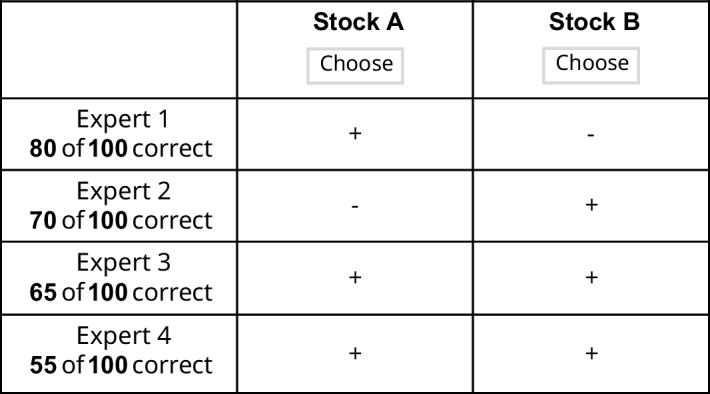 Figure 1
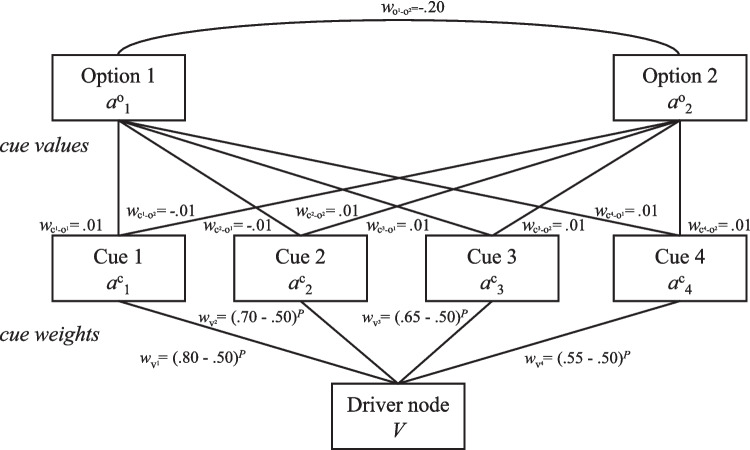 Figure 2
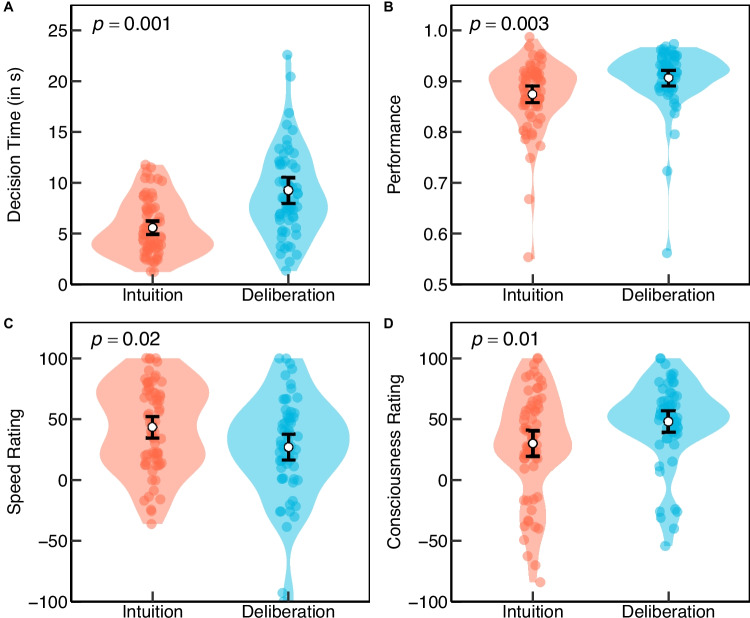 Figure 3
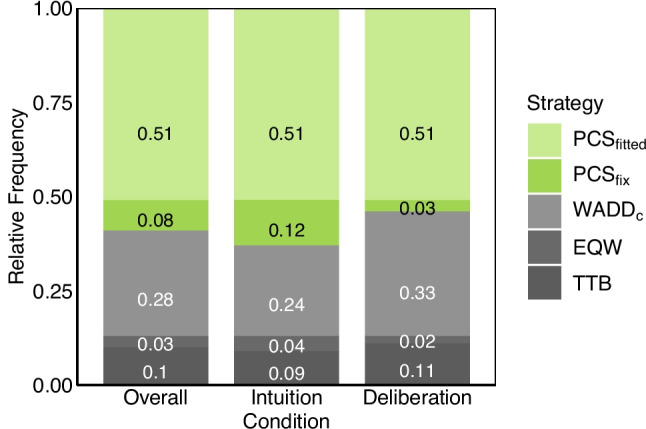 Figure 4
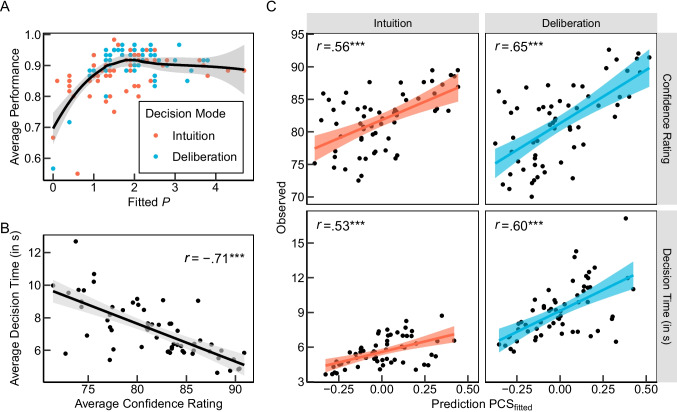 Figure 5
- —Universität Mannheim (3157)
Peer Reviews
No public reviews on file for this paper yet. If you reviewed it on a platform where reviews are public (OpenReview, ICLR, NeurIPS, ICML), you can paste yours below so the community can read it here.
Videos
No videos yet. Explain this paper in a talk, walkthrough, or lecture? Add one.
Taxonomy
TopicsDecision-Making and Behavioral Economics · Neural and Behavioral Psychology Studies · Behavioral Health and Interventions
In human thinking, some cognitive operations unfold quickly and effortlessly, while others require slow, effortful reflection. Popular dual-process theories explain these patterns by distinguishing between intuitive (or System 1) and deliberate (or System 2) processes or modes of thought (e.g., Evans, 2008; Evans & Stanovich, 2013; Sloman, 1996; Kahneman & Frederick, 2002). Although influential in areas such as reasoning, judgment, and decision-making, these models have sparked a debate about the cognitive processes that underlie intuitive and deliberate thinking and the extent to which they differ from each other (e.g., De Neys, 2021; Gawronski et al., 2014; Evans & Stanovich, 2013).Fig. 1. Example probabilistic inference task. A and B represent the two choice options. Experts (i.e., cues) provide dichotomous predictions (“+” = stock will perform well, “–” = stock will perform poorly). Cues are ordered by decreasing validity, which reflects how often each expert’s predictions were correct in the past (e.g., Expert 1 was correct in 80 out of 100 cases)
Defining intuition and deliberation solely by surface features such as speed or effort has been criticized as inadequate, as these features are not consistently observed, do not reliably co-occur, and reveal little about the underlying processes (Gawronski et al., 2014; De Neys, 2021; Melnikoff & Bargh, 2018). However, identifying the cognitive processes behind feature differences is complicated by the fact that they cannot be directly observed from the outside, and intuition is often defined by involving unconscious processes (Glöckner & Witteman, 2010), which limits access through verbalization or self-reporting.
A promising approach to translating dual-process theories into empirically testable hypotheses is the use of formalized cognitive models (Rumana, 2021; Glöckner, 2009). Such models specify precise, quantitative predictions for outcome measures such as judgments and decisions as well as process measures such as reaction times that can be compared across models and tested against empirically observable data (Marewski & Olsson, 2009; Guest & Martin, 2021). In the present study, we apply this modeling approach to assess whether the behavioral patterns observed under intuitive and deliberate conditions can be accounted for by adaptations within a common formalized mechanism, an integrated processes perspective (details below), or whether they are better captured by distinct models implying different underlying processes.
Task formats for which assumptions about intuitive and deliberate processing have been formalized within cognitive process models are therefore particularly well suited to test these competing perspectives. These include probabilistic inference tasks as shown in Fig. 1. In these tasks, participants judge which of two options is better on a not directly observable (distal) criterion based on probabilistic cue information (cue values) with a certain predictive validity (cue validity), such as expert predictions about stock performance (e.g., Glöckner et al., 2014, 2024; Newell & Shanks, 2003; Bröder, 2003). The open matrix format minimizes demands for information acquisition, allowing observation of behavior driven primarily by information integration processes.
Cognitive process models of probabilistic inferences
As a candidate for a common underlying mechanism, we focus on the Parallel Constraint Satisfaction (PCS) network model of decision-making (Glöckner & Betsch, 2008a; Glöckner et al., 2014). It formalizes decisions as a (partly) automatic process of spreading activation among nodes representing cues and choice options (for a description, see Fig. 2 and the Appendix B). The class of PCS models has been proposed as a general account of various classes of cognition (McClelland et al., 2014, 2010). While originally developed to implement coherence-based mechanisms of perception (McClelland & Rumelhart, 1981; Rumelhart & McClelland, 1982; but see also Rumelhart et al., 1986), they have also been very successful in accounting for other processes such as social cognition (Kunda & Thagard, 1996; Read & Miller, 2014) and decision-making (Glöckner & Betsch, 2008a; Holyoak & Simon, 1999). Empirically, PCS models have outperformed competing accounts in explaining intuitive decision-making behavior (e.g., Heck and Erdfelder, 2017; Glöckner et al., 2024), including adaptations to environmental structure (Glöckner et al., 2014) and information search patterns (Jekel et al., 2018). On a theoretical level, the model assumes that decisions rely on partially automatic and partially unconscious integration of information to overcome limits of conscious capacity (Glöckner & Betsch, 2008a, 2012, 2008b), consistent with evidence that people integrate cues in a weighted, compensatory manner rapidly and effortlessly (Glöckner et al., 2024; Hochman, 2024; Brusovansky et al., 2018; Bröder, 2003). This perspective challenges a strict dichotomy that links intuition exclusively to non-compensatory and deliberation to compensatory information integration (Hochman, 2024; Ayal et al., 2011; Glöckner & Hochman, 2011).Fig. 2. Network representation of the decision task from Fig. 1 in a PCS model. Connections between cue and option nodes, \documentclass[12pt]{minimal} \usepackage{amsmath} \usepackage{wasysym} \usepackage{amsfonts} \usepackage{amssymb} \usepackage{amsbsy} \usepackage{mathrsfs} \usepackage{upgreek} \setlength{\oddsidemargin}{-69pt} \begin{document}$$w_{c-o}$$\end{document} , are excitatory or inhibitory depending on cue values, and cue nodes receive input weighted by subjective cue validities from a driver node that maintains network activation. The connections \documentclass[12pt]{minimal} \usepackage{amsmath} \usepackage{wasysym} \usepackage{amsfonts} \usepackage{amssymb} \usepackage{amsbsy} \usepackage{mathrsfs} \usepackage{upgreek} \setlength{\oddsidemargin}{-69pt} \begin{document}$$w_{v_i}$$\end{document} represent cue validities corrected for chance level (.50 in the case of binary choices between two options) and adjusted by parameter P. Through iterative, parallel updating of activation of nodes, \documentclass[12pt]{minimal} \usepackage{amsmath} \usepackage{wasysym} \usepackage{amsfonts} \usepackage{amssymb} \usepackage{amsbsy} \usepackage{mathrsfs} \usepackage{upgreek} \setlength{\oddsidemargin}{-69pt} \begin{document}$$a^c$$\end{document} and \documentclass[12pt]{minimal} \usepackage{amsmath} \usepackage{wasysym} \usepackage{amsfonts} \usepackage{amssymb} \usepackage{amsbsy} \usepackage{mathrsfs} \usepackage{upgreek} \setlength{\oddsidemargin}{-69pt} \begin{document}$$a^o$$\end{document} , the network settles into a stable state of maximal coherence in which one option and its supporting evidence is favored. For a comprehensive description of the model, we refer to Glöckner and Betsch (2008a) and the Appendix B
In contrast, assuming a conscious, step-wise, rule-based information integration, according to the adaptive strategy selection view, limited cognitive resources encourage reliance on heuristics or rules of thumb that simplify the decision by ignoring information (Beach & Mitchell, 1978; Payne et al., 1988). Compensatory strategies in which positive and negative attributes are weighed so that strengths can offset weaknesses would therefore only be used for a few important slow decisions. In the present study, we include three formalized heuristics that differ in features relevant for investigating differences between intuitive and deliberative processing, namely in their complexity and degree of compensatory versus non-compensatory cue use (see also Glöckner et al., 2014; Glöckner et al., 2024; Pachur, 2022; Bröder, 2003; Glöckner and Hodges, 2011): the take-the-best heuristic (TTB), which bases decisions on the most valid discriminating cue (Gigerenzer & Goldstein, 1996); the equal weights strategy (EQW), which sums positive cues without weighting (Payne et al., 1988); and the weighted additive rule, which integrates cues by weighting them by change-corrected validity (WADD \documentclass[12pt]{minimal} \usepackage{amsmath} \usepackage{wasysym} \usepackage{amsfonts} \usepackage{amssymb} \usepackage{amsbsy} \usepackage{mathrsfs} \usepackage{upgreek} \setlength{\oddsidemargin}{-69pt} \begin{document}$$_{\text {c}}$$\end{document} ) (Payne et al., 1988; Jekel & Glöckner, 2018) (see Table 1 for a description of strategy predictions).Table 1. Strategy predictionsStrategyPrediction AbbreviationNameChoiceConfidenceTimeTTBTake-the-best or lexiographic ruleOption favored by the most valid differentiating cueValidity of the most valid differentiating cueNumber of elementary information processes requiredWADD \documentclass[12pt]{minimal} \usepackage{amsmath} \usepackage{wasysym} \usepackage{amsfonts} \usepackage{amssymb} \usepackage{amsbsy} \usepackage{mathrsfs} \usepackage{upgreek} \setlength{\oddsidemargin}{-69pt} \begin{document}$$_{\text {c}}$$\end{document} Weighted additive correctedOption with the highest chance-corrected weighted sum of cue valuesDifferences between chance-corrected weighted sums of cuesNumber of elementary information processes requiredEQWEqual weightOption with the highest unweighted sum of cue valuesDifference between unweighted sums of cuesNumber of elementary information processes requiredPCS \documentclass[12pt]{minimal} \usepackage{amsmath} \usepackage{wasysym} \usepackage{amsfonts} \usepackage{amssymb} \usepackage{amsbsy} \usepackage{mathrsfs} \usepackage{upgreek} \setlength{\oddsidemargin}{-69pt} \begin{document}$$_{\text {fix}}$$\end{document} Parallel Constraint Satisfaction network model of decision-making with fixed parameter P = 1.9 and deterministic choicesOption with the highest final node activation of the option nodeAbsolute difference in the final activation between the option nodesNumber of iterations until convergencePCS \documentclass[12pt]{minimal} \usepackage{amsmath} \usepackage{wasysym} \usepackage{amsfonts} \usepackage{amssymb} \usepackage{amsbsy} \usepackage{mathrsfs} \usepackage{upgreek} \setlength{\oddsidemargin}{-69pt} \begin{document}$$_{\text {fitted}}$$\end{document} Parallel Constraint Satisfaction network model of decision-making with per person fitted parameters P and \documentclass[12pt]{minimal} \usepackage{amsmath} \usepackage{wasysym} \usepackage{amsfonts} \usepackage{amssymb} \usepackage{amsbsy} \usepackage{mathrsfs} \usepackage{upgreek} \setlength{\oddsidemargin}{-69pt} \begin{document}$$\lambda $$\end{document} Option with the highest final activation of the option node, with determinacy governed by parameter \documentclass[12pt]{minimal} \usepackage{amsmath} \usepackage{wasysym} \usepackage{amsfonts} \usepackage{amssymb} \usepackage{amsbsy} \usepackage{mathrsfs} \usepackage{upgreek} \setlength{\oddsidemargin}{-69pt} \begin{document}$$\lambda $$\end{document} Absolute difference in the final activation between the option nodesNumber of iterations until convergence
Comparability of intuitive and deliberate processes
Previous findings on probabilistic inferences do not allow conclusions to be drawn about the comparability of intuitive and deliberate decisions, as participants were usually instructed to respond quickly (e.g., Ayal & Hochman, 2009; Glöckner et al., 2024, 2014) or faced strict time limits (e.g., Brusovansky et al., 2018; Glöckner & Betsch, 2008b). Using an instruction to respond quickly facilitates interpretable response times (Fazio, 1990) but has also been proposed as a method to induce an intuitive processing mode (for reviews, see Horstmann et al., 2010; Isler & Yilmaz, 2022). According to the PCS model, the process of coherence maximization is always activated first but runs continuously and independently of the decision mode, while deliberate activity primarily monitors and adjusts the informational basis (i.e., the network structure) and supports the achievement of an acceptable level of coherence without changing the actual process directly (Glöckner & Betsch, 2008a). This represents an integrated processes view, according to which intuitive and deliberate decisions do not rely on entirely distinct processes but changes in the parameters of a single cognitive process (e.g., Glöckner & Betsch, 2008a; De Neys, 2023). In contrast, theories with a distinct processes view predict systematic shifts in strategy use under the instruction to deliberate, with more people relying on stepwise, rule-based processing (e.g., Sloman 1996; 2002; Petty & Cacioppo 1986; see Evans 2008, for a review). Initial support for the integrated processes view comes from eye-tracking evidence that shows that deliberation instructions, unlike instructions to apply rule-based calculations of weighted sums in line with a WADD strategy, do not qualitatively alter fixation duration patterns but primarily increase double-checking (Horstmann et al., 2009).
Overview and research aim
In the present study, we employ a cognitive modeling approach to critically test competing predictions of the integrated and distinct processes view for intuitive and deliberate processing. Specifically, we examine (a) whether the distribution of strategies assigned to participants based on their choices, decision times, and confidence ratings differs between more intuitive versus more deliberate decision modes, and (b) whether existing models vary in their ability to capture the underlying decision processes across these modes. According to PCS representing the integrated processes view, the predictive accuracy of the PCS model should remain stable or even improve under deliberation, since deliberation efforts might be driven by the same factor (i.e., coherence) that has been shown to drive response time and confidence in intuitive decision-making (Glcökner & Betsch, 2012; see also Lee & Holyoak, 2021). Moreover, consistent with default-interventionist models (Evans, 2008), with deliberation more choices should align with a rational solution. This is due to the fact that the open matrix format used in the current study allows generating a mental (network) representation of the task that accurately represents the task structure, and deliberation can help to rule out remaining misinterpretations or mistakes (Glöckner & Betsch, 2008a). The rational solution in this case is a naïve Bayesian solution based on posterior probabilities assuming cue independence and equal priors (Lee & Cummins, 2004). By contrast, if intuitive and deliberate decisions rely on distinct processes, deliberation should promote shifts toward serial, rule-based, conscious heuristics, thereby reducing the fit of models grounded in parallel, (partially) automatic processing such as the PCS (Horstmann et al., 2009).
To test these predictions, we compare PCS and serial heuristics in accounting for decision behavior by deriving predictions not only for choices but also decision times, and confidence ratings (see Table 1). Unlike serial heuristics, PCS predicts decision times based on the time required to construct a coherent representation of information rather than the amount of integrated cue information, with additional information sometimes even speeding up decisions if it increases initial information coherence (Glöckner & Betsch, 2008a; Glöckner et al., 2014). Confidence is predicted from differences in option activations once a coherent solution is reached via bidirectional, parallel activation updating, whereas serial heuristics derive confidence from differences in support based on serial, unidirectional cue integration. Testing these predictions in a multi-measure approach allows differentiation between models and conditions that do not elicit unique choice responses, such as deliberate vs. intuitive processes (De Neys, 2023) or process models for probabilistic inferences (Glöckner, 2009; Jekel et al., 2010; Hilbig et al., 2010). It is sufficient if models differ in their predictions for process or other outcome variables. These variables impose additional constraints for more critical testing and efficient model refinement (Johnson et al., 2008; Jarecki et al., 2020).
Method
The experiment was preregistered at the Open Science Framework (https://doi.org/10.17605/OSF.IO/D8BKZ). Hypotheses, data, experiment materials, and analysis code are available at the OSF project site (doi.org/10.17605/OSF.IO/7Q8MB).
Design and manipulation
We used a 2 (DECISION MODE: Intuition vs. Deliberation) x 60 (TASK VERSION) design with TASK VERSION as a within-subjects factor. Decision mode was manipulated between participants. For this, we randomly assigned participants to two conditions (intuitive vs. deliberate) and varied instructions between these groups. In both conditions, participants were instructed to repeatedly choose the better of two options and to make good decisions (e.g., Glöckner et al., 2014). In the intuitive decision condition, participants were additionally asked to decide intuitively, spontaneously, and as quickly as possible. In contrast, in the deliberate condition, participants were asked to make conscious and reflected decisions and to take their time (original instructions in Appendix A). While a variety of experimental manipulations have been used to elicit intuitive versus deliberative decision-making modes (for overviews, see Horstmann et al., 2010; Isler & Yilmaz, 2022), the present approach is well established (e.g., Raoelison et al., 2021; Beauvais et al., 2025). It aims to accentuate process characteristics commonly linked to intuition and deliberation (Evans, 2008). It furthermore avoids the instruction of specific cognitive strategies, such as calculating weighted sums, or interference with parallel, partially unconscious processes through procedures like the loud verbalization of the decision-making process. In addition, the manipulation avoids confounds associated with alternative methods, such as emotion induction. Finally, no strict response deadlines are specified, preserving decision time as a dependent variable and allowing behavioral measures (choices, decision times, and confidence) to test model-based assumptions about cognitive processes as they occur without the imposition of specific strategies. To prevent regression to the mean (participants settling into less distinct modes over the course of the experiment), participants were reminded of these instructions in two breaks after every 20 trials.
Participants
An a priori power analysis using a bootstrapping resampling method as well as G*Power (Faul et al., 2009) revealed a required total sample size of 128 participants to reach a power of at least \documentclass[12pt]{minimal} \usepackage{amsmath} \usepackage{wasysym} \usepackage{amsfonts} \usepackage{amssymb} \usepackage{amsbsy} \usepackage{mathrsfs} \usepackage{upgreek} \setlength{\oddsidemargin}{-69pt} \begin{document}$$1-\beta =.80$$\end{document} for each main hypothesis with \documentclass[12pt]{minimal} \usepackage{amsmath} \usepackage{wasysym} \usepackage{amsfonts} \usepackage{amssymb} \usepackage{amsbsy} \usepackage{mathrsfs} \usepackage{upgreek} \setlength{\oddsidemargin}{-69pt} \begin{document}$$\alpha =.05$$\end{document} . A detailed description of the power analysis can be found in the Appendix D. Anticipating online experiment challenges such as participant exclusions, we collected 10% more than the required sample size and aimed for a total sample size of \documentclass[12pt]{minimal} \usepackage{amsmath} \usepackage{wasysym} \usepackage{amsfonts} \usepackage{amssymb} \usepackage{amsbsy} \usepackage{mathrsfs} \usepackage{upgreek} \setlength{\oddsidemargin}{-69pt} \begin{document}$$N = 140$$\end{document} participants. Correspondingly, we recruited a sample of N = 140 participants, of which N = 128 (81 female, 43 male, four other) with a mean age of 28.61 (SD = 10.20) fulfilled the criteria for inclusion. Participants were recruited from the Decision Lab Cologne participant pool and university mailing lists. The data collection was stopped after N = 140 complete data sets had been obtained. We only included complete data sets that allowed us to test our hypotheses. Additionally, persons who cancelled the task and then restarted it ( \documentclass[12pt]{minimal} \usepackage{amsmath} \usepackage{wasysym} \usepackage{amsfonts} \usepackage{amssymb} \usepackage{amsbsy} \usepackage{mathrsfs} \usepackage{upgreek} \setlength{\oddsidemargin}{-69pt} \begin{document}$$n = 6$$\end{document} ) were excluded. As preregistered, we excluded participants who solved less than 55% of the tasks in accordance with the naive Bayesian solution ( \documentclass[12pt]{minimal} \usepackage{amsmath} \usepackage{wasysym} \usepackage{amsfonts} \usepackage{amssymb} \usepackage{amsbsy} \usepackage{mathrsfs} \usepackage{upgreek} \setlength{\oddsidemargin}{-69pt} \begin{document}$$n = 3$$\end{document} ), assuming they did not conduct the study seriously, as well as people who indicated that they had not answered seriously ( \documentclass[12pt]{minimal} \usepackage{amsmath} \usepackage{wasysym} \usepackage{amsfonts} \usepackage{amssymb} \usepackage{amsbsy} \usepackage{mathrsfs} \usepackage{upgreek} \setlength{\oddsidemargin}{-69pt} \begin{document}$$n = 3$$\end{document} )1. These exclusions apply to all subsequent analyses. For the analysis of reaction times, we excluded trials with response times longer than 60 s, as well as data points exceeding three standard deviations from the grand mean across all participants, as preregistered (61 trials in total). The randomized assignment of participants to the two conditions and the participant exclusions resulted in 67 participants in the Intuition group and 61 participants in the Deliberation group.
The experiment lasted approximately 20 min. Participants from the participant pool were financially rewarded with a basic payment and a performance-dependent bonus. The other participants could receive course credit and take part in a lottery for a performance-dependent financial reward. All participants provided informed consent. Ethics approval was obtained from the German Association for Experimental Economic Research (Number FaGdgmFw, https://gfew.de/ethik/FaGdgmFw).
Materials and procedure
The experiment was computer-based and conducted online. The participants were informed that they were taking part in a decision experiment. To ensure statistical power and data reliability, the experiment comprised 60 multi-cue probabilistic inference tasks. For this, 60 different combinations of cue patterns and cue validities were randomly generated (excluding dominated choices and duplicates). This avoidance of task repetition ensured that memory effects did not bias behavior toward fast, associative processing (e.g., activating the option previously selected in the same task), but left room for other strategies to operate. Adapted from previous research, the basic paradigm was a hypothetical stock market game (Bröder, 2003; Glöckner et al., 2014; Newell & Shanks, 2003). In this task, participants decided between two stocks (options) based on evaluations from four independent experts (cues) for which cue validities (predictive accuracies) were explicitly provided in an information matrix (see Fig. 1 and Table 2). The open matrix format minimizes the influence of information acquisition, such as reading additional information, and thus allows focusing on processes of information integration. Each matrix contained eight pieces of information (cue values) in the form of symbols indicating whether a good ("+") or bad ("-") performance is predicted for the respective stock in the coming month. Cue validity, presented as the proportion of 100 previous predictions of that expert that have come true, varied between the four experts and was presented below each cue label. Cues were sorted in descending order, with the most valid cue in the top row. To prevent influences of prior knowledge activated from memory (Dorrough et al., 2017), the options were labeled with “Stock A” and “Stock B” and the cues with “Expert 1” to “Expert 4”. Each probabilistic inference task was followed by an assessment of decision confidence, which was measured on a scale from very uncertain (50; i.e., random) to very certain (100; i.e., certain) using a horizontal slider. The 60 task versions were presented in randomized order and separated by two short breaks of self-paced duration after every 20 trials. All tasks were self-paced.Table 2. Three examples out of 60 task versions used in the experimentTask 1Task 2Task 3 Cue \documentclass[12pt]{minimal} \usepackage{amsmath} \usepackage{wasysym} \usepackage{amsfonts} \usepackage{amssymb} \usepackage{amsbsy} \usepackage{mathrsfs} \usepackage{upgreek} \setlength{\oddsidemargin}{-69pt} \begin{document}$$v_i$$\end{document} AB \documentclass[12pt]{minimal} \usepackage{amsmath} \usepackage{wasysym} \usepackage{amsfonts} \usepackage{amssymb} \usepackage{amsbsy} \usepackage{mathrsfs} \usepackage{upgreek} \setlength{\oddsidemargin}{-69pt} \begin{document}$$v_i$$\end{document} AB \documentclass[12pt]{minimal} \usepackage{amsmath} \usepackage{wasysym} \usepackage{amsfonts} \usepackage{amssymb} \usepackage{amsbsy} \usepackage{mathrsfs} \usepackage{upgreek} \setlength{\oddsidemargin}{-69pt} \begin{document}$$v_i$$\end{document} AB1.87++.94++.77++2.87+–.79–+.74+–3.76–+.73+–.68–+4.60–+.63+–.63++Note. A and B represent the two choice options, with A defined as the option that has the higher posterior probability according to the naïve Bayesian solution, and \documentclass[12pt]{minimal} \usepackage{amsmath} \usepackage{wasysym} \usepackage{amsfonts} \usepackage{amssymb} \usepackage{amsbsy} \usepackage{mathrsfs} \usepackage{upgreek} \setlength{\oddsidemargin}{-69pt} \begin{document}$$v_i$$\end{document} denoting the validity of the respective cue. While the order in which the options were presented was randomized across trials, the labels “A” and “B” were always fixed to the left and right positions on the screen. This procedure ensured that the labels themselves did not provide information about which option was normatively superior
After the decision task, participants answered demographic questions and a questionnaire containing open and closed questions on the use of decision-making strategies in the previous task (see Appendix C). The study ended with a prompt asking participants to describe their strategy by moving several sliders to the right or left, with the ends labeled with opposite features typically associated with an intuitive or deliberate mode, derived from Evans (2008).
Strategy predictions and classification
Choices, decision time, and confidence were predicted for all 60 probabilistic inference tasks given all considered strategies (PCS \documentclass[12pt]{minimal} \usepackage{amsmath} \usepackage{wasysym} \usepackage{amsfonts} \usepackage{amssymb} \usepackage{amsbsy} \usepackage{mathrsfs} \usepackage{upgreek} \setlength{\oddsidemargin}{-69pt} \begin{document}$$_{\text {fix}}$$\end{document} , PCS \documentclass[12pt]{minimal} \usepackage{amsmath} \usepackage{wasysym} \usepackage{amsfonts} \usepackage{amssymb} \usepackage{amsbsy} \usepackage{mathrsfs} \usepackage{upgreek} \setlength{\oddsidemargin}{-69pt} \begin{document}$$_{\text {fitted}}$$\end{document} , WADD \documentclass[12pt]{minimal} \usepackage{amsmath} \usepackage{wasysym} \usepackage{amsfonts} \usepackage{amssymb} \usepackage{amsbsy} \usepackage{mathrsfs} \usepackage{upgreek} \setlength{\oddsidemargin}{-69pt} \begin{document}$$_{\text {c}}$$\end{document} , EQW, TTB). The approaches to derive the strategies’ predictions are explained in Table 1 and a further description of the strategies is provided in Appendices B and F.
In a fitted model version, PCS \documentclass[12pt]{minimal} \usepackage{amsmath} \usepackage{wasysym} \usepackage{amsfonts} \usepackage{amssymb} \usepackage{amsbsy} \usepackage{mathrsfs} \usepackage{upgreek} \setlength{\oddsidemargin}{-69pt} \begin{document}$$_{\text {fitted}}$$\end{document} contains up to two free person parameters. The sensitivity parameter P directly determines whether decisions are more compensatory ( \documentclass[12pt]{minimal} \usepackage{amsmath} \usepackage{wasysym} \usepackage{amsfonts} \usepackage{amssymb} \usepackage{amsbsy} \usepackage{mathrsfs} \usepackage{upgreek} \setlength{\oddsidemargin}{-69pt} \begin{document}$$P < 1$$\end{document} ) or more non-compensatory with a higher sensitivity to differences in cue validities ( \documentclass[12pt]{minimal} \usepackage{amsmath} \usepackage{wasysym} \usepackage{amsfonts} \usepackage{amssymb} \usepackage{amsbsy} \usepackage{mathrsfs} \usepackage{upgreek} \setlength{\oddsidemargin}{-69pt} \begin{document}$$P > 1$$\end{document} ) relative to a model that linearly weights cue validities ( \documentclass[12pt]{minimal} \usepackage{amsmath} \usepackage{wasysym} \usepackage{amsfonts} \usepackage{amssymb} \usepackage{amsbsy} \usepackage{mathrsfs} \usepackage{upgreek} \setlength{\oddsidemargin}{-69pt} \begin{document}$$P = 1$$\end{document} ). A second free parameter, the determinism parameter \documentclass[12pt]{minimal} \usepackage{amsmath} \usepackage{wasysym} \usepackage{amsfonts} \usepackage{amssymb} \usepackage{amsbsy} \usepackage{mathrsfs} \usepackage{upgreek} \setlength{\oddsidemargin}{-69pt} \begin{document}$$\lambda $$\end{document} , is relevant if a probabilistic version of the model is applied. Here, the predicted probability of choosing the preferred option for a given choice pattern follows a logistic choice function, with \documentclass[12pt]{minimal} \usepackage{amsmath} \usepackage{wasysym} \usepackage{amsfonts} \usepackage{amssymb} \usepackage{amsbsy} \usepackage{mathrsfs} \usepackage{upgreek} \setlength{\oddsidemargin}{-69pt} \begin{document}$$\lambda $$\end{document} determining the steepness of the function. For fitting these parameters, a grid-search fitting procedure was used to estimate the sensitivity parameter P in [0, 5]2 and the determinism parameter \documentclass[12pt]{minimal} \usepackage{amsmath} \usepackage{wasysym} \usepackage{amsfonts} \usepackage{amssymb} \usepackage{amsbsy} \usepackage{mathrsfs} \usepackage{upgreek} \setlength{\oddsidemargin}{-69pt} \begin{document}$$\lambda $$\end{document} in [0, 5] in steps of 0.1 to find the combination of parameter values that maximized the multiple-measure maximum log-likelihood of the observed data for each participant (Glöckner et al., 2014). Strategy predictions for choices, decision time, and decision confidence were then derived for the 60 different cue patterns according to the procedures described in Table 1 and transformed into contrast weights that add up to zero and have a range of one.
To determine the strategy that maximizes the likelihood of a participant’s data, we conducted a model classification with the multiple-measure maximum likelihood estimation method (MM-ML, Glöckner, 2009; Jekel et al., 2010). We calculated the maximum log-likelihood of observing the participants’ overall data vector, which includes their choices, decision times, and confidence ratings, given each potential strategy. Participants were then assigned to the strategy that yielded the smallest Bayesian information criterion (BIC) score, which penalizes strategies with a higher number of free model parameters (for a detailed description, see Glöckner et al., 2014). The inclusion of decision times and confidence judgments in the simultaneous MM-ML estimation allows differentiating between models that generate similar choice patterns but differ in their process predictions (Glöckner, 2009).
Statistical analyses were performed using R 4.3.2 (R Core Team, 2024), the lme4 (Bates et al., 2014), the lmerTest (Kuznetsova et al., 2017), and the glmmTMB (Brooks et al., 2017; McGillycuddy et al., 2025) packages. The significance level alpha was set at \documentclass[12pt]{minimal} \usepackage{amsmath} \usepackage{wasysym} \usepackage{amsfonts} \usepackage{amssymb} \usepackage{amsbsy} \usepackage{mathrsfs} \usepackage{upgreek} \setlength{\oddsidemargin}{-69pt} \begin{document}$$\alpha =.05$$\end{document} . For all exploratory analyses, \documentclass[12pt]{minimal} \usepackage{amsmath} \usepackage{wasysym} \usepackage{amsfonts} \usepackage{amssymb} \usepackage{amsbsy} \usepackage{mathrsfs} \usepackage{upgreek} \setlength{\oddsidemargin}{-69pt} \begin{document}$$\alpha $$\end{document} was Bonferroni corrected with the number of exploratory tests (28) to \documentclass[12pt]{minimal} \usepackage{amsmath} \usepackage{wasysym} \usepackage{amsfonts} \usepackage{amssymb} \usepackage{amsbsy} \usepackage{mathrsfs} \usepackage{upgreek} \setlength{\oddsidemargin}{-69pt} \begin{document}$$\alpha =.0018$$\end{document} . As in previous studies, decision times were ln-transformed and order effects were partialed out to reduce skewness and the influence of outliers (Glöckner et al., 2014).Fig. 3. Behavioral and self-report differences between intuitive and deliberate decision modes. Decision time (A), performance (i.e., choices in line with the rational solution) (B), and self-report ratings concerning speed (C) and consciousness (D) of the applied decision strategy were averaged across trials for each participant. Error bars represent 95% confidence intervals of the mean
Results
The manipulation of decision mode was effective, as indicated by both behavioral and subjective measures (Fig. 3). Participants in the deliberate condition exhibited significantly longer decision times ( \documentclass[12pt]{minimal} \usepackage{amsmath} \usepackage{wasysym} \usepackage{amsfonts} \usepackage{amssymb} \usepackage{amsbsy} \usepackage{mathrsfs} \usepackage{upgreek} \setlength{\oddsidemargin}{-69pt} \begin{document}$$M = 9241$$\end{document} ms, \documentclass[12pt]{minimal} \usepackage{amsmath} \usepackage{wasysym} \usepackage{amsfonts} \usepackage{amssymb} \usepackage{amsbsy} \usepackage{mathrsfs} \usepackage{upgreek} \setlength{\oddsidemargin}{-69pt} \begin{document}$$SD = 4917$$\end{document} ms) than those in the intuitive condition ( \documentclass[12pt]{minimal} \usepackage{amsmath} \usepackage{wasysym} \usepackage{amsfonts} \usepackage{amssymb} \usepackage{amsbsy} \usepackage{mathrsfs} \usepackage{upgreek} \setlength{\oddsidemargin}{-69pt} \begin{document}$$M = 5583$$\end{document} ms, \documentclass[12pt]{minimal} \usepackage{amsmath} \usepackage{wasysym} \usepackage{amsfonts} \usepackage{amssymb} \usepackage{amsbsy} \usepackage{mathrsfs} \usepackage{upgreek} \setlength{\oddsidemargin}{-69pt} \begin{document}$$SD = 2694$$\end{document} ms), \documentclass[12pt]{minimal} \usepackage{amsmath} \usepackage{wasysym} \usepackage{amsfonts} \usepackage{amssymb} \usepackage{amsbsy} \usepackage{mathrsfs} \usepackage{upgreek} \setlength{\oddsidemargin}{-69pt} \begin{document}$$t(123.52) = 4.79$$\end{document} , \documentclass[12pt]{minimal} \usepackage{amsmath} \usepackage{wasysym} \usepackage{amsfonts} \usepackage{amssymb} \usepackage{amsbsy} \usepackage{mathrsfs} \usepackage{upgreek} \setlength{\oddsidemargin}{-69pt} \begin{document}$$p <.001$$\end{document} , \documentclass[12pt]{minimal} \usepackage{amsmath} \usepackage{wasysym} \usepackage{amsfonts} \usepackage{amssymb} \usepackage{amsbsy} \usepackage{mathrsfs} \usepackage{upgreek} \setlength{\oddsidemargin}{-69pt} \begin{document}$$d = 0.85$$\end{document} 3. They also rated their strategy as more conscious ( \documentclass[12pt]{minimal} \usepackage{amsmath} \usepackage{wasysym} \usepackage{amsfonts} \usepackage{amssymb} \usepackage{amsbsy} \usepackage{mathrsfs} \usepackage{upgreek} \setlength{\oddsidemargin}{-69pt} \begin{document}$$M = 47.85$$\end{document} , \documentclass[12pt]{minimal} \usepackage{amsmath} \usepackage{wasysym} \usepackage{amsfonts} \usepackage{amssymb} \usepackage{amsbsy} \usepackage{mathrsfs} \usepackage{upgreek} \setlength{\oddsidemargin}{-69pt} \begin{document}$$SD = 33.83$$\end{document} vs. \documentclass[12pt]{minimal} \usepackage{amsmath} \usepackage{wasysym} \usepackage{amsfonts} \usepackage{amssymb} \usepackage{amsbsy} \usepackage{mathrsfs} \usepackage{upgreek} \setlength{\oddsidemargin}{-69pt} \begin{document}$$M = 30.07$$\end{document} , \documentclass[12pt]{minimal} \usepackage{amsmath} \usepackage{wasysym} \usepackage{amsfonts} \usepackage{amssymb} \usepackage{amsbsy} \usepackage{mathrsfs} \usepackage{upgreek} \setlength{\oddsidemargin}{-69pt} \begin{document}$$SD = 43.22$$\end{document} ), \documentclass[12pt]{minimal} \usepackage{amsmath} \usepackage{wasysym} \usepackage{amsfonts} \usepackage{amssymb} \usepackage{amsbsy} \usepackage{mathrsfs} \usepackage{upgreek} \setlength{\oddsidemargin}{-69pt} \begin{document}$$t(123.30) = 2.60$$\end{document} , \documentclass[12pt]{minimal} \usepackage{amsmath} \usepackage{wasysym} \usepackage{amsfonts} \usepackage{amssymb} \usepackage{amsbsy} \usepackage{mathrsfs} \usepackage{upgreek} \setlength{\oddsidemargin}{-69pt} \begin{document}$$p =.010$$\end{document} , \documentclass[12pt]{minimal} \usepackage{amsmath} \usepackage{wasysym} \usepackage{amsfonts} \usepackage{amssymb} \usepackage{amsbsy} \usepackage{mathrsfs} \usepackage{upgreek} \setlength{\oddsidemargin}{-69pt} \begin{document}$$d = 0.46$$\end{document} , and less fast ( \documentclass[12pt]{minimal} \usepackage{amsmath} \usepackage{wasysym} \usepackage{amsfonts} \usepackage{amssymb} \usepackage{amsbsy} \usepackage{mathrsfs} \usepackage{upgreek} \setlength{\oddsidemargin}{-69pt} \begin{document}$$M = 27.16$$\end{document} , \documentclass[12pt]{minimal} \usepackage{amsmath} \usepackage{wasysym} \usepackage{amsfonts} \usepackage{amssymb} \usepackage{amsbsy} \usepackage{mathrsfs} \usepackage{upgreek} \setlength{\oddsidemargin}{-69pt} \begin{document}$$SD = 40.94$$\end{document} vs. \documentclass[12pt]{minimal} \usepackage{amsmath} \usepackage{wasysym} \usepackage{amsfonts} \usepackage{amssymb} \usepackage{amsbsy} \usepackage{mathrsfs} \usepackage{upgreek} \setlength{\oddsidemargin}{-69pt} \begin{document}$$M = 43.31$$\end{document} , \documentclass[12pt]{minimal} \usepackage{amsmath} \usepackage{wasysym} \usepackage{amsfonts} \usepackage{amssymb} \usepackage{amsbsy} \usepackage{mathrsfs} \usepackage{upgreek} \setlength{\oddsidemargin}{-69pt} \begin{document}$$SD = 35.86$$\end{document} ), \documentclass[12pt]{minimal} \usepackage{amsmath} \usepackage{wasysym} \usepackage{amsfonts} \usepackage{amssymb} \usepackage{amsbsy} \usepackage{mathrsfs} \usepackage{upgreek} \setlength{\oddsidemargin}{-69pt} \begin{document}$$t(119.90) = 2.36$$\end{document} , \documentclass[12pt]{minimal} \usepackage{amsmath} \usepackage{wasysym} \usepackage{amsfonts} \usepackage{amssymb} \usepackage{amsbsy} \usepackage{mathrsfs} \usepackage{upgreek} \setlength{\oddsidemargin}{-69pt} \begin{document}$$p =.020$$\end{document} , \documentclass[12pt]{minimal} \usepackage{amsmath} \usepackage{wasysym} \usepackage{amsfonts} \usepackage{amssymb} \usepackage{amsbsy} \usepackage{mathrsfs} \usepackage{upgreek} \setlength{\oddsidemargin}{-69pt} \begin{document}$$d = 0.42$$\end{document} . Participants demonstrated the ability to solve the task with an average rate of 88.92 % correct decisions in accordance with the naïve Bayesian solution. As hypothesized, performance was significantly enhanced in the deliberate decision condition ( \documentclass[12pt]{minimal} \usepackage{amsmath} \usepackage{wasysym} \usepackage{amsfonts} \usepackage{amssymb} \usepackage{amsbsy} \usepackage{mathrsfs} \usepackage{upgreek} \setlength{\oddsidemargin}{-69pt} \begin{document}$$M = 0.91$$\end{document} , \documentclass[12pt]{minimal} \usepackage{amsmath} \usepackage{wasysym} \usepackage{amsfonts} \usepackage{amssymb} \usepackage{amsbsy} \usepackage{mathrsfs} \usepackage{upgreek} \setlength{\oddsidemargin}{-69pt} \begin{document}$$SD = 0.06$$\end{document} ) compared to the intuitive decision mode ( \documentclass[12pt]{minimal} \usepackage{amsmath} \usepackage{wasysym} \usepackage{amsfonts} \usepackage{amssymb} \usepackage{amsbsy} \usepackage{mathrsfs} \usepackage{upgreek} \setlength{\oddsidemargin}{-69pt} \begin{document}$$M = 0.87$$\end{document} , \documentclass[12pt]{minimal} \usepackage{amsmath} \usepackage{wasysym} \usepackage{amsfonts} \usepackage{amssymb} \usepackage{amsbsy} \usepackage{mathrsfs} \usepackage{upgreek} \setlength{\oddsidemargin}{-69pt} \begin{document}$$SD = 0.07$$\end{document} ), \documentclass[12pt]{minimal} \usepackage{amsmath} \usepackage{wasysym} \usepackage{amsfonts} \usepackage{amssymb} \usepackage{amsbsy} \usepackage{mathrsfs} \usepackage{upgreek} \setlength{\oddsidemargin}{-69pt} \begin{document}$$t(125.99) = 2.84$$\end{document} , \documentclass[12pt]{minimal} \usepackage{amsmath} \usepackage{wasysym} \usepackage{amsfonts} \usepackage{amssymb} \usepackage{amsbsy} \usepackage{mathrsfs} \usepackage{upgreek} \setlength{\oddsidemargin}{-69pt} \begin{document}$$p =.003$$\end{document} , \documentclass[12pt]{minimal} \usepackage{amsmath} \usepackage{wasysym} \usepackage{amsfonts} \usepackage{amssymb} \usepackage{amsbsy} \usepackage{mathrsfs} \usepackage{upgreek} \setlength{\oddsidemargin}{-69pt} \begin{document}$$d = 0.50$$\end{document} .
Contrary to the hypothesized shift towards more serial strategies under the distinct processes view, choice adherence to PCS \documentclass[12pt]{minimal} \usepackage{amsmath} \usepackage{wasysym} \usepackage{amsfonts} \usepackage{amssymb} \usepackage{amsbsy} \usepackage{mathrsfs} \usepackage{upgreek} \setlength{\oddsidemargin}{-69pt} \begin{document}$$_{\text {fitted}}$$\end{document} , defined as the proportion of choices aligning with strategy predictions averaged across participants, was significantly higher in the deliberate condition ( \documentclass[12pt]{minimal} \usepackage{amsmath} \usepackage{wasysym} \usepackage{amsfonts} \usepackage{amssymb} \usepackage{amsbsy} \usepackage{mathrsfs} \usepackage{upgreek} \setlength{\oddsidemargin}{-69pt} \begin{document}$$M = 0.95$$\end{document} , \documentclass[12pt]{minimal} \usepackage{amsmath} \usepackage{wasysym} \usepackage{amsfonts} \usepackage{amssymb} \usepackage{amsbsy} \usepackage{mathrsfs} \usepackage{upgreek} \setlength{\oddsidemargin}{-69pt} \begin{document}$$SD = 0.04$$\end{document} ) compared to the intuitive condition ( \documentclass[12pt]{minimal} \usepackage{amsmath} \usepackage{wasysym} \usepackage{amsfonts} \usepackage{amssymb} \usepackage{amsbsy} \usepackage{mathrsfs} \usepackage{upgreek} \setlength{\oddsidemargin}{-69pt} \begin{document}$$M = 0.91$$\end{document} , \documentclass[12pt]{minimal} \usepackage{amsmath} \usepackage{wasysym} \usepackage{amsfonts} \usepackage{amssymb} \usepackage{amsbsy} \usepackage{mathrsfs} \usepackage{upgreek} \setlength{\oddsidemargin}{-69pt} \begin{document}$$SD = 0.13$$\end{document} ), as determined by a non-parametric Mann–Whitney U test ( \documentclass[12pt]{minimal} \usepackage{amsmath} \usepackage{wasysym} \usepackage{amsfonts} \usepackage{amssymb} \usepackage{amsbsy} \usepackage{mathrsfs} \usepackage{upgreek} \setlength{\oddsidemargin}{-69pt} \begin{document}$$W = 1569$$\end{document} , \documentclass[12pt]{minimal} \usepackage{amsmath} \usepackage{wasysym} \usepackage{amsfonts} \usepackage{amssymb} \usepackage{amsbsy} \usepackage{mathrsfs} \usepackage{upgreek} \setlength{\oddsidemargin}{-69pt} \begin{document}$$p =.022$$\end{document} ).Table 3. Choice adherence ratesPCS Model VersionsHeuristics ConditionNPCS \documentclass[12pt]{minimal} \usepackage{amsmath} \usepackage{wasysym} \usepackage{amsfonts} \usepackage{amssymb} \usepackage{amsbsy} \usepackage{mathrsfs} \usepackage{upgreek} \setlength{\oddsidemargin}{-69pt} \begin{document}$$_{\text {fitted}}$$\end{document} PCS \documentclass[12pt]{minimal} \usepackage{amsmath} \usepackage{wasysym} \usepackage{amsfonts} \usepackage{amssymb} \usepackage{amsbsy} \usepackage{mathrsfs} \usepackage{upgreek} \setlength{\oddsidemargin}{-69pt} \begin{document}$$_{\text {fix}}$$\end{document} WADD \documentclass[12pt]{minimal} \usepackage{amsmath} \usepackage{wasysym} \usepackage{amsfonts} \usepackage{amssymb} \usepackage{amsbsy} \usepackage{mathrsfs} \usepackage{upgreek} \setlength{\oddsidemargin}{-69pt} \begin{document}$$_{\text {c}}$$\end{document} EQWTTBIntuition67.91 (.004).87 (.005).88 (.005).82 (.008).85 (.006)Deliberation61.95 (.004).90 (.005).91 (.005).80 (.008).89 (.005)Overall128.93 (.003).89 (.004).89 (.004).81 (.006).87 (.004)Note. SEs are in parentheses. For WADD \documentclass[12pt]{minimal} \usepackage{amsmath} \usepackage{wasysym} \usepackage{amsfonts} \usepackage{amssymb} \usepackage{amsbsy} \usepackage{mathrsfs} \usepackage{upgreek} \setlength{\oddsidemargin}{-69pt} \begin{document}$$_{\text {c}}$$\end{document} and EQW, the cue patterns for which random choice was predicted were excluded
A joint analysis of choices, confidence ratings, and decision times using an MM-ML classification procedure (Glöckner, 2009) allowed participants to be assigned to a decision strategy. This was possible even though averaged choice adherence rates were above 80% for all strategies (Table 3). For most participants (59%), decision behavior was best explained by one of the two PCS implementations. An additional 28% were classified as using a compensatory WADD \documentclass[12pt]{minimal} \usepackage{amsmath} \usepackage{wasysym} \usepackage{amsfonts} \usepackage{amssymb} \usepackage{amsbsy} \usepackage{mathrsfs} \usepackage{upgreek} \setlength{\oddsidemargin}{-69pt} \begin{document}$$_{\text {c}}$$\end{document} strategy, whereas only 13% were assigned to simpler heuristics such as EQW or TTB (see Fig. 4). Importantly, there was no effect of decision mode on the distribution of strategy usage ( \documentclass[12pt]{minimal} \usepackage{amsmath} \usepackage{wasysym} \usepackage{amsfonts} \usepackage{amssymb} \usepackage{amsbsy} \usepackage{mathrsfs} \usepackage{upgreek} \setlength{\oddsidemargin}{-69pt} \begin{document}$$\chi ^2(4) = 4.99$$\end{document} , \documentclass[12pt]{minimal} \usepackage{amsmath} \usepackage{wasysym} \usepackage{amsfonts} \usepackage{amssymb} \usepackage{amsbsy} \usepackage{mathrsfs} \usepackage{upgreek} \setlength{\oddsidemargin}{-69pt} \begin{document}$$p =.288$$\end{document} , Cramérs’ V \documentclass[12pt]{minimal} \usepackage{amsmath} \usepackage{wasysym} \usepackage{amsfonts} \usepackage{amssymb} \usepackage{amsbsy} \usepackage{mathrsfs} \usepackage{upgreek} \setlength{\oddsidemargin}{-69pt} \begin{document}$$=.20$$\end{document} ), suggesting comparable behavioral patterns across intuitive and deliberate conditions consistent with an integrated processes view.
As a robustness check and to reduce the risk of overfitting, we performed a six-fold cross-validation to investigate whether the strategy distribution changes if the PCS \documentclass[12pt]{minimal} \usepackage{amsmath} \usepackage{wasysym} \usepackage{amsfonts} \usepackage{amssymb} \usepackage{amsbsy} \usepackage{mathrsfs} \usepackage{upgreek} \setlength{\oddsidemargin}{-69pt} \begin{document}$$_{\text {fitted}}$$\end{document} model predicts new, unseen behavior (Hastie et al., 2009). Details on the procedure and detailed results can be found in Appendix E. The cross-validation procedure led to the same conclusions. There was a predominance of PCS classifications in both the intuitive and deliberate decision mode conditions (74% and 66%, respectively) and no indication of a strategy switch between them ( \documentclass[12pt]{minimal} \usepackage{amsmath} \usepackage{wasysym} \usepackage{amsfonts} \usepackage{amssymb} \usepackage{amsbsy} \usepackage{mathrsfs} \usepackage{upgreek} \setlength{\oddsidemargin}{-69pt} \begin{document}$$\chi ^2(4) = 1.86$$\end{document} , \documentclass[12pt]{minimal} \usepackage{amsmath} \usepackage{wasysym} \usepackage{amsfonts} \usepackage{amssymb} \usepackage{amsbsy} \usepackage{mathrsfs} \usepackage{upgreek} \setlength{\oddsidemargin}{-69pt} \begin{document}$$p =.761$$\end{document} , Cramérs’ V \documentclass[12pt]{minimal} \usepackage{amsmath} \usepackage{wasysym} \usepackage{amsfonts} \usepackage{amssymb} \usepackage{amsbsy} \usepackage{mathrsfs} \usepackage{upgreek} \setlength{\oddsidemargin}{-69pt} \begin{document}$$=.12$$\end{document} ). The number of PCS classifications even increased compared to the previous classifications based on BIC values for both decision modes. This was mainly due to switches from WADD \documentclass[12pt]{minimal} \usepackage{amsmath} \usepackage{wasysym} \usepackage{amsfonts} \usepackage{amssymb} \usepackage{amsbsy} \usepackage{mathrsfs} \usepackage{upgreek} \setlength{\oddsidemargin}{-69pt} \begin{document}$$_{\text {c}}$$\end{document} to PCS \documentclass[12pt]{minimal} \usepackage{amsmath} \usepackage{wasysym} \usepackage{amsfonts} \usepackage{amssymb} \usepackage{amsbsy} \usepackage{mathrsfs} \usepackage{upgreek} \setlength{\oddsidemargin}{-69pt} \begin{document}$$_{\text {fix}}$$\end{document} and from PCS \documentclass[12pt]{minimal} \usepackage{amsmath} \usepackage{wasysym} \usepackage{amsfonts} \usepackage{amssymb} \usepackage{amsbsy} \usepackage{mathrsfs} \usepackage{upgreek} \setlength{\oddsidemargin}{-69pt} \begin{document}$$_{\text {fitted}}$$\end{document} to PCS \documentclass[12pt]{minimal} \usepackage{amsmath} \usepackage{wasysym} \usepackage{amsfonts} \usepackage{amssymb} \usepackage{amsbsy} \usepackage{mathrsfs} \usepackage{upgreek} \setlength{\oddsidemargin}{-69pt} \begin{document}$$_{\text {fix}}$$\end{document} classifications.Fig. 4. Strategy classification using a multiple measure strategy classification. All individuals could be classified as for no individual the best strategy showed a significant choice misfit compared to a saturated model (Glöckner et al., 2014). Percentages that do not add up to one are due to rounding
We found high positive correlations between PCS \documentclass[12pt]{minimal} \usepackage{amsmath} \usepackage{wasysym} \usepackage{amsfonts} \usepackage{amssymb} \usepackage{amsbsy} \usepackage{mathrsfs} \usepackage{upgreek} \setlength{\oddsidemargin}{-69pt} \begin{document}$$_{\text {fitted}}$$\end{document} predictions and decision times averaged across participants for both intuitive and deliberate decisions, as visualized in Fig. 5C. Consistent with PCS predictions, people decided faster and with greater certainty when a task had a clearer superior option that made it easier to form a coherent preference (see Fig. 5B). Individual-level correlations between strategy predictions and observed decision times, averaged using Fisher z-transformation, were highest for PCS \documentclass[12pt]{minimal} \usepackage{amsmath} \usepackage{wasysym} \usepackage{amsfonts} \usepackage{amssymb} \usepackage{amsbsy} \usepackage{mathrsfs} \usepackage{upgreek} \setlength{\oddsidemargin}{-69pt} \begin{document}$$_{\textit{fitted}}$$\end{document} predictions in both conditions (Table 4). Contrary to predictions of heuristics like EQW and WADD \documentclass[12pt]{minimal} \usepackage{amsmath} \usepackage{wasysym} \usepackage{amsfonts} \usepackage{amssymb} \usepackage{amsbsy} \usepackage{mathrsfs} \usepackage{upgreek} \setlength{\oddsidemargin}{-69pt} \begin{document}$$_{\text {c}}$$\end{document} , decision times varied systematically across tasks, with longer times required for a priori less coherent information patterns with a less clearly superior option. A linear mixed model (LMM) analysis with random intercepts at the participant level confirmed a significant positive association between PCS \documentclass[12pt]{minimal} \usepackage{amsmath} \usepackage{wasysym} \usepackage{amsfonts} \usepackage{amssymb} \usepackage{amsbsy} \usepackage{mathrsfs} \usepackage{upgreek} \setlength{\oddsidemargin}{-69pt} \begin{document}$$_{\text {fitted}}$$\end{document} predictions and observed decision times ( \documentclass[12pt]{minimal} \usepackage{amsmath} \usepackage{wasysym} \usepackage{amsfonts} \usepackage{amssymb} \usepackage{amsbsy} \usepackage{mathrsfs} \usepackage{upgreek} \setlength{\oddsidemargin}{-69pt} \begin{document}$$b = 0.48$$\end{document} , \documentclass[12pt]{minimal} \usepackage{amsmath} \usepackage{wasysym} \usepackage{amsfonts} \usepackage{amssymb} \usepackage{amsbsy} \usepackage{mathrsfs} \usepackage{upgreek} \setlength{\oddsidemargin}{-69pt} \begin{document}$$SE = 0.04$$\end{document} , \documentclass[12pt]{minimal} \usepackage{amsmath} \usepackage{wasysym} \usepackage{amsfonts} \usepackage{amssymb} \usepackage{amsbsy} \usepackage{mathrsfs} \usepackage{upgreek} \setlength{\oddsidemargin}{-69pt} \begin{document}$$t(7489) = 13.56$$\end{document} , \documentclass[12pt]{minimal} \usepackage{amsmath} \usepackage{wasysym} \usepackage{amsfonts} \usepackage{amssymb} \usepackage{amsbsy} \usepackage{mathrsfs} \usepackage{upgreek} \setlength{\oddsidemargin}{-69pt} \begin{document}$$p <.001$$\end{document} ). A main effect of dummy-coded decision mode (0 = Intuition, 1 = Deliberation) again indicated longer decision times in the deliberate condition ( \documentclass[12pt]{minimal} \usepackage{amsmath} \usepackage{wasysym} \usepackage{amsfonts} \usepackage{amssymb} \usepackage{amsbsy} \usepackage{mathrsfs} \usepackage{upgreek} \setlength{\oddsidemargin}{-69pt} \begin{document}$$b = 0.46$$\end{document} , \documentclass[12pt]{minimal} \usepackage{amsmath} \usepackage{wasysym} \usepackage{amsfonts} \usepackage{amssymb} \usepackage{amsbsy} \usepackage{mathrsfs} \usepackage{upgreek} \setlength{\oddsidemargin}{-69pt} \begin{document}$$SE = 0.10$$\end{document} , \documentclass[12pt]{minimal} \usepackage{amsmath} \usepackage{wasysym} \usepackage{amsfonts} \usepackage{amssymb} \usepackage{amsbsy} \usepackage{mathrsfs} \usepackage{upgreek} \setlength{\oddsidemargin}{-69pt} \begin{document}$$t(126) = 4.79$$\end{document} , \documentclass[12pt]{minimal} \usepackage{amsmath} \usepackage{wasysym} \usepackage{amsfonts} \usepackage{amssymb} \usepackage{amsbsy} \usepackage{mathrsfs} \usepackage{upgreek} \setlength{\oddsidemargin}{-69pt} \begin{document}$$p <.001$$\end{document} ). Crucially, a significant interaction between decision mode and PCS \documentclass[12pt]{minimal} \usepackage{amsmath} \usepackage{wasysym} \usepackage{amsfonts} \usepackage{amssymb} \usepackage{amsbsy} \usepackage{mathrsfs} \usepackage{upgreek} \setlength{\oddsidemargin}{-69pt} \begin{document}$$_{\text {fitted}}$$\end{document} predictions indicated that the association of PCS \documentclass[12pt]{minimal} \usepackage{amsmath} \usepackage{wasysym} \usepackage{amsfonts} \usepackage{amssymb} \usepackage{amsbsy} \usepackage{mathrsfs} \usepackage{upgreek} \setlength{\oddsidemargin}{-69pt} \begin{document}$$_{\text {fitted}}$$\end{document} predictions with observed decision times was more pronounced in the deliberation condition than in the intuition condition ( \documentclass[12pt]{minimal} \usepackage{amsmath} \usepackage{wasysym} \usepackage{amsfonts} \usepackage{amssymb} \usepackage{amsbsy} \usepackage{mathrsfs} \usepackage{upgreek} \setlength{\oddsidemargin}{-69pt} \begin{document}$$b = 0.17$$\end{document} , \documentclass[12pt]{minimal} \usepackage{amsmath} \usepackage{wasysym} \usepackage{amsfonts} \usepackage{amssymb} \usepackage{amsbsy} \usepackage{mathrsfs} \usepackage{upgreek} \setlength{\oddsidemargin}{-69pt} \begin{document}$$SE = 0.05$$\end{document} , \documentclass[12pt]{minimal} \usepackage{amsmath} \usepackage{wasysym} \usepackage{amsfonts} \usepackage{amssymb} \usepackage{amsbsy} \usepackage{mathrsfs} \usepackage{upgreek} \setlength{\oddsidemargin}{-69pt} \begin{document}$$t(7489) = 3.33$$\end{document} , \documentclass[12pt]{minimal} \usepackage{amsmath} \usepackage{wasysym} \usepackage{amsfonts} \usepackage{amssymb} \usepackage{amsbsy} \usepackage{mathrsfs} \usepackage{upgreek} \setlength{\oddsidemargin}{-69pt} \begin{document}$$p <.001$$\end{document} ), contrary to predictions of the distinct processes account.4Fig. 5Associations between outcome and process measures and PCS \documentclass[12pt]{minimal} \usepackage{amsmath} \usepackage{wasysym} \usepackage{amsfonts} \usepackage{amssymb} \usepackage{amsbsy} \usepackage{mathrsfs} \usepackage{upgreek} \setlength{\oddsidemargin}{-69pt} \begin{document}$$_{\text {fitted}}$$\end{document} model predictions across decision modes. A Average performance (proportion correct) as a function of the fitted PCS model parameter P. Points represent participant-level data, with a LOESS smoother (black line) and 95% confidence band. B Association between average confidence ratings and decision times across the 60 tasks. C Observed response times, confidence ratings, and PCS \documentclass[12pt]{minimal} \usepackage{amsmath} \usepackage{wasysym} \usepackage{amsfonts} \usepackage{amssymb} \usepackage{amsbsy} \usepackage{mathrsfs} \usepackage{upgreek} \setlength{\oddsidemargin}{-69pt} \begin{document}$$_{\text {fitted}}$$\end{document} predictions for the 60 tasks. Coefficients r indicate Pearson correlations. For B and C, response times longer than 60 s and values exceeding three standard deviations from the mean were excluded. *** \documentclass[12pt]{minimal} \usepackage{amsmath} \usepackage{wasysym} \usepackage{amsfonts} \usepackage{amssymb} \usepackage{amsbsy} \usepackage{mathrsfs} \usepackage{upgreek} \setlength{\oddsidemargin}{-69pt} \begin{document}$$p<$$\end{document} .001Table 4Individual-level correlations between predicted and observed decision time and confidencePCS Model VersionsHeuristics ConditionNPCS \documentclass[12pt]{minimal} \usepackage{amsmath} \usepackage{wasysym} \usepackage{amsfonts} \usepackage{amssymb} \usepackage{amsbsy} \usepackage{mathrsfs} \usepackage{upgreek} \setlength{\oddsidemargin}{-69pt} \begin{document}$$_{\text {fitted}}$$\end{document} PCS \documentclass[12pt]{minimal} \usepackage{amsmath} \usepackage{wasysym} \usepackage{amsfonts} \usepackage{amssymb} \usepackage{amsbsy} \usepackage{mathrsfs} \usepackage{upgreek} \setlength{\oddsidemargin}{-69pt} \begin{document}$$_{\text {fix}}$$\end{document} WADD \documentclass[12pt]{minimal} \usepackage{amsmath} \usepackage{wasysym} \usepackage{amsfonts} \usepackage{amssymb} \usepackage{amsbsy} \usepackage{mathrsfs} \usepackage{upgreek} \setlength{\oddsidemargin}{-69pt} \begin{document}$$_{\text {c}}$$\end{document} EQWTTBDecision TimeIntuition67.23.23(0)(0)-.04Deliberation61.29.27(0)(0)-.04Overall128.25.25(0)(0)-.04ConfidenceIntuition67.29.25.30.05.15Deliberation61.38.36.41.05.21Overall128.33.31.35.05.18Note. Correlations were calculated per individual and then averaged using Fisher z-transformation. Correlations averaged across cue patterns for PCS \documentclass[12pt]{minimal} \usepackage{amsmath} \usepackage{wasysym} \usepackage{amsfonts} \usepackage{amssymb} \usepackage{amsbsy} \usepackage{mathrsfs} \usepackage{upgreek} \setlength{\oddsidemargin}{-69pt} \begin{document}$$_{\text {fitted}}$$\end{document} are reported in Fig. 5
A similar pattern was found for confidence ratings. As shown in the lower part of Table 4, confidence ratings were most strongly associated with PCS predictions and predictions of WADD \documentclass[12pt]{minimal} \usepackage{amsmath} \usepackage{wasysym} \usepackage{amsfonts} \usepackage{amssymb} \usepackage{amsbsy} \usepackage{mathrsfs} \usepackage{upgreek} \setlength{\oddsidemargin}{-69pt} \begin{document}$$_{\text {c}}$$\end{document} . In an LMM with random intercepts at the participant level, PCS \documentclass[12pt]{minimal} \usepackage{amsmath} \usepackage{wasysym} \usepackage{amsfonts} \usepackage{amssymb} \usepackage{amsbsy} \usepackage{mathrsfs} \usepackage{upgreek} \setlength{\oddsidemargin}{-69pt} \begin{document}$$_{\text {fitted}}$$\end{document} predicted confidence ratings very well ( \documentclass[12pt]{minimal} \usepackage{amsmath} \usepackage{wasysym} \usepackage{amsfonts} \usepackage{amssymb} \usepackage{amsbsy} \usepackage{mathrsfs} \usepackage{upgreek} \setlength{\oddsidemargin}{-69pt} \begin{document}$$b = 10.69$$\end{document} , \documentclass[12pt]{minimal} \usepackage{amsmath} \usepackage{wasysym} \usepackage{amsfonts} \usepackage{amssymb} \usepackage{amsbsy} \usepackage{mathrsfs} \usepackage{upgreek} \setlength{\oddsidemargin}{-69pt} \begin{document}$$SE = 0.61$$\end{document} , \documentclass[12pt]{minimal} \usepackage{amsmath} \usepackage{wasysym} \usepackage{amsfonts} \usepackage{amssymb} \usepackage{amsbsy} \usepackage{mathrsfs} \usepackage{upgreek} \setlength{\oddsidemargin}{-69pt} \begin{document}$$t(7550) = 17.62$$\end{document} , \documentclass[12pt]{minimal} \usepackage{amsmath} \usepackage{wasysym} \usepackage{amsfonts} \usepackage{amssymb} \usepackage{amsbsy} \usepackage{mathrsfs} \usepackage{upgreek} \setlength{\oddsidemargin}{-69pt} \begin{document}$$p <.001$$\end{document} ). There was no significant main effect of decision mode on confidence ( \documentclass[12pt]{minimal} \usepackage{amsmath} \usepackage{wasysym} \usepackage{amsfonts} \usepackage{amssymb} \usepackage{amsbsy} \usepackage{mathrsfs} \usepackage{upgreek} \setlength{\oddsidemargin}{-69pt} \begin{document}$$b = -0.52$$\end{document} , \documentclass[12pt]{minimal} \usepackage{amsmath} \usepackage{wasysym} \usepackage{amsfonts} \usepackage{amssymb} \usepackage{amsbsy} \usepackage{mathrsfs} \usepackage{upgreek} \setlength{\oddsidemargin}{-69pt} \begin{document}$$SE = 1.54$$\end{document} , \documentclass[12pt]{minimal} \usepackage{amsmath} \usepackage{wasysym} \usepackage{amsfonts} \usepackage{amssymb} \usepackage{amsbsy} \usepackage{mathrsfs} \usepackage{upgreek} \setlength{\oddsidemargin}{-69pt} \begin{document}$$t(126) = 0.34$$\end{document} , \documentclass[12pt]{minimal} \usepackage{amsmath} \usepackage{wasysym} \usepackage{amsfonts} \usepackage{amssymb} \usepackage{amsbsy} \usepackage{mathrsfs} \usepackage{upgreek} \setlength{\oddsidemargin}{-69pt} \begin{document}$$p =.738$$\end{document} ). Crucially, a significant interaction between decision mode condition and PCS \documentclass[12pt]{minimal} \usepackage{amsmath} \usepackage{wasysym} \usepackage{amsfonts} \usepackage{amssymb} \usepackage{amsbsy} \usepackage{mathrsfs} \usepackage{upgreek} \setlength{\oddsidemargin}{-69pt} \begin{document}$$_{\text {fitted}}$$\end{document} predictions ( \documentclass[12pt]{minimal} \usepackage{amsmath} \usepackage{wasysym} \usepackage{amsfonts} \usepackage{amssymb} \usepackage{amsbsy} \usepackage{mathrsfs} \usepackage{upgreek} \setlength{\oddsidemargin}{-69pt} \begin{document}$$b = 4.99$$\end{document} , \documentclass[12pt]{minimal} \usepackage{amsmath} \usepackage{wasysym} \usepackage{amsfonts} \usepackage{amssymb} \usepackage{amsbsy} \usepackage{mathrsfs} \usepackage{upgreek} \setlength{\oddsidemargin}{-69pt} \begin{document}$$SE = 0.87$$\end{document} , \documentclass[12pt]{minimal} \usepackage{amsmath} \usepackage{wasysym} \usepackage{amsfonts} \usepackage{amssymb} \usepackage{amsbsy} \usepackage{mathrsfs} \usepackage{upgreek} \setlength{\oddsidemargin}{-69pt} \begin{document}$$t(7550) = 5.71$$\end{document} , \documentclass[12pt]{minimal} \usepackage{amsmath} \usepackage{wasysym} \usepackage{amsfonts} \usepackage{amssymb} \usepackage{amsbsy} \usepackage{mathrsfs} \usepackage{upgreek} \setlength{\oddsidemargin}{-69pt} \begin{document}$$p <.001$$\end{document} ) again revealed that PCS \documentclass[12pt]{minimal} \usepackage{amsmath} \usepackage{wasysym} \usepackage{amsfonts} \usepackage{amssymb} \usepackage{amsbsy} \usepackage{mathrsfs} \usepackage{upgreek} \setlength{\oddsidemargin}{-69pt} \begin{document}$$_{\text {fitted}}$$\end{document} predicted confidence ratings in the deliberate condition better than in the intuitive condition, contrary to predictions of the distinct processes view5.
As a further robustness check, we analyzed whether the results remained the same when the parameter range is restricted to a smaller range of P = [1, 2], as originally pre-registered. Although such a restriction leads to considerable problems with corner solutions (e.g., 58% of persons have parameter values of 1 or 2), the conclusions concerning all hypotheses remained unchanged. Detailed results are reported in the OSF project.
To investigate potential modifications within the PCS process by the decision mode manipulation, we compared average values of PCS parameter P between the intuitive and deliberate conditions in several preregistered exploratory analyses. P captures intra- and inter-individual differences in the scaling of and the sensitivity to differences in cue validities (for details, see Appendix B). Descriptively, the average fitted P parameter was higher for deliberate decisions ( \documentclass[12pt]{minimal} \usepackage{amsmath} \usepackage{wasysym} \usepackage{amsfonts} \usepackage{amssymb} \usepackage{amsbsy} \usepackage{mathrsfs} \usepackage{upgreek} \setlength{\oddsidemargin}{-69pt} \begin{document}$$M = 1.97$$\end{document} , \documentclass[12pt]{minimal} \usepackage{amsmath} \usepackage{wasysym} \usepackage{amsfonts} \usepackage{amssymb} \usepackage{amsbsy} \usepackage{mathrsfs} \usepackage{upgreek} \setlength{\oddsidemargin}{-69pt} \begin{document}$$SD = 0.81$$\end{document} ) compared to intuitive decisions ( \documentclass[12pt]{minimal} \usepackage{amsmath} \usepackage{wasysym} \usepackage{amsfonts} \usepackage{amssymb} \usepackage{amsbsy} \usepackage{mathrsfs} \usepackage{upgreek} \setlength{\oddsidemargin}{-69pt} \begin{document}$$M = 1.70$$\end{document} , \documentclass[12pt]{minimal} \usepackage{amsmath} \usepackage{wasysym} \usepackage{amsfonts} \usepackage{amssymb} \usepackage{amsbsy} \usepackage{mathrsfs} \usepackage{upgreek} \setlength{\oddsidemargin}{-69pt} \begin{document}$$SD = 0.95$$\end{document} ) (see Fig. 5A), although not significant at the Bonferroni-corrected \documentclass[12pt]{minimal} \usepackage{amsmath} \usepackage{wasysym} \usepackage{amsfonts} \usepackage{amssymb} \usepackage{amsbsy} \usepackage{mathrsfs} \usepackage{upgreek} \setlength{\oddsidemargin}{-69pt} \begin{document}$$\alpha $$\end{document} level ( \documentclass[12pt]{minimal} \usepackage{amsmath} \usepackage{wasysym} \usepackage{amsfonts} \usepackage{amssymb} \usepackage{amsbsy} \usepackage{mathrsfs} \usepackage{upgreek} \setlength{\oddsidemargin}{-69pt} \begin{document}$$U = 1612$$\end{document} \documentclass[12pt]{minimal} \usepackage{amsmath} \usepackage{wasysym} \usepackage{amsfonts} \usepackage{amssymb} \usepackage{amsbsy} \usepackage{mathrsfs} \usepackage{upgreek} \setlength{\oddsidemargin}{-69pt} \begin{document}$$p =.039$$\end{document} ) in a non-parametric Mann–Whitney U test.
Discussion
This work used a multi-measure cognitive modeling approach to compare competing predictions of whether the same cognitive models can account for behavior under both intuitive and deliberate decision modes, or whether distinct models better capture behavior in each condition. We found a higher choice quality, longer decision times, and a subjective experience of conscious decision-making under the instruction to deliberate. However, a PCS model of parallel, compensatory information integration accounted for choices, decision time, and metacognitive decision confidence in both decision modes. Further analyses that classified participants to their most likely decision strategy based on all three measures found no difference in strategy distribution between decision modes, with 50–60% being classified to a PCS strategy, fewer than 30% to a weighted additive strategy (WADD \documentclass[12pt]{minimal} \usepackage{amsmath} \usepackage{wasysym} \usepackage{amsfonts} \usepackage{amssymb} \usepackage{amsbsy} \usepackage{mathrsfs} \usepackage{upgreek} \setlength{\oddsidemargin}{-69pt} \begin{document}$$_{\text {c}}$$\end{document} ), and less than 15% to simpler heuristics (TTB, EQW). Both findings align with self-reported differences in speed and effort but not in process characteristics such as associative versus rule-based or sequential versus parallel thinking (see Table 8), highlighting that several attributes commonly associated with intuition and deliberation do not necessarily co-occur (Melnikoff & Bargh, 2018; but see also Evans & Stanovich 2013).
Arguing against demanding serial integration of weighted cues, we observed generally short latencies and faster responses when cue predictions aligned, despite a constant number of cues. This finding is incompatible with serial, conscious integration models such as WADD \documentclass[12pt]{minimal} \usepackage{amsmath} \usepackage{wasysym} \usepackage{amsfonts} \usepackage{amssymb} \usepackage{amsbsy} \usepackage{mathrsfs} \usepackage{upgreek} \setlength{\oddsidemargin}{-69pt} \begin{document}$$_{\text {c}}$$\end{document} . Participants classified as WADD \documentclass[12pt]{minimal} \usepackage{amsmath} \usepackage{wasysym} \usepackage{amsfonts} \usepackage{amssymb} \usepackage{amsbsy} \usepackage{mathrsfs} \usepackage{upgreek} \setlength{\oddsidemargin}{-69pt} \begin{document}$$_{\text {c}}$$\end{document} users may therefore have partially relied on PCS processes that approximate the rational integration of all available information assumed by WADD \documentclass[12pt]{minimal} \usepackage{amsmath} \usepackage{wasysym} \usepackage{amsfonts} \usepackage{amssymb} \usepackage{amsbsy} \usepackage{mathrsfs} \usepackage{upgreek} \setlength{\oddsidemargin}{-69pt} \begin{document}$$_{\text {c}}$$\end{document} (Brusovansky et al., 2018; Horstmann et al., 2009; Glöckner & Betsch, 2008b). This conclusion aligns with the observation that participants tended to disagree with having deliberately used formula-based strategies in our questionnaire (Table 7) and with the substantial number of classification switches from WADD \documentclass[12pt]{minimal} \usepackage{amsmath} \usepackage{wasysym} \usepackage{amsfonts} \usepackage{amssymb} \usepackage{amsbsy} \usepackage{mathrsfs} \usepackage{upgreek} \setlength{\oddsidemargin}{-69pt} \begin{document}$$_{\text {c}}$$\end{document} to PCS in the cross-validation. It is also consistent with the dominance of short fixations even under the instruction to deliberate in a previous study, in contrast to a pattern of particularly long fixations observed under the instruction to consciously calculate weighted sums (Horstmann et al., 2009). Strategy classification results of the present study may therefore benefit from further validation studies by combining cognitive modeling approaches with more direct process-tracing methods (e.g., Seitz et al., 2025).
Beyond strategy classifications based on relative model fit, the close absolute correspondence between PCS predictions and observed behavior supports theoretical claims that a single unified parametric model can account for both intuitive and deliberate behavior and therefore the idea of integrative dual-process models (e.g., Keren & Schul, 2009; Kruglanski et al., 2006; Braem et al., 2023; Kruglanski & Gigerenzer, 2011; Osman, 2004). Importantly, testing predictions derived from formalized parametric models allows research to move beyond questions about the number of cognitive systems. Instead, it enables explicit tests of assumptions about the nature of intuitive and deliberative processes and their interaction, as advocated in contemporary dual-process research (De Neys, 2021, 2025; Glöckner & Witteman, 2010). In the present study, findings of the predicted effects of initial information coherence on decision time and confidence suggest that coherence-structuring processes that detect and resolve conflict among cognitions to form coherent representations (good "Gestalts”) may underlie both intuitive and deliberate processing (see also De Neys, 2014). In line with conflict-monitoring accounts of cognitive control (Botvinick et al., 2001), such monitoring and resolution of conflict and uncertainty is often attributed a central role in the initiation and function of deliberation in contemporary dual-process frameworks (e.g., De Neys, 2023; Pennycook et al., 2015; De Neys, 2025; Cho et al., 2023; Braem et al., 2023; Evans & Stanovich, 2013), but have remained insufficiently specified. The present work suggests that these processes can be formalized as coherence maximization within a connectionist network and operate independently of decision mode. However, when coherence falls below a subjective threshold, or people are forced by explicit instruction, deliberation can potentially induce changes in specific model parameters to further support conflict resolution (Glöckner & Betsch, 2008a). These may involve the construction of the network and thus information representation6, the dynamics of bidirectional activation updating and thus coherence maximization (cf. Lee & Holyoak, 2021), or more complex constructive processes that serve to double-check or improve initial interpretations (cf. Horstmann et al., 2009). Using the terminology of Stanovich’s tripartite model of the mind (Evans & Stanovich, 2013; Stanovich, 2009, 2011, 2009b), our manipulation has activated control processes of the reflective mind that might have involved processes of control and decoupling. The manipulation has not activated qualitatively different processes of the algorithmic mind (but also does not speak against their existence). Importantly, depending on the specific processes amplified by deliberation, increased effort does not necessarily result in more normative decisions (De Neys, 2025). Nevertheless, coherence processes and all processes that serve this goal are adaptive in themselves in enabling confident action in the face of extreme ambiguity and conflicting information (Simon & Read, 2023; Simon et al., 2015; Holyoak & Simon, 1999).
Other single parametric models, such as evidence accumulation models (EAMs), conceptualize differences between intuitive and deliberate processing as parameter adaptations in sequential evidence sampling (Braem et al., 2023; Li et al., 2024; Alós-Ferrer, 2018; Cho et al., 2023). The intuition and deliberation instructions used in this and previous studies (e.g., Raoelison et al., 2021; Beauvais et al., 2025) partially overlap with speed–accuracy trade-off manipulations that increase response thresholds (Heitz, 2014). Such threshold adjustments could account for higher performance and longer decision times under deliberation (Heitz, 2014; Braem et al., 2023). However, we found no differences in decision confidence and (non-)compensatory cue integration between conditions typically associated with threshold differences (e.g., Lee & Cummins, 2004; Söllner & Bröder, 2016; Hausmann & Läge, 2008; Lee et al., 2023). Additionally, effects of initial coherence on decision time and confidence observed here and in prior work (e.g., Glöckner & Betsch, 2012) and the finding that individuals typically change the evaluation of the evidence in the decision process instead of merely accumulating it (i.e., coherence effects also referred to as pre-decisional information distortions, Russo, 2015; Simon & Read, 2023; Glöckner et al., 2010) are more directly explained by PCS and require additional assumptions in sequential, unidirectional EAMs (e.g., Pleskac & Busemeyer, 2010; Wang et al., 2024). However, since EAMs can capture some aspects of the data, future research might investigate whether threshold adaptations account for differences between intuitive and deliberate instructions in other tasks or task formats.
Overall, our study shows that PCS-like mechanisms provide the best account of individuals’ behavior across both intuitive and deliberate conditions, despite differences in performance, response time, and subjective measures. This is consistent with recent advances in applying coherence accounts as a parsimonious approach to higher cognitive functions (McClelland et al., 2010) and as a common explanation of various biases (Simon & Read, 2023; Oeberst & Imhoff, 2023). Also, our results support the broader claim that connectionist architectures capture core principles of neural information processing (Simon & Read, 2023). Importantly, this convergence does not warrant the general conclusion that identical processes underlie intuitive and deliberate decisions. First, strategy classification is inherently limited to the set of models considered, leaving open the possibility that untested mechanisms could produce similar patterns (Glöckner & Bröder, 2011). Future work should therefore include additional candidate models, including EAMs that have also been shown to effectively explain choices and decision times in other decision tasks (Ratcliff et al., 2015; Milosavljevic et al., 2010; Ratcliff et al., 1999). Importantly, the use of multiple dependent measures largely reduces the risk that the behavioral pattern was produced by other models not included in the model comparison (Jarecki et al., 2020). Second, other deliberation manipulations or task formats that involve sequential or effortful information processing may engage qualitatively different processes (Horstmann et al., 2009; Söllner et al., 2013; Bröder & Schiffer, 2003; Bröder & Gaissmaier, 2007). Taking these considerations into account, we conclude that for this specific and widely used manipulation of decision mode and task format investigated in our study, PCS-like mechanisms best capture the observed behavioral patterns. Methodologically, our results highlight the value of comparing intuitive and deliberate behavior using cognitive process models and multiple dependent measures, including response time as a process measure and metacognitive confidence, to more stringently test assumptions of dual-process theories.
The reference list from the paper itself. Each links out to its DOI / PubMed record.
- 1Bates, D., Mächler, M., Bolker, B., & Walker, S. (2014). Fitting linear mixed-effects models using lme 4. ar Xiv:1406.5823.
- 2Beauvais, N., Voudouri, A., Boissin, E., & De Neys, W. (2025). System 2 and cognitive transparency: Deliberation helps to justify sound intuitions during reasoning. Thinking & Reasoning,1–26. 10.1080/13546783.2025.2532653.
- 3Braem, S., Held, L., Shenhav, A., & Frömer, R. (2023). Learning how to reason and deciding when to decide. Behavioral and Brain Sciences, 46, e 115. 10.1017/S 0140525 X 22003090.
- 4Bröder, A. (2003). Decision making with the ”adaptive toolbox”: Influence of environmental structure, intelligence, and working memory load. Journal of Experimental Psychology: Learning, Memory, and Cognition, 29(4), 611–625. 10.1037/0278-7393.29.4.611.
- 5Cho, H., Teoh, Y. Y., Cunningham, W. A., & Hutcherson, C. A. (2023). Deliberative control is more than just reactive: Insights from sequential sampling models. Behavioral and Brain Sciences, 46, Article e 116. 10.1017/S 0140525 X 22003120.
- 6De Neys, W. (2023). Advancing theorizing about fast-and-slow thinking. Behavioral and Brain Sciences, 46, Article e 111. 10.1017/S 0140525 X 2200142 X.
- 7Faul, F., Erdfelder, E., Buchner, A., & Lang, A.-G. (2009). Statistical power analyses using G*Power 3.1: Tests for correlation and regression analyses. Behavior Research Methods, 41(4), 1149–1160. 10.3758/BRM.41.4.1149.
- 8Gawronski, B., Sherman, J. W., & Trope, Y. (2014). Two of what? A conceptual analysis of dual-process theories. In J. W. Sherman, B. Gawronski, & Y. Trope (Eds.), Dual-process theories of the social mind (pp. 3–19). Guilford Press.