In vitro inhibitory effects of gentamicin and ceftiofur against Trypanosoma evansi: Promising antibiotic alternatives for equine trypanosomosis in Thailand
Apiraya Rudeekiatthamrong, Giang Thi Nguyen, Ketsarin Kamyingkird

TL;DR
This study shows that gentamicin and ceftiofur can inhibit the growth of Trypanosoma evansi in the lab, suggesting they may be useful as alternative or supporting treatments for equine trypanosomosis in Thailand.
Contribution
The study provides the first in vitro evidence of gentamicin and ceftiofur's trypanocidal activity against the Thai strain of T. evansi.
Findings
Gentamicin and ceftiofur significantly inhibited T. evansi growth in vitro.
Ceftiofur had a lower EC50 value than gentamicin, indicating higher efficacy.
Both antibiotics completely eliminated T. evansi at high concentrations after 48 hours.
Abstract
Trypanosoma evansi infection (Surra) remains a major constraint to equine health and productivity in Thailand. The only available trypanocidal drug, diminazene aceturate (DA), has limited efficacy, poor blood–brain barrier penetration, and toxicity in horses. This study aimed to investigate the in vitro inhibitory effects of commonly used equine antibiotics, gentamicin (GMC), ceftiofur (CTF), and trimethoprim–sulfamethoxazole (TS), against T. evansi (Thai strain isolated from dairy cattle number 953; TEDC 953) to identify potential therapeutic alternatives or adjuncts for equine trypanosomosis. An in vitro growth inhibition assay was conducted using the T. evansi TEDC 953 strain cultivated in Hirumi’s Modified Iscove’s medium 9 (HMI-9 medium) containing 20% horse serum under controlled conditions (37°C, 5% CO2, 75% humidity). Serial dilutions of DA, GMC, CTF, and TS were tested in…
Genes, proteins, chemicals, diseases, species, mutations and cell lines named across the full text — each resolved to its canonical identifier and authoritative record.
Click any figure to enlarge with its caption.
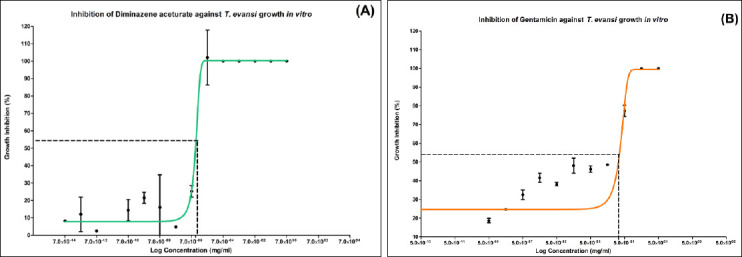 Figure 1
| Drug | EC₅₀ (mg/mL) | SD |
|---|---|---|
| DA | 1.25 × 10⁻⁵ | ±3.90 × 10⁻⁶ |
| GMC | 0.22 | ±0.08 |
| CTF | 0.08 | ±0.05 |
| TS | Ineffective | Ineffective |
| Drug | Replicate | D1 | D2 | D3 | D4 | D5 | D6 | D7 | D8 | D9 | D10 | D11 | D12 | D13 | D14 | D15 | D16 | D17 |
|---|---|---|---|---|---|---|---|---|---|---|---|---|---|---|---|---|---|---|
| DA | Dilutions | 7 | 7×10⁻¹ | 7×10⁻² | 7×10⁻³ | 7×10⁻⁴ | 7×10⁻⁵ | 7×10⁻⁶ | 7×10⁻⁷ | 7×10⁻⁸ | 7×10⁻⁹ | 7×10⁻¹⁰ | 7×10⁻¹¹ | 7×10⁻¹² | 7×10⁻¹³ | 7×10⁻¹⁴ | 10% IMDM | Control |
| R1 | − | − | − | − | − | + | + | + | + | + | + | + | + | + | + | + | + | |
| R2 | − | − | − | − | − | + | + | + | + | + | + | + | + | + | + | + | + | |
| GMC | Dilutions | 50 | 5 | 5×10⁻¹ | 2×10⁻² | 2×10⁻³ | 2×10⁻⁴ | 2×10⁻⁵ | 2×10⁻⁶ | 2×10⁻⁷ | 5×10⁻⁸ | 5×10⁻⁹ | 5×10⁻¹⁰ | 5×10⁻¹¹ | 5×10⁻¹² | 5×10⁻¹³ | 10% IMDM | Control |
| R1 | − | − | + | + | + | + | + | + | + | + | + | + | + | + | + | + | + | |
| R2 | − | − | + | + | + | + | + | + | + | + | + | + | + | + | + | + | + | |
| CTF | Dilutions | 2 | 2×10⁻¹ | 2×10⁻² | 2×10⁻³ | 2×10⁻⁴ | 2×10⁻⁵ | 2×10⁻⁶ | 2×10⁻⁷ | 2×10⁻⁸ | 2×10⁻⁹ | 2×10⁻¹⁰ | 2×10⁻¹¹ | 2×10⁻¹² | 2×10⁻¹³ | 2×10⁻¹⁴ | 1% DMSO | Control |
| R1 | − | − | + | + | + | + | + | + | + | + | + | + | + | + | + | + | + | |
| R2 | − | − | + | + | + | + | + | + | + | + | + | + | + | + | + | + | + | |
| TS | Dilutions | 5×10⁻¹ | 5×10⁻² | 5×10⁻³ | 5×10⁻⁴ | 5×10⁻⁵ | 5×10⁻⁶ | 5×10⁻⁷ | 5×10⁻⁸ | 5×10⁻⁹ | 5×10⁻¹⁰ | 5×10⁻¹¹ | 5×10⁻¹² | 5×10⁻¹³ | 5×10⁻¹⁴ | 5×10⁻¹⁵ | 1% DMSO | Control |
| R1 | + | + | + | + | + | + | + | + | + | + | + | + | + | + | + | + | + | |
| R2 | + | + | + | + | + | + | + | + | + | + | + | + | + | + | + | + | + |
Peer Reviews
No public reviews on file for this paper yet. If you reviewed it on a platform where reviews are public (OpenReview, ICLR, NeurIPS, ICML), you can paste yours below so the community can read it here.
Videos
No videos yet. Explain this paper in a talk, walkthrough, or lecture? Add one.
Taxonomy
TopicsTrypanosoma species research and implications · Helminth infection and control · Research on Leishmaniasis Studies
INTRODUCTION
Trypanosoma evansi is a flagellated protozoan parasite primarily transmitted by hematophagous insects. Among all trypanosome species, T. evansi has the broadest host range and worldwide distribution [1], with horses among the most severely affected hosts [2]. Clinical manifestations in infected horses include high fever, anemia, lethargy, weakness, lymphadenopathy, and neurological disturbances [2]. In acute cases, mortality rates can exceed 50%, and death may occur within three months of infection [3]. In Thailand, T. evansi outbreaks are reported annually, resulting in substantial economic losses to the horse-breeding industry [4].
Currently, there is no vaccine available for T. evansi, and treatment relies solely on trypanocidal drugs such as polysulfonate naphthylamine, quinapyramine sulfate and chloride, melarsomine, homidium salts, and diminazene aceturate (DA) [4, 5]. However, these drugs are often expensive, difficult to access, and unavailable in remote regions, prompting livestock owners to explore alternative or adjunct therapies. In some cases, trypanocidal drugs have been combined with antibiotics or ethnoveterinary (herbal) remedies to treat trypanosomosis, particularly in camels [6]. Infection in horses not only compromises animal health and performance but also affects international animal movement and trade. A major limitation remains the scarcity of effective compounds capable of completely eliminating T. evansi infection in equines.
Veterinary antibiotics commonly used in horses may offer a promising alternative or supportive role in trypanosomosis treatment because of their safety and widespread availability. These include eleven major classes: β-lactams, aminoglycosides, sulfonamides, tetracyclines, macrolides, ansamycins, fluoroquinolones, nitroimi-dazoles, phenicols, polypeptides, and streptogramins [7–9]. Gentamicin (GMC), an aminoglycoside antibiotic, is widely used against Gram-negative bacterial infections. It inhibits protein synthesis by binding to the A-site of 16S ribosomal RNA on the 30S ribosomal subunit with high affinity [10]. GMC is considered safe for intramuscular and intravenous administration in both adult horses and foals [8]. Experimentally, GMC has shown efficacy in treating T. evansi infection in goats [11] and has been reported to successfully treat a T. lewisi-like infection in an infant [12].
Ceftiofur (CTF), a third-generation cephalosporin belonging to the β-lactam class [8, 9, 13], exhibits broad activity against both Gram-positive and Gram-negative bacteria. β-lactams act by disrupting bacterial cell wall synthesis by inhibiting penicillin-binding proteins, although they do not cross the blood–brain barrier [14, 15]. CTF is widely used in horses and foals due to its safety and efficacy [8]. A previous study by Singla et al. [16] suggests that CTF may enhance DA penetration into erythrocytes, thereby improving DA pharmacokinetics and therapeutic outcomes in trypanosomosis.
Trimethoprim–sulfamethoxazole (TS), a combination of two sulfonamide derivatives [17], is an effective broad-spectrum antimicrobial for equine bacterial infections [8]. However, it is unsuitable for treating infections involving purulent or necrotic tissue [18]. Trimethoprim inhibits dihydrofolate reduction to tetrahydrofolate, while sulfonamides inhibit folate synthesis by competing with para-aminobenzoic acid [18, 19]. TS can be safely administered orally or intravenously to horses [8]. Although TS was ineffective against Trypanosoma cruzi in some experimental models [20], it successfully eliminated Trypanosoma brucei brucei parasitemia in sheep, with sustained recovery for up to 100 days post-treatment [21]. Its effect on T. evansi, however, remains unexplored.
In Thailand, DA remains the sole approved drug for T. evansi treatment. DA acts by inhibiting kinetoplast DNA synthesis [22], but because T. evansi can invade the central nervous system (CNS) [23], and DA poorly crosses the blood–brain barrier [22, 24], its effectiveness against CNS infections is limited. Moreover, DA can induce toxicity in horses, and emerging reports of resistance have raised concerns [25]. These factors highlight the urgent need for safer and more effective therapeutic alternatives for controlling equine trypanosomosis [26].
Drug repurposing, the use of existing, well-characterized pharmaceuticals for new therapeutic indications, offers a practical and time-efficient approach to discovering effective anti-trypanosomal agents. Antibiotics such as GMC, CTF, and TS are widely available in Thailand and are frequently prescribed for bacterial infections in horses [27]. However, despite their proven antimicrobial activity and safety in equines, limited or no data exist regarding their efficacy against T. evansi, particularly against local Thai strains. Moreover, the previous studies have largely focused on traditional trypanocides using DA, leaving the possible trypanocidal effects of these antibiotics unexplored. Therefore, the in vitro evaluation of their inhibitory potential against T. evansi represents a critical research gap that could pave the way for novel or adjunct therapeutic strategies in equine trypanosomosis management.
This study aimed to evaluate the in vitro inhibitory effects of GMC, CTF, and TS against the Thai strain of T. evansi (TEDC 953). The investigation focused on determining the half-maximal effective concentration (EC_50_) of each antibiotic and assessing parasite viability after exposure. By exploring the potential anti-trypanosomal activity of antibiotics that are already widely used and considered safe in horses, this research seeks to identify promising candidates for repurposing or combination therapy with existing trypanocidal drugs such as DA. The findings are expected to contribute to the development of more effective, accessible, and less toxic treatment strategies for equine trypanosomosis in Thailand and other endemic regions.
MATERIALS AND METHODS
Ethical approval
The present study was conducted in compliance with the ethical principles for the use of animals in scientific research as outlined by the National Research Council of Thailand and the Faculty of Veterinary Medicine, Kasetsart University, Thailand. All experimental procedures were reviewed and approved by the Institutional Animal Care and Use Committee (IACUC) of Kasetsart University under the protocol titled “In vitro evaluation of antibiotic inhibition on Trypanosoma evansi” (Approval No. ACKU67-VET-083).
Since this research involved in vitro assays using cultured T. evansi parasites and did not include the use of live vertebrate animals, no procedures were performed that caused pain, distress, or discomfort to any animal. All biological materials were handled in accordance with the biosafety level 2 (BSL-2) laboratory standards of the Faculty of Veterinary Medicine, Kasetsart University, Bangkok, Thailand.
The study ensured strict adherence to institutional biosafety protocols, proper waste disposal, and the use of personal protective equipment by all personnel. The culture materials and chemical reagents were disposed of following the Kasetsart University Laboratory Biosafety Guidelines.
Ethical oversight by the IACUC guarantees that the research design, execution, and data handling complied with national and international standards. These standards include the Organization for Economic Co-operation and Development good laboratory practice principles, where applicable, in the Animal Research: Reporting In Vivo Experiments 2.0 guidelines.
Study period and location
The experiments were conducted between April 26 and September 12, 2024, in the BSL-2 Laboratory, Faculty of Veterinary Medicine, Kasetsart University, Bangkok, Thailand.
Parasite strain and in vitro cultivation
The Thai strain of T. evansi (TEDC 953) was used in this study [28, 29]. Trypomastigotes were cultured in Hirumi’s Modified Iscove’s Medium 9 (HMI-9) medium prepared with Iscove’s Modified Dulbecco’s Medium (IMDM) (IMDM; Gibco, USA, Cat. No. 12440046) supplemented with 0.05 mM bathocuproine disulfonic acid (Sigma-Aldrich, Cat. No. B1125), 1.5 mM L-cysteine (Merck KGaA, Darmstadt, Germany, Cat. No. C7352), 1 mM hypoxanthine (Merck KGaA Cat. No. H9636), 0.16 mM thymidine (Merck KGaACat. No. T1895), 1.4% 2-β-mercaptoethanol (Merck, USA), 1 mM sodium pyruvate (Gibco, Thermo Fisher Scientific, Waltham, MA, USA,), and 1 mM penicillin-streptomycin (Gibco, Thermo Fisher Scientific, Cat. No. 15140–122). The culture was further enriched with 20% horse serum (Gibco, Thermo Fisher Scientific). Parasites were maintained under stationary conditions at 37°C, 5% CO_2_ and 75% humidity for 48 h [28]. Parasite viability was monitored daily using an inverted microscope (Olympus Corp., Japan).
Antibiotic and trypanocidal drug preparation
The reference trypanocidal drug DA (Berenil R.T.U., USA) was prepared in IMDM at a stock concentration of 7 mg/mL [30]. CTF (Sigma-Aldrich, USA) was dissolved in dimethyl sulfoxide (DMSO) at 200 mg/mL [31], GMC (Sigma-Aldrich) in IMDM at 500 mg/mL [32], and TS (Cotrimoxazole; Sigma-Aldrich) in DMSO at 50 mg/mL [33].
DA and GMC stocks were stored at 4°C under light protection, whereas CTF and TS stocks were stored at −20°C. In all assays, final concentrations of IMDM and DMSO did not exceed 10% and 1%, respectively. Working dilutions were prepared in HMI-9 medium (15 serial tenfold dilutions) to yield concentration ranges as follows:
- DA: 7 to 7 × 10^-14^ mg/mL
- GMC: 50 to 5 × 10^-13^ mg/mL
- CTF: 2 to 2 × 10^-14^ mg/mL
- TS: 5 × 101 to 5 × 10^-15^ mg/mL.
Concentration ranges were selected based on safety limits for equine use and previous experimental data. All solvent choices followed the manufacturer’s recommendations.
In vitro drug-inhibition assay
T. evansi trypomastigotes were enumerated using a modified Bürker counting chamber [34], and the inoculum was adjusted to 5 × 10^3^ trypomastigotes/µL [35–37]. In vitro inhibition assays were performed in sterile 96-well cell culture plates (Eppendorf, Germany). Each well contained 100 µL of the drug dilution in HMI-9 medium and 5 × 10^3^ trypomastigotes. Plates were incubated at 37°C, 5% CO_2_, and 75% humidity for 48 h.
DA served as the positive control, and untreated parasites served as the negative control. All experiments were conducted in duplicate across three independent trials by a single observer to minimize variability.
In vitro viability assessment
Parasite viability was determined 48 h post-treatment by direct microscopic observation. The number of motile parasites was recorded, and mortality was confirmed by two independent observers.
Statistical analysis
Parasite counts from the Bürker chamber were used to calculate the percentage inhibition of parasite growth using the following formula:
Drug efficacy was analyzed using GraphPad Prism 5 software (GraphPad Software, Inc., San Diego, CA, USA). Nonlinear regression analysis (four-parameter logistic model) was applied to determine the half-maximal effective concentration (EC_50_) for each drug [38]. The regression equation used was:
Where Y represents the drug response (% inhibition), Max and Min are the upper and lower asymptotes (100% and 0%), and X is the logarithm of drug concentration.
RESULTS
Antibiotic inhibition of T. evansi TEDC 953 Thai strain in vitro
The in vitro growth inhibition assay demonstrated that GMC and CTF effectively suppressed the proliferation of T. evansi (Thai strain TEDC 953) after 48 h of incubation. In contrast, TS showed no inhibitory activity against T. evansi under the experimental conditions.
The half-maximal effective concentration (EC_50_) values obtained for the tested compounds were 1.25 × 10^-5^ ± 3.90 × 10^-6^ mg/mL for DA, 0.22 ± 0.08 mg/mL for GMC, and 0.08 ± 0.05 mg/mL for CTF (Table 1). These results indicate that both GMC and CTF possess notable in vitro trypanocidal activity, although their potency was lower than that of the reference trypanocide DA.
Figure 1 illustrates the concentration-dependent inhibition curves of DA and GMC against T. evansi growth. The inhibitory curve for CTF and the EC_50_ determination for TS could not be established due to insufficient inhibitory response during the assay.
(A) Efficacy of diminazene aceturate in inhibiting Trypanosoma evansi growth in vitro. (B) Efficacy of gentamicin in inhibiting T. evansi growth in vitro.
Viability assessment of T. evansi after antibiotic exposure
The parasite viability test supported the inhibition results. Complete or near-complete mortality of T. evansi trypomastigotes was observed following exposure to DA (7 × 10^-4^ mg/mL), GMC (5 mg/mL), and CTF (0.2 mg/mL) (Table 2). No reduction in parasite viability was detected in the TS-treated or untreated control groups after 48 h of incubation. Overall, these findings confirm that GMC and CTF exhibit measurable in vitro trypanocidal activity against the Thai strain of T. evansi, whereas TS shows no inhibitory activity under the tested conditions.
DISCUSSION
GMC and its trypanocidal potential
GMC, an aminoglycoside antibiotic known for its broad-spectrum antibacterial activity through inhibition of protein synthesis [10], demonstrated a clear trypanocidal effect against the T. evansi TEDC 953 Thai strain in the present study. GMC effectively inhibited T. evansi proliferation at nanomolar levels, suggesting promising anti-trypanosomal potential. This finding aligns with a previous experimental study in Nubian goats, in which GMC reduced peripheral blood parasitemia for up to 8 weeks post-treatment. Moreover, clinical evidence of successful use of GMC in treating T. lewisi-like infections in infants further supports its therapeutic safety and potential as an alternative to conventional trypanocides [12].
The in vitro EC_50_ value of GMC against T. evansi (0.22 ± 0.08 mg/mL) observed here corresponds well with the recommended safety limits for horses established by the Asia Pacific Center for Animal Health and the National Center for Antimicrobial Stewardship [32]. Previous studies by Bryan [39] and Sirgel et al. [40] show that GMC inhibits Escherichia coli, Staphylococcus aureus, and Mycoplasma spp. with EC_50_ values ranging from 0.5 to 16 µg/mL. However, its EC_50_ values for protozoan parasites such as T. brucei brucei, T. evansi, Leishmania major [41], and Toxoplasma gondii [42] are typically 100–1,000 times higher than for bacteria, reflecting the greater resilience of protozoa to aminoglycoside action.
Compared with standard trypanocides, GMC displayed lower potency than DA or suramin but comparable or superior efficacy to the other evaluated antibiotics. For instance, chloramphenicol [43] and tetracycline [44] were previously reported to have weak-to-moderate inhibitory effects on T. evansi growth (EC_50_ = 50–150 µg/mL), while metronidazole was largely ineffective (EC_50_ > 200 µg/mL) [1]. In contrast, several herbal extracts, such as Allium sativum (garlic; 8–20 µg/mL), Azadirachta indica (neem; 4–10 µg/mL), Moringa oleifera (5–12 µg/mL), and Nigella sativa oil (6–10 µg/mL), have demonstrated mild-to-moderate anti-trypanosomal activity [45–48]. These comparisons suggest that while GMC’s trypanocidal activity is moderate, its established safety and pharmacological familiarity make it a feasible candidate for repurposing or combination therapy.
CTF and comparative inhibitory activity
CTF, a third-generation cephalosporin belonging to the β-lactam antibiotic class [13], also exhibited slight inhibitory effects against T. evansi in vitro, as confirmed by the viability assays. β-lactam antibiotics act by inhibiting penicillin-binding proteins, thereby interrupting bacterial cell wall synthesis [14]. Although this mechanism does not directly target protozoa, certain β-lactams have been shown to improve trypanocide pharmacokinetics. For example, combining DA with procaine enhanced drug penetration and improved therapeutic outcomes in *T. evansi-*infected buffalo calves [16]. Similarly, the multi-component formulation “Trypan” which combines DA, phenazone, and procaine, has exhibited potent activity against Trypanosoma congolense, Trypanosoma vivax, T. brucei brucei, and T. evansi [49].
In this context, the observed partial inhibitory effect of CTF may be attributed to indirect interference with parasite metabolic processes or improved drug bioavailability in combination regimens. These findings warrant further pharmacodynamic studies to elucidate CTF’s mode of action on T. evansi and its potential synergism with conventional trypanocides.
Lack of inhibitory activity of TS
In contrast, TS showed no inhibitory effect on the Thai strain of T. evansi under the current experimental conditions. This result is consistent with a previous report by Aregawi et al. [1] in mice infected with T. cruzi, where TS displayed no therapeutic benefit. The absence of trypanocidal activity can be explained by its mechanism of action: Inhibition of folate synthesis, which is effective against apicomplexan protozoa but not kinetoplastid parasites such as trypanosomes. Nevertheless, combination therapy approaches could enhance TS activity. Earlier studies demonstrated improved efficacy when TS was combined with adjuvant compounds, such as Medicinal Synthetic Aluminum Magnesium Silicate (MSAMS), which stabilizes the drug, prolongs its bioavailability, and modulates drug uptake and metabolic pathways [21, 41]. Such combination strategies merit further exploration for potential synergistic effects against trypanosomosis.
CONCLUSION
This study demonstrated that GMC and CTF, two antibiotics commonly used in equine medicine, possess notable in vitro inhibitory effects against the Thai strain of T. evansi (TEDC 953). In contrast, TS showed no measurable inhibition under the tested conditions. The calculated EC_50_ values revealed moderate trypanocidal activity of GMC (0.22 ± 0.08 mg/mL) and CTF (0.08 ± 0.05 mg/mL) when compared with the standard trypanocidal drug DA (1.25 × 10^-5^ ± 3.90 × 10^-6^ mg/mL). Viability assays further confirmed that GMC and CTF induced substantial mortality in T. evansi trypomastigotes after 48 h of exposure.
From a practical standpoint, these findings highlight the potential for drug repurposing of GMC and CTF as safe, accessible, and cost-effective therapeutic candidates for managing equine trypanosomosis (Surra) in Thailand and other endemic regions. Given their well-established safety profiles and regulatory approval for veterinary use, these antibiotics could serve as adjuncts to current trypanocidal therapy, helping to mitigate the toxicity and resistance issues associated with DA.
The strength of this study lies in its systematic in vitro evaluation of antibiotics not previously characterized for anti-trypanosomal activity against Thai isolates, contributing valuable baseline data for future research. It also provides the first comparative assessment of these drugs’ EC_50_ values against T. evansi, establishing a framework for subsequent pharmacological testing.
The present study provides important preliminary insights but also has limitations. The lack of pharmacokinetic data for GMC and the unexplored mechanism of action of CTF against T. evansi constrain definitive conclusions regarding their therapeutic potential. While EC_50_ estimation provides valuable quantitative evidence of drug efficacy, in vivo pharmacokinetic and pharmacodynamic investigations are essential to confirm clinical applicability.
Future studies should focus on (i) evaluating GMC and CTF in experimental animal models of T. evansi infection, (ii) assessing their toxicity and tissue distribution in horses, and (iii) investigating synergistic effects when combined with existing trypanocidal agents such as DA. Such efforts will be critical for developing effective, low-toxicity, and accessible therapeutic options for controlling equine trypanosomosis.
In conclusion, the present study provides promising evidence that GMC and CTF exhibit measurable trypanocidal activity against T. evansi in vitro. These findings open new avenues for developing safe, repurposed, and combinatory therapeutic strategies to enhance the treatment and control of equine trypanosomosis, thereby improving animal health and reducing economic losses in endemic regions.
AUTHORS’ CONTRIBUTIONS
KK: Designed and supervised the study and drafted and edited the manuscript. AR and GTN: Contributed equally to this study, performed the experiments, analyzed the data, and drafted and reviewed the manuscript. All authors have read and approved the final version of the manuscript.
The reference list from the paper itself. Each links out to its DOI / PubMed record.
- 1Aregawi W. G Agga G. E Abdi R. D Buscher P Systematic review and meta-analysis on the global distribution, host range, and prevalence of Trypanosoma evansi. Parasit Vectors 201912(1)6710.1186/s 13071-019-3311-4PMC 635747330704516 · doi ↗ · pubmed ↗
- 2Trypanosoma evansi Infections (Including Surra)WOAH 2023 Available from: https://www.woah.org/ fileadmin/home/eng/animal_health_in_the_world/docs/pdf/disease_cards/trypano_evansi.pdf.Retrieved on 23-11-2024.
- 3Mekonnen G Mohammed E. F Kidane W Nesibu A Yohannes H Van Reet N Buscher P Birhanu H Isometamidium chloride and homidium chloride fail to cure mice infected with Ethiopian Trypanosoma evansi type A and BP Lo S Negl. Trop. Dis.2018129000679010.1371/journal.pntd.0006790 PMC 615299330208034 · doi ↗ · pubmed ↗
- 4Desquesnes M Dargantes A Lai D. H Lun Z. R Holzmuller P Jittapalapong S Trypanosoma evansi and surra:A review and perspectives on transmission, epidemiology and control, impact, and zoonotic aspects Biomed. Res. Int.201320133212372415159510.1155/2013/321237 PMC 3789323 · doi ↗ · pubmed ↗
- 5Buscher P Gonzatti M. I Hebert L Inoue N Pascucci I Schnaufer A Suganuma K Touratier L Van Reet N Equine trypanosomosis:Enigmas and diagnostic challenges Parasit. Vectors 20191212343109228510.1186/s 13071-019-3484-x PMC 6518633 · doi ↗ · pubmed ↗
- 6Mdachi R. E Ogolla K. O Auma J. E Wamwiri F. N Kurgat R. K Wanjala K. B Mugunieri L. G Alusi P. M Chemuliti J. K Mukiria P. W Okoth S. O Variation of sensitivity of Trypanosoma evansi isolates from Isiolo and Marsabit counties of Kenya to locally available trypanocidal drugs P Lo S One 2023182028118010.1371/journal.pone.0281180 PMC 989449036730273 · doi ↗ · pubmed ↗
- 7Erin Malone D Large Animal Surgery -- Supplemental Notes. University of Minnesota Libraries Publishing 2019 Available from: https://open.lib.umn.edu/largeanimalsurgery.Retrieved on 26-06-2024.
- 8Hardefeldt L. Y Bailey K. E Slater J Overview of the use of antimicrobial drugs for the treatment of bacterial infections in horses Equine Vet. Educ 20203311602611