Front-Surface Potential of Platinized p‑InP Photocathodes Probed by Dual-Working-Electrode Measurements
Weilai Yu, Nathan S. Lewis

TL;DR
This study uses a new method to measure the surface potential of a material used for hydrogen production, showing how catalyst activity affects its performance.
Contribution
The paper introduces a dual-working-electrode method to measure the front-surface potential of platinized p-InP photocathodes under operating conditions.
Findings
The front-surface potential of Pt-modified p-InP is near the reversible hydrogen electrode potential.
The surface potential is governed by catalytic kinetics, not the back-contact potential.
The method provides a rapid, operando metric for interfacial catalyst activity.
Abstract
The front-surface potential (E fr) of p-InP/Pt photocathodes performing the hydrogen-evolution reaction has been probed under operating conditions using a dual-working-electrode (DWE) method. The DWE data are consistent with expectations for proposed stability mechanisms for p-InP photocathodes. Specifically, E fr for Pt-modified p-InP adopts a value near the reversible hydrogen electrode (RHE) potential, consistent with kinetic suppression of metallic In0 formation. The data provide a rapid, operando metric of interfacial catalyst activity, and indicate that E fr for the p-InP/Pt junction is governed by surface catalytic kinetics rather than by the applied back-contact potential (E b).
Genes, proteins, chemicals, diseases, species, mutations and cell lines named across the full text — each resolved to its canonical identifier and authoritative record.
Click any figure to enlarge with its caption.
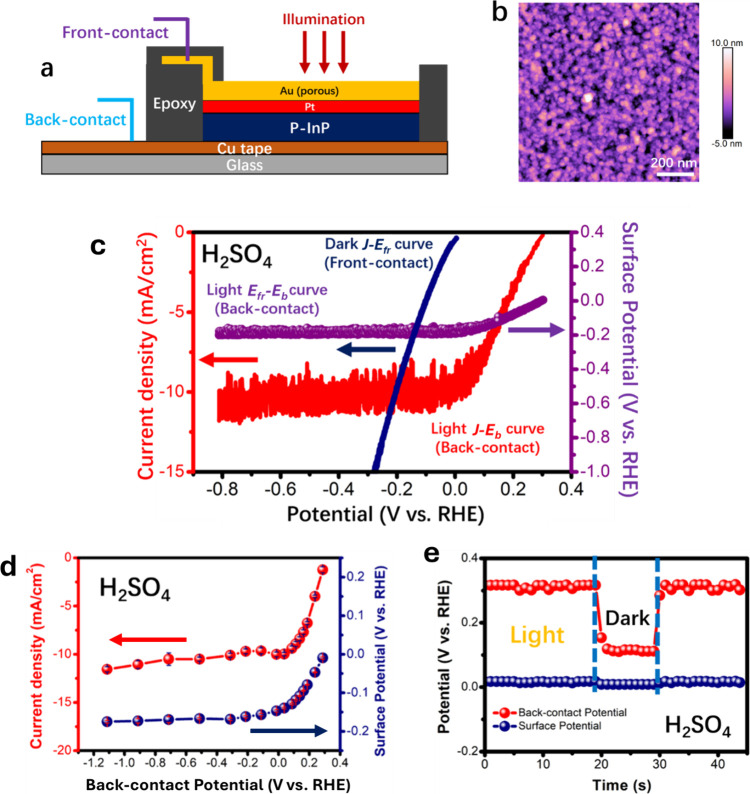 Figure 1
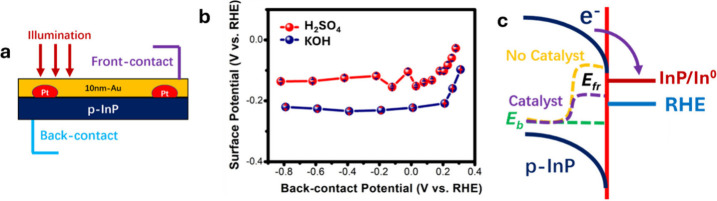 Figure 2
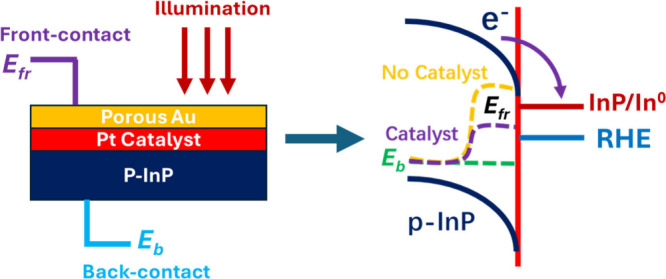 Figure 3
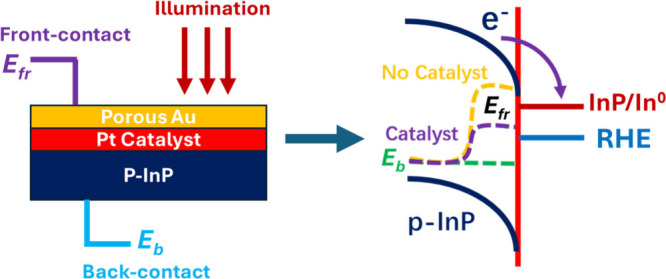 Figure 4
- —Basic Energy Sciences10.13039/100006151
Peer Reviews
No public reviews on file for this paper yet. If you reviewed it on a platform where reviews are public (OpenReview, ICLR, NeurIPS, ICML), you can paste yours below so the community can read it here.
Videos
No videos yet. Explain this paper in a talk, walkthrough, or lecture? Add one.
Taxonomy
TopicsPhotocathodes and Microchannel Plates · solar cell performance optimization · Semiconductor materials and interfaces
Understanding electrochemical reactions at buried semiconductor–catalyst interfaces is a central challenge for solar fuels, because conventional photoelectrochemical (PEC) metricsback-contact biasing, chopped-light current density–potential (J–E) scans, and open-circuit photovoltageoften conflate the energetics of the semiconductor junction with catalytic overpotentials, ?−? ? ? obscuring the origins of performance and stability limitations in photocathodes, ?−? ? including high-photovoltage p-InP systems. ?,?
Here, we report results of an operando dual-working-electrode (DWE) method in which the back-contact potential (E b) was independently controlled while the front-surface potential (E fr) of a catalyst-coated p-InP photocathode was monitored directly during hydrogen evolution, providing real-time access to the electrochemical potential at the semiconductor/catalyst/liquid interface under working photoelectrochemical conditions. The Supporting Information describes the fabrication and testing of the DWE (Figurea and Figure S1). A thin (∼10 nm) nanoporous Au front contact maintained electrical continuity, served as an effective probe of E fr, and permitted electrolyte access to the underlying Pt catalyst (Figureb). ?,? Unlike prior DWE studies that were performed in the dark,? this configuration allowed measurement of the illuminated, operating photocathode, enabling direct measurement of the surface potential that governs interfacial kinetics and electrode degradation.
We test the hypothesis that, in the light-limited regime, the stability of the photocathode is dictated by the instantaneous E fr at the illuminated surface rather than solely by the externally applied bias. Real-time E fr measurements cleanly decouple the semiconductor photovoltage from the catalytic overpotential, directly linking the photocurrent to the catalytic driving force. ?,? This operando view identifies when corrosion pathways are activated and connects the surface-potential trajectories to long-term stability, extending mechanistic frameworks for p-InP photocathodes.?
Sweeps of the potential of the back contact (E b) from open circuit to −0.9 V versus the reversible hydrogen electrode (RHE) (−0.9 V_RHE_) did not shift the surface potential (E fr) of the p-InP/3 nm Pt/10 nm Au DWE. Instead, E fr plateaued at −0.17 V_RHE_ in 1.0 M H_2_SO_4_(aq) and at −0.23 V_RHE_ in 1.0 M KOH(aq), corresponding to light-limited photocurrents densities (J ph) of −10.5 ± 0.2 and −11.7 ± 0.2 mA cm^–2^, respectively, under 100 mW cm^–2^ of illumination (Figurec and Figure S2). Hence, the Pt/liquid interface controlled the “pinned” E fr value that was required to sustain the photocurrent in this system.
At open circuit, the measured E fr value of p-InP/3 nm Pt/10 nm Au DWEs equilibrated to ∼0 V_RHE_, consistent with equilibration of the Pt to the RHE potential (Figured,e). Direct control of E fr through the front contact in the dark yielded J–E fr data that were identical to the polarization behavior of metallic Pt for hydrogen evolution, confirming that the measured E fr probes the electrochemical potential at the surface of the Pt HER catalyst (Figure S3). The voltammetric and potentiostatic data were mutually consistent, and demonstrate that E fr scaled with current density and surface kinetics rather than with E b (Figured,e and Figure S3). These results establish that E fr provides a direct, operando method to decouple the semiconductor photovoltage from interfacial catalytic overpotentials.
At comparable values of J ph, DWE electrodes fabricated with pre-photoelectrodeposited Pt nanoparticles showed E fr pinning at −0.12 V_RHE_ in 1.0 M H_2_SO_4_(aq) and at −0.23 V_RHE_ in 1.0 M KOH(aq) (Figurea,b and Table S1). These values are essentially identical to those obtained with sputtered Pt, indicating that E fr does not depend on the Pt deposition method. The shift in E fr between acidic and alkaline electrolytes arises from the pH-dependent HER overpotential on Pt.
When Pt was replaced with a Au front contact (Figure S4), the p-InP/14 nm Au DWE exhibited E fr values of −0.30 V_RHE_ in 1.0 M H_2_SO_4_(aq) (J ph = −8.1 ± 0.3 mA cm^–2^) and −0.47 V_RHE_ in 1.0 M KOH(aq) (J ph = −7.5 ± 0.3 mA cm^–2^). These potentials are substantially more negative than those measured for p-InP/3 nm Pt/10 nm Au photoelectrodes under nominally identical operating conditions, indicating that the porous Au layer alone is a substantially less active HER catalyst than Pt. The more negative front-surface potentials observed with Au are consistent with the higher HER overpotential of Au relative to Pt, and confirm that the pinned value of E fr reflects the catalytic overpotential required to sustain the photocurrent. To sustain a given current density, a less active catalyst drives the surface potential to more negative values, showing that photocathode performance is governed by catalyst kinetics and that, in Pt-modified electrodes, the Au overlayer does not dominate the interfacial behavior. For a given photocurrent density, E fr is pinned at a catalyst-dependent potential, making the DWE platform a rapid, quantitative benchmark that links kinetics to operating surface potential and enables direct evaluation of catalyst composition, morphology, and contact strategy under working conditions.
Notably, the DWE data are consistent with proposed stability mechanisms for p-InP photocathodes (Figurec). ?,?,? Because the plating potential for In^0^ from InP (approximately −0.31 V_RHE_) is more negative than the RHE potential, the intrinsically high HER overpotential at etched p-InP can drive the surface to sufficiently negative potentials to enable cathodic corrosion via metallic In^0^ formation, introducing kinetic competition between In reduction and hydrogen evolution. The conversion of p-InP to In^0^ is thermodynamically less favorable than HER, so kinetic stabilization can render p-InP quasi-stable, in accord with Gerischer’s classification.? Consistently, decoration of p-InP with Pt suppresses the formation of In^0^ by preferentially channeling photogenerated carriers into the HER, yielding more positive operando surface potentials than nonplatinized, etched p-InP photocathodes under comparable applied bias conditions.?
Our results directly confirm this picture: for Pt-modified p-InP, E fr remains near RHE, consistent with kinetic suppression of In^0^ formation, whereas less active catalysts such as Au drive E fr to more negative values that favor corrosion. Beyond decoupling photovoltage from catalytic kinetics, operando DWE establishes a mechanistic link between surface overpotential, catalyst activity, and stability, and highlights practical levers to bias selectivity toward the HERoptimizing catalyst loading and morphology, introducing ultrathin interlayers that hinder In^0^ nucleation, and tuning the electrolyte composition and applied bias to keep E fr within an HER-favorable window. More broadly, DWE links the surface potential to catalyst kinetics operando, rapidly exposing bottlenecks and degradation pathways to guide the development of scalable, robust photocathodes.
Supplementary Material
The reference list from the paper itself. Each links out to its DOI / PubMed record.
- 1Walter M. G.Warren E. L.Mc Kone J. R.Boettcher S. W.Mi Q.Santori E. A.Lewis N. S.Solar Water Splitting Cells Chem. Rev.2010110116446647310.1021/cr 100232621062097 · doi ↗ · pubmed ↗
- 2Chen R.Fan F.Dittrich T.Li C.Imaging Photogenerated Charge Carriers on Surfaces and Interfaces of Photocatalysts with Surface Photovoltage Microscopy Chem. Soc. Rev.201847228238826210.1039/C 8CS 00320 C 30059114 · doi ↗ · pubmed ↗
- 3Wang Y.Schwartz J.Gim J.Hovden R.Mi Z.Stable Unassisted Solar Water Splitting on Semiconductor Photocathodes Protected by Multifunctional Ga N Nanostructures ACS Energy Lett.2019471541154810.1021/acsenergylett.9b 00549 · doi ↗
- 4Niu W.Moehl T.Cui W.Wick-Joliat R.Zhu L.Tilley S. D.Extended Light Harvesting with Dual Cu 2 O-Based Photocathodes for High Efficiency Water Splitting Adv. Energy Mater.2018810170232310.1002/aenm.201702323 · doi ↗
- 5Nellist M. R.Laskowski F. A. L.Lin F.Mills T. J.Boettcher S. W.Semiconductor–Electrocatalyst Interfaces: Theory, Experiment, and Applications in Photoelectrochemical Water Splitting Acc. Chem. Res.201649473374010.1021/acs.accounts.6b 0000127035051 · doi ↗ · pubmed ↗
- 6Laskowski F. A. L.Nellist M. R.Qiu J.Boettcher S. W.Metal Oxide/(Oxy)Hydroxide Overlayers as Hole Collectors and Oxygen-Evolution Catalysts on Water-Splitting Photoanodes J. Am. Chem. Soc.201914141394140510.1021/jacs.8b 0944930537811 · doi ↗ · pubmed ↗
- 7Laskowski F. A. L.Oener S. Z.Nellist M. R.Gordon A. M.Bain D. C.Fehrs J. L.Boettcher S. W.Nanoscale Semiconductor/Catalyst Interfaces in Photoelectrochemistry Nat. Mater.2020196910.1038/s 41563-019-0488-z 31591528 · doi ↗ · pubmed ↗
- 8Yu W.Richter M. H.Buabthong P.Moreno-Hernandez I. A.Read C. G.Simonoff E.Brunschwig B. S.Lewis N. S.Investigations of the Stability of Etched or Platinized P-In P(100) Photocathodes for Solar-Driven Hydrogen Evolution in Acidic or Alkaline Aqueous Electrolytes Energy Environ. Sci.202114116007602010.1039/D 1EE 02809 J · doi ↗