Population Access to US Trauma Centers and Teletrauma-Using Emergency Departments
Zain G. Hashmi, Russell Griffin, Janice A. Espinola, Ashley F. Sullivan, Krislyn M. Boggs, Maeve Swanton, Molly P. Jarman, Jan O. Jansen, Jeffrey D. Kerby, Carlos A. Camargo

TL;DR
This study examines how telehealth improves access to trauma care in the US and updates national estimates of trauma center reach.
Contribution
The study introduces updated national estimates of trauma center access and evaluates the role of teletrauma in expanding care reach.
Findings
Teletrauma in emergency departments increases population access to trauma care expertise.
Updated national estimates show the geographic reach of trauma centers in the US.
Abstract
This cross-sectional study determines the additional population access to trauma care expertise provided by telehealth for trauma in emergency departments and provides updated national estimates of trauma center access.
Genes, proteins, chemicals, diseases, species, mutations and cell lines named across the full text — each resolved to its canonical identifier and authoritative record.
Click any figure to enlarge with its caption.
 Figure
| Population | Population in millions, No. (%) | |||
|---|---|---|---|---|
| Advanced trauma center | Basic trauma center | TTEDs | No access to trauma care expertise | |
| Total | 235.0 (71) | 29.1 (9) | 7.3 (2) | 60.0 (18) |
| Urbanicity | ||||
| Rural | 4.0 (9) | 8.2 (18) | 4.7 (10) | 29.0 (63) |
| Urban | 231.0 (81) | 21.0 (7) | 2.5 (1) | 30.9 (11) |
| Census regions | ||||
| Midwest | 48.1 (70) | 7.1 (10) | 2.5 (4) | 11.3 (16) |
| Northeast | 46.8 (81) | 2.0 (3) | 1.1 (2) | 7.8 (14) |
| South | 78.7 (62) | 14.3 (11) | 2.9 (2) | 30.3 (24) |
| West | 61.4 (78) | 5.7 (7) | 0.8 (1) | 10.6 (14) |
Peer Reviews
No public reviews on file for this paper yet. If you reviewed it on a platform where reviews are public (OpenReview, ICLR, NeurIPS, ICML), you can paste yours below so the community can read it here.
Videos
No videos yet. Explain this paper in a talk, walkthrough, or lecture? Add one.
Taxonomy
TopicsTrauma and Emergency Care Studies · Telemedicine and Telehealth Implementation · COVID-19 and healthcare impacts
Introduction
Trauma centers (TCs) are specialized hospital units with resources and expertise to treat injured patients. In the US, a hierarchical network of TCs exists.^1^ Levels 1 and 2 (ie, advanced) TCs provide definitive injury management, while level 3 and lower (ie, basic) TCs offer initial care and often transfer patients to advanced TCs.
Prior research suggests that 23% of the US population and 42% of the rural population lack access to TC care within 60 minutes by ground ambulance, a disparity that contributes to worse outcomes.^2^ Although building new TCs can improve access, this strategy is cost- and resource-prohibitive.^3,4^ Teletrauma (clinician-to-clinician telehealth for injury care) has emerged as a promising alternative to expand access to trauma care expertise, but its geographic reach beyond existing TCs remains unclear.^5,6^ We aimed to determine the additional population access to trauma care expertise provided by teletrauma-using emergency departments (TTEDs) and provide updated national estimates of TC access.
Methods
This cross-sectional study was approved by the Mass General Brigham Institutional Review Board with a waiver of informed consent owing to non–human participant research. We followed the STROBE reporting guideline.
Using the 2022 National Emergency Department Inventory (NEDI)-USA, we identified all adult TCs and self-reported TTEDs (>80% response). The unit of analysis was the 2020 US Census block group (CBG), with location of injury defined as the population-weighted centroid. We defined access as the highest-level TC (advanced TCs highest and TTEDs lowest) available to each CBG within 60 minutes by ground ambulance. Network cost analysis (ArcGIS Pro, version 3.4.3; ESRI) estimated drive times as the sum of emergency medical services (EMS) dispatch, departure, and scene times (per 2023-2024 data from the National EMS Information System) and travel time from EMS base to centroid to facility. Sensitivity analyses including air EMS transport were performed (eMethods in Supplement 1). Urbanicity was defined using 2013 Urban Influence Codes. Additional details, including methodological limitations, are provided in eMethods in Supplement 1.
Results
In 2022, 4607 EDs responded to NEDI-USA; 379 (8%) were TTEDs. Among TTEDs, 347 (92%) were located at facilities without a TC. Among 1505 EDs in rural areas without a TC, 286 (19%) reported using teletrauma.
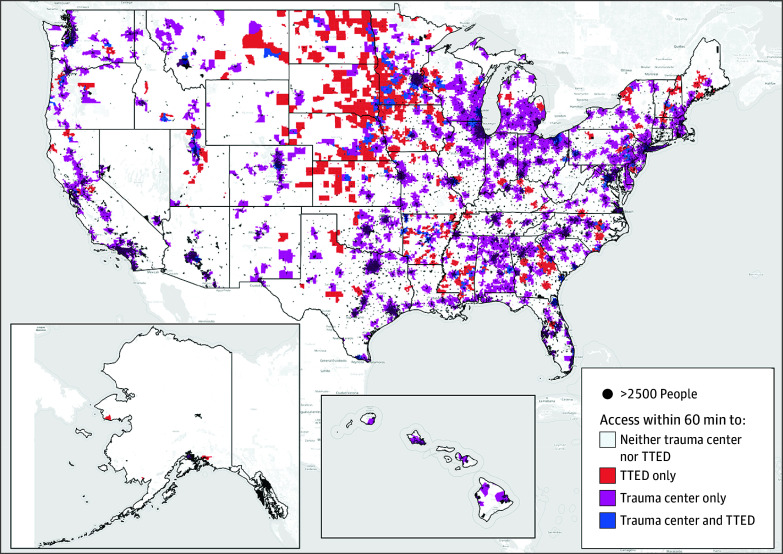
Of 331 351 858 people in the US population, an estimated 264 million (79.7%) had access to a TC within 60 minutes by ground ambulance. Although 40 748 183 people (13%) had access to a TTED, these facilities expanded access to trauma care by only 2% (7.3 million) (Table and Figure). TTEDs provided access to 10% of 67 214 203 people without prior access to any TC. This proportion varied regionally: 2 506 209 of 13 760 768 (18%) in the Midwest, 1 081 095 of 8 835 829 (12%) in the Northeast, 2 938 959 of 33 227 024 (9%) in the South, 771 650 of 11 390 582 (7%) in the West, and 4 748 473 of 33 783 378 (14%) in rural areas.
Map Depicting Estimated Population Access to Trauma Care Expertise in the US Within 60 Minutes by Ground Emergency Medical Service TransportTTED indicates teletrauma-using emergency department.
Approximately 60 million people (18% of the US population) lacked access to any level of trauma care, more than half (30 288 365 [51%]) of whom resided in the South. Air EMS sensitivity analysis accounted for additional trauma care access to 317 045 people (0.1%).
Discussion
TTEDs improve access to trauma care expertise for 1 in 10 people who previously lacked access to a TC. Most TTEDs are located near existing TCs, limiting their impact on underserved areas. Our updated national estimates align with 2019 data and confirm that millions of US residents still lack timely trauma care access.
A key limitation of this study is the self-reported use of teletrauma on the survey; however, the survey was completed by ED directors who likely had correct information. Our findings suggest that TTEDs are not being strategically deployed to expand access to trauma care, especially in rural areas. Targeted efforts are needed to expand access to teletrauma care to realize its true potential in alignment with goals established by the American College of Surgeons Committee on Trauma.^5^
The reference list from the paper itself. Each links out to its DOI / PubMed record.
- 1Resources for optimal care of the injured patient (2022 standards). American College of Surgeons. 2023. Accessed June 16, 2025. https://www.facs.org/quality-programs/trauma/quality/verification-review-and-consultation-program/standards/
- 2Jarman MP, Dalton MK, Askari R, Sonderman K, Salim A, Inaba K. Accessibility of level III trauma centers for underserved populations: a cross-sectional study. J Trauma Acute Care Surg. 2022;93(5):664-671. doi:10.1097/TA.0000000000003725 35687808 · doi ↗ · pubmed ↗
- 3Ashley DW, Mullins RF, Dente CJ, ; Georgia Research Institute for Trauma Study Group. How much green does it take to be orange? determining the cost associated with trauma center readiness. J Trauma Acute Care Surg. 2019;86(5):765-773. doi:10.1097/TA.0000000000002213 30768564 · doi ↗ · pubmed ↗
- 4Amato S, Benson JS, Stewart B, . Current patterns of trauma center proliferation have not led to proportionate improvements in access to care or mortality after injury: an ecologic study. J Trauma Acute Care Surg. 2023;94(6):755-764. doi:10.1097/TA.0000000000003940 36880704 PMC 10208642 · doi ↗ · pubmed ↗
- 5Hashmi ZG, Park C; American College of Surgeons Committee on Trauma Teletrauma Spotlight Session Workgroup. Using teletrauma to improve access to trauma care in the US: a call for action. J Am Coll Surg. 2025;240(2):212-219. doi:10.1097/XCS.0000000000001210 39268968 · doi ↗ · pubmed ↗
- 6Hashmi ZG, Rokayak O, Boggs KM, . Teletrauma use in US emergency departments. JAMA Surg. 2024;159(12):1383-1391. doi:10.1001/jamasurg.2024.3758 39292475 PMC 11411445 · doi ↗ · pubmed ↗