Correction: Deciphering the molecular origin of the 19.3 eV electronic excitation energy of H3+
Josene M. Toldo, Jakob K. Staab, Eduard Matito, Cina Foroutan-Nejad, Henrik Ottosson

TL;DR
This paper corrects a previous study on the electronic excitation energy of the H3+ molecule.
Contribution
The correction addresses errors in the prior analysis of the 19.3 eV excitation energy of H3+.
Findings
The original study's interpretation of the electronic excitation energy was revised.
Updated data provides a more accurate understanding of the molecular origin of the excitation.
Abstract
Correction for ‘Deciphering the molecular origin of the 19.3 eV electronic excitation energy of H3+’ by Josene M. Toldo et al., Chem. Sci., 2026, https://doi.org/10.1039/d5sc09067a.
Genes, proteins, chemicals, diseases, species, mutations and cell lines named across the full text — each resolved to its canonical identifier and authoritative record.
Click any figure to enlarge with its caption.
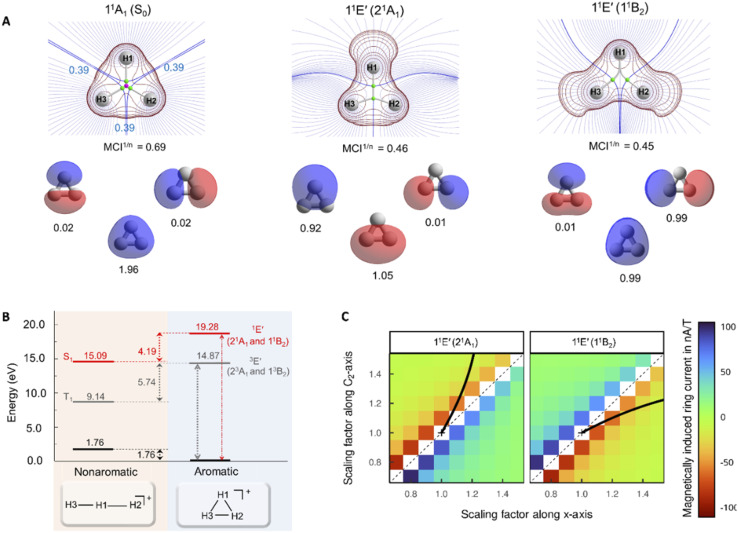 Figure 1
- —Vetenskapsrådet10.13039/501100004359
- —Olle Engkvists Stiftelse10.13039/501100004200
- —Université Claude Bernard Lyon 110.13039/501100006687
- —Donostia International Physics Center10.13039/100021105
- —Narodowe Centrum Nauki10.13039/501100004281
Peer Reviews
No public reviews on file for this paper yet. If you reviewed it on a platform where reviews are public (OpenReview, ICLR, NeurIPS, ICML), you can paste yours below so the community can read it here.
Videos
No videos yet. Explain this paper in a talk, walkthrough, or lecture? Add one.
Taxonomy
TopicsAdvanced Chemical Physics Studies · Atomic and Molecular Physics · Photosynthetic Processes and Mechanisms
The authors regret that panel A of Fig. 4 in the original article was not complete as its right part, with results for the excited state labelled 1^1^B_2_, was accidently omitted. The missing part, with the topological analysis of the electron density, the 2D Laplacian of the electron density, and the natural orbitals of the 1^1^B_2_ state, is contained in the new Fig. 4 shown as follows.
The Royal Society of Chemistry apologises for these errors and any consequent inconvenience to authors and readers.