The interplay between attention deficit/hyperactivity disorder and internet addiction: executive dysfunction and insomnia as mediators and the role of physical activity
Fangtai Liu, Liping Zhong, Haiyu Chen, Ziwei Teng, Yuhan Su, Jinliang Chen, Yue Qin, Qiong Luo

TL;DR
This study explores how ADHD and internet addiction are linked in college students, with executive dysfunction and insomnia acting as mediators, and finds that physical activity can reduce internet addiction symptoms.
Contribution
The study identifies executive dysfunction and insomnia as mediators between ADHD and internet addiction and shows that physical activity reduces internet addiction symptoms.
Findings
ADHD symptoms are significantly associated with internet addiction symptoms, mediated by insomnia and executive dysfunction.
Moderate and high-level physical activity is negatively correlated with internet addiction symptoms.
Physical activity reduces internet addiction symptoms regardless of mediation by insomnia and executive dysfunction.
Abstract
Attention Deficit/Hyperactivity Disorder (ADHD) and internet addiction (IA) are common among college students and often co-exist. This study investigated the relationship between ADHD symptoms, executive dysfunction, insomnia, and IA in Chinese college students. A cross-sectional study was conducted in June 2024 at six universities in Hunan Province, China. Demographic data and symptoms of ADHD, IA, executive dysfunction, insomnia, and physical activity were collected via interviews and self-reported questionnaires. Physical activity level was further quantified and categorized using metabolic equivalents (METs) method. Mediation models were performed to explore the path from ADHD to IA and the role of physical activity in IA symptoms. Among 1925 students, 12.52% had ADHD symptoms, and 14.03% had IA symptoms. ADHD symptoms were related to IA symptoms (total effects: 0.38, p < 0.001;…
Genes, proteins, chemicals, diseases, species, mutations and cell lines named across the full text — each resolved to its canonical identifier and authoritative record.
Click any figure to enlarge with its caption.
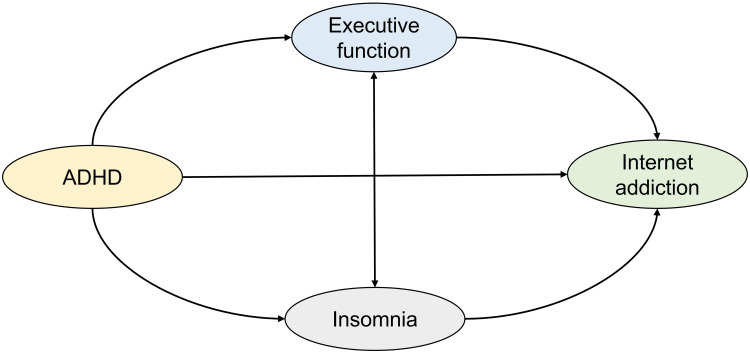 Figure 1
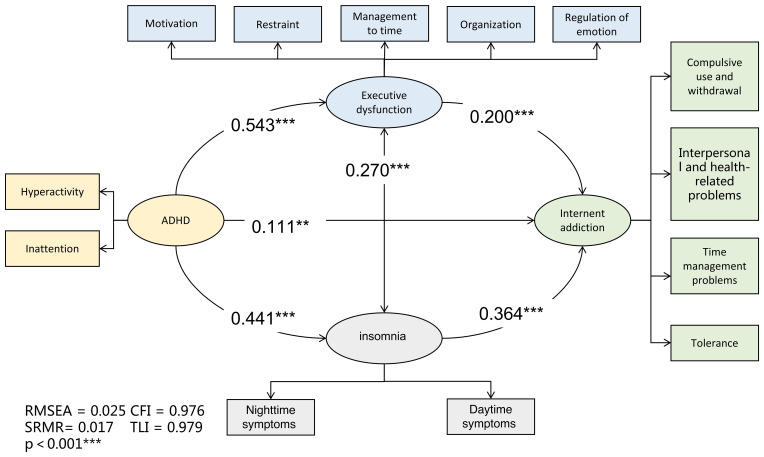 Figure 2
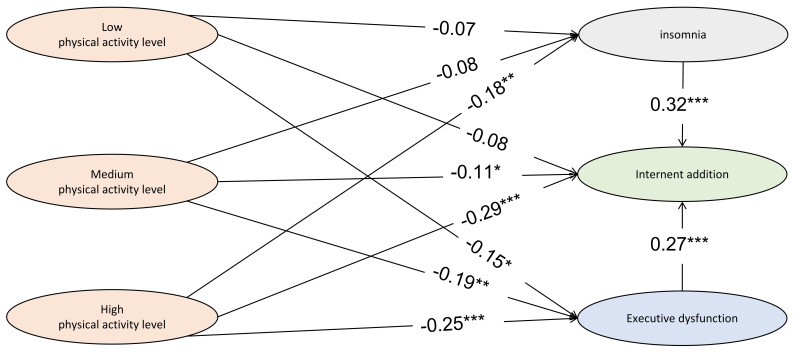 Figure 3
Peer Reviews
No public reviews on file for this paper yet. If you reviewed it on a platform where reviews are public (OpenReview, ICLR, NeurIPS, ICML), you can paste yours below so the community can read it here.
Videos
No videos yet. Explain this paper in a talk, walkthrough, or lecture? Add one.
Taxonomy
TopicsAttention Deficit Hyperactivity Disorder · Impact of Technology on Adolescents · Anxiety, Depression, Psychometrics, Treatment, Cognitive Processes