Discordance between non-zero physician's global scores and absence of active joints in juvenile idiopathic arthritis: multicenter vs. single-center cohorts
Ana Isabel Rebollo-Giménez, Silvia Rosina, Francesca Ridella, Silvia Maria Orsi, Elena Aldera, Marco Burrone, Valentina Natoli, Alessandro Consolaro, Francesca Bovis, Esperanza Naredo, Angelo Ravelli

TL;DR
This study finds that physicians sometimes rate juvenile arthritis patients as having active disease even when no joints are inflamed, with this happening less in a specialized clinic.
Contribution
The study reveals differences in physician assessments between multicenter and single-center JIA cohorts.
Findings
14.8% and 13.7% of multicenter patients had non-zero PhGA scores despite no active joints.
Single-center patients showed only 5.1% with this discordance, suggesting training improves consistency.
Elevated APRs and morning stiffness were key reasons for non-zero PhGA scores.
Abstract
This study aims to compare the frequency of instances in which the physician's global assessment of disease activity (PhGA) was scored >0 despite the absence of active joints in children with juvenile idiopathic arthritis (JIA), using two multicenter patient datasets and one single-center dataset from a pediatric rheumatology center with expertise in clinimetric assessments. Data were extracted from two multicenter datasets and one single-center dataset, comprising 9,081, 563, and 394 patients, respectively. Patients with an active joint count (AJC) of 0 were included. The PhGA and fulfillment of other criteria from the 2004 or 2011 Wallace definition of clinically inactive disease (CID) were assessed. UpSet plots were used to analyze the frequency and overlap of PhGA and CID items across the datasets. Among patients with an AJC of 0, the percentage for whom a PhGA score >0 was the…
Genes, proteins, chemicals, diseases, species, mutations and cell lines named across the full text — each resolved to its canonical identifier and authoritative record.
Click any figure to enlarge with its caption.
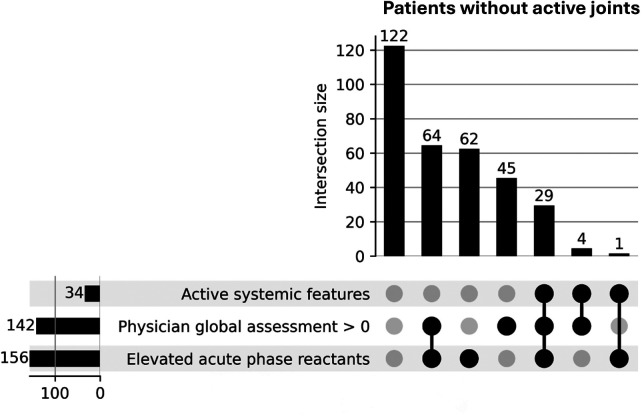 Figure 1
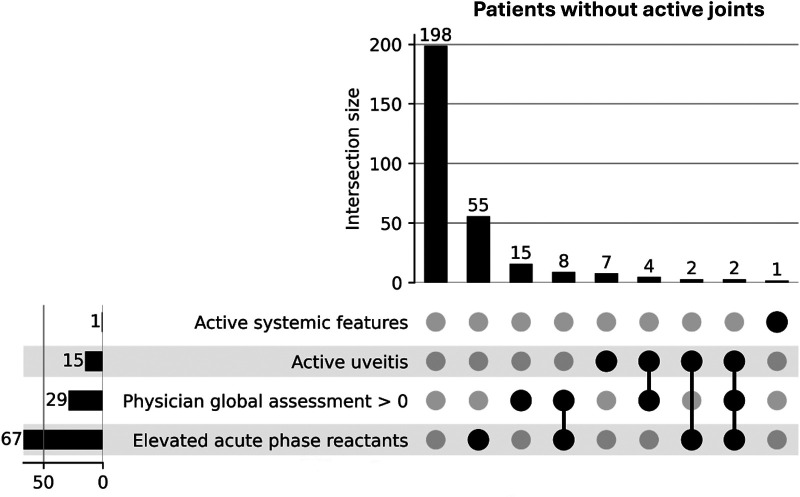 Figure 2
Peer Reviews
No public reviews on file for this paper yet. If you reviewed it on a platform where reviews are public (OpenReview, ICLR, NeurIPS, ICML), you can paste yours below so the community can read it here.
Videos
No videos yet. Explain this paper in a talk, walkthrough, or lecture? Add one.
Taxonomy
TopicsAutoimmune and Inflammatory Disorders Research · Adolescent and Pediatric Healthcare · Rheumatoid Arthritis Research and Therapies