Ecological factors affecting prosociality in marmoset monkeys
Anand R. Mysorekar, Anushka Vispute, Cory T. Miller

TL;DR
This study explores how short-term ecological factors influence prosocial behavior in marmoset monkeys.
Contribution
The study reveals how food size and time since food access affect prosocial interactions in marmosets.
Findings
Larger food portions consistently promoted prosocial interactions in marmosets.
Longer durations since food access led to more individualistic behavior.
There was no significant interaction between food size and time since food access.
Abstract
Prosocial behaviors, such as cooperation and food sharing, are critical for maintaining group cohesion in social species, yet the influence of transient physiological states on these behaviors remains poorly understood. This study investigates how short-term ecological factors impact social behavior in common marmosets (Callithrix jacchus), a highly prosocial nonhuman primate species. Specifically, we tested how food divisibility (small vs. large food items) and time since food access (TSFA; 0 h, 1 h, and 3 h) influenced food sharing behavior. Results revealed that larger food portions consistently promoted prosocial interactions, while longer durations since food access shifted behavior toward individualism. No significant interaction effect between TSFA and food size was observed. These findings suggest that marmoset prosociality is sensitive to immediate ecological conditions,…
Genes, proteins, chemicals, diseases, species, mutations and cell lines named across the full text — each resolved to its canonical identifier and authoritative record.
Click any figure to enlarge with its caption.
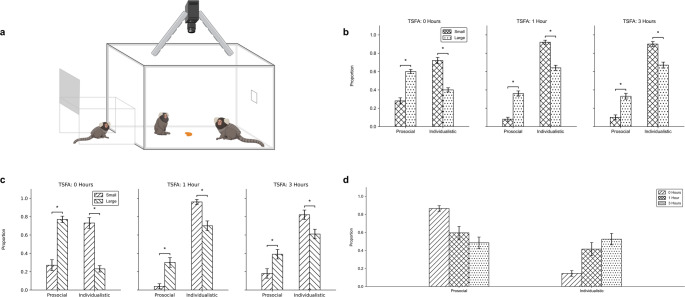 Figure 1
Peer Reviews
No public reviews on file for this paper yet. If you reviewed it on a platform where reviews are public (OpenReview, ICLR, NeurIPS, ICML), you can paste yours below so the community can read it here.
Videos
No videos yet. Explain this paper in a talk, walkthrough, or lecture? Add one.
Taxonomy
TopicsPrimate Behavior and Ecology · Evolutionary Game Theory and Cooperation · Animal Vocal Communication and Behavior