Acetoclastic versus hydrogenotrophic methanogenesis: defining how pH and alkalinity shape acetate metabolism in a haloalkaliphilic methanogenic community for biomethane production
Beatriz C. Diniz, Ben Abbas, Dimitry Y. Sorokin, Mark C. M. van Loosdrecht, Philipp Zantout-Wilfert

TL;DR
This study explores how pH and alkalinity affect methane production pathways in a haloalkaliphilic microbial community, showing that higher pH and alkalinity favor hydrogenotrophic over acetoclastic methanogenesis.
Contribution
The study identifies the pH tipping point and the influence of alkalinity on the shift from acetoclastic to hydrogenotrophic methanogenesis in haloalkaliphilic communities.
Findings
Methanocalculus abundance increases with pH, especially at higher alkalinity.
Alkalinity has a stronger influence than pH on the metabolic shift in methanogenesis.
Syntrophic interactions with 'Candidatus Contubernalis' support hydrogenotrophic methanogenesis.
Abstract
In methanogenic communities, two main pathways drive methanogenesis: acetoclastic methanogenesis, which converts acetate into CH4 and CO2, and hydrogenotrophic methanogenesis, which reduces CO2 with H2 to CH4. Under high-pH conditions, a shift in dominance from acetoclastic to hydrogenotrophic methanogenesis is often observed. The goal of this work was to identify the pH tipping point for this metabolic shift and to elucidate the influence of alkalinity on this transition in a haloalkaliphilic methanogenic community enriched from anaerobic soda lake sediments. To this end, a haloalkaliphilic microbial community was cultivated across a pH range (8.20–10.00) at three different alkalinities (0.1, 0.6, 1.2 eq/L). Specific qPCR probes were developed to quantify the two dominant methanogens for each catabolism: “Ca. Methanocrinis natronophilus” (acetoclastic) and Methanocalculus alkaliphilus…
Genes, proteins, chemicals, diseases, species, mutations and cell lines named across the full text — each resolved to its canonical identifier and authoritative record.
Click any figure to enlarge with its caption.
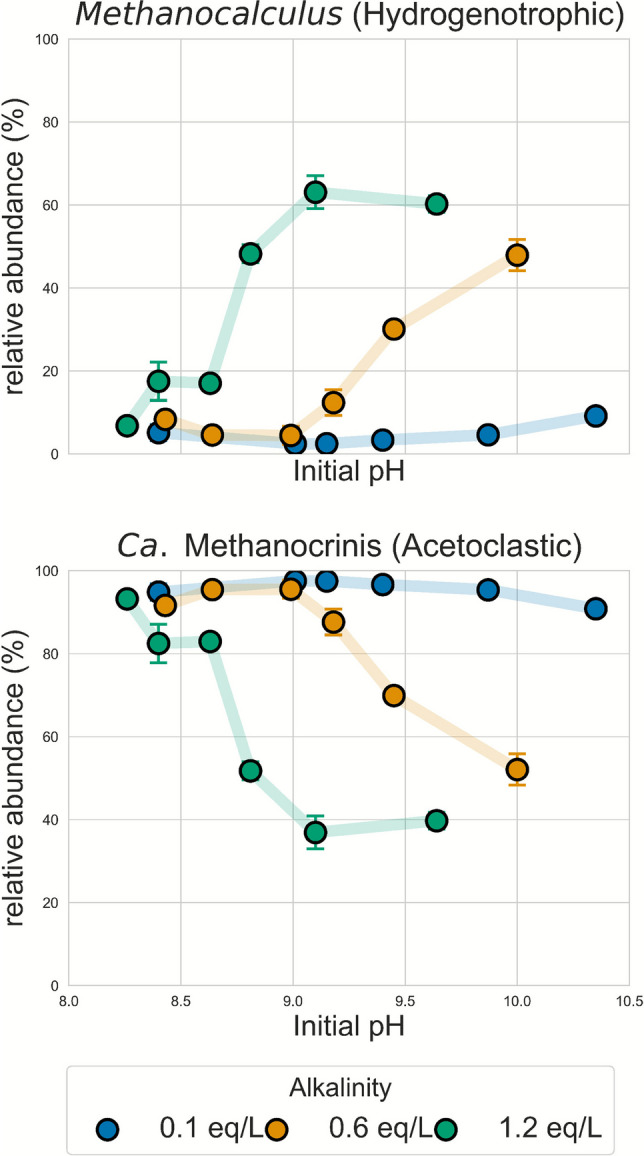 Figure 1
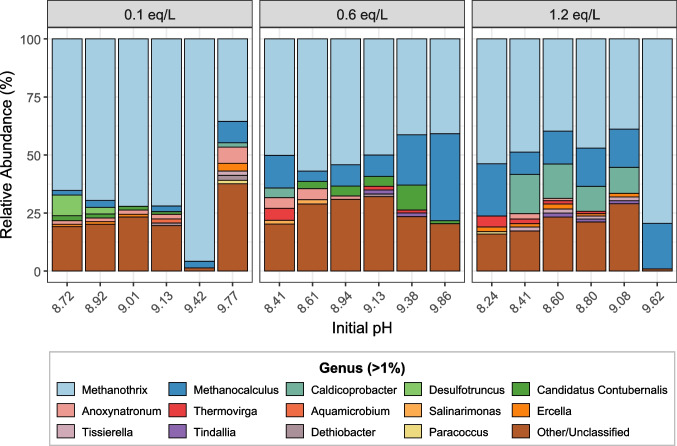 Figure 2
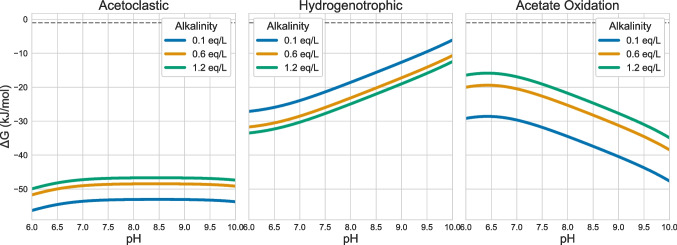 Figure 3
Peer Reviews
No public reviews on file for this paper yet. If you reviewed it on a platform where reviews are public (OpenReview, ICLR, NeurIPS, ICML), you can paste yours below so the community can read it here.
Videos
No videos yet. Explain this paper in a talk, walkthrough, or lecture? Add one.
Taxonomy
TopicsAnaerobic Digestion and Biogas Production · Microbial Community Ecology and Physiology · Microbial metabolism and enzyme function