Understanding steinstrasse: a systematic review of definitions, clinical management, and emerging perspectives in endourology
F. Zorzi, S. Moretto, L. M. I. Jannello, A. Bravo-Balado, A. Quarà, H. Werth, G. Rossin, A. Alanazi, P. Scilipoti, L. Candela, G. Liguori, S. Doizi, O. Traxer, F. Panthier

TL;DR
This review explores Steinstrasse, a condition after kidney stone treatments, focusing on its causes, diagnosis, and management.
Contribution
The paper provides a systematic review of Steinstrasse definitions, incidence, and management strategies, highlighting emerging concerns with endoscopic procedures.
Findings
The incidence of Steinstrasse ranges from 1% to 23%, influenced by stone burden and treatment modality.
Conservative management clears Steinstrasse in nearly half of cases, while flexible ureterorenoscopy is preferred for persistent cases.
Steinstrasse occurrence after flexible ureterorenoscopy is an emerging concern, requiring updated management strategies.
Abstract
To systematically review the definitions, diagnostic modalities, incidence, predictive factors, and management strategies of Steinstrasse (SS), following extracorporeal shock wave lithotripsy (ESWL) and endourological procedures. A comprehensive literature search was conducted in accordance with the PRISMA guidelines across PubMed, Scopus, and Embase, identifying randomized controlled trials, prospective and retrospective observational studies, and case series published between 1986 and May 2025. Forty-two studies met the inclusion criteria. The reported incidence of SS varied ranged from 1% to 23%, depending on initial stone burden, location, and treatment modality. Historical classifications, such as that proposed by Coptcoat et al., remain the most adopted linking SS morphology to clinical management. Diagnostic methods have evolved over time, from plain abdominal radiography (KUB)…
Genes, proteins, chemicals, diseases, species, mutations and cell lines named across the full text — each resolved to its canonical identifier and authoritative record.
Click any figure to enlarge with its caption.
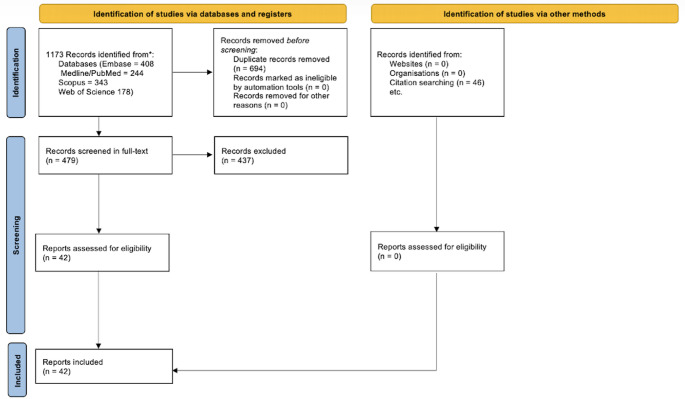 Figure 1
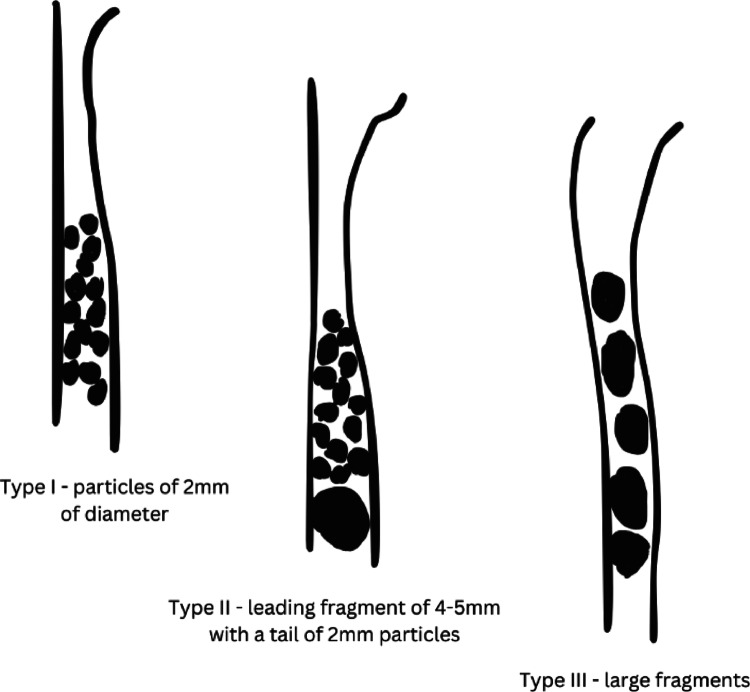 Figure 2
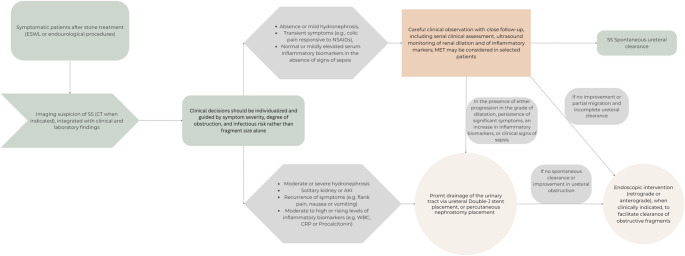 Figure 3
Peer Reviews
No public reviews on file for this paper yet. If you reviewed it on a platform where reviews are public (OpenReview, ICLR, NeurIPS, ICML), you can paste yours below so the community can read it here.
Videos
No videos yet. Explain this paper in a talk, walkthrough, or lecture? Add one.
Taxonomy
TopicsKidney Stones and Urolithiasis Treatments · Abdominal Surgery and Complications · Ureteral procedures and complications