Patterns and persistence of use, effectiveness, safety, clinical inertia, and adherence related to Levothyroxine treatment with real-world evidence. An observational, longitudinal and retrospective study
Luis Fernando Valladales-Restrepo, Diego Andrés Londoño-Cano, Carlos Mauricio Muñoz-Velez, Lian Manuela Soto-Romero, Marlon Eleazart Tafur-Ramirez, Maria José Rojas-Varón, Jorge Enrique Machado-Alba

TL;DR
This study examines how levothyroxine is used, its effectiveness, and adherence in Colombian patients with thyroid disease using real-world data.
Contribution
The study provides real-world evidence on levothyroxine treatment patterns and adherence in a Colombian patient cohort.
Findings
Only 47.7% of patients persisted with levothyroxine treatment after one year.
Clinical inertia and poor disease control were common despite few adverse events.
Older patients and those with comorbidities were more likely to persist with treatment.
Abstract
Over- and undertreatment of chronic diseases are common. In this context, real-world data on the use of levothyroxine are limited. The aim was to determine the patterns of use, persistence, effectiveness, safety, clinical inertia, and adherence related to levothyroxine treatment in a group of patients with thyroid disease in Colombia. This was an observational study of patients treated with levothyroxine. Clinical records were reviewed, and the minimum patient follow-up was one year. Descriptive, bivariate and multivariate analyses were performed. A total of 398 patients were identified; the median age was 53.5 years, and 71.1% were women. A total of 76.9% of the patients received levothyroxine for clinical hypothyroidism, and few adverse events occurred (4.3%). 52% of the patients were not on goal at their first thyroid-stimulating hormone (TSH) checkup. Only 36.4% had a second TSH…
Genes, proteins, chemicals, diseases, species, mutations and cell lines named across the full text — each resolved to its canonical identifier and authoritative record.
Click any figure to enlarge with its caption.
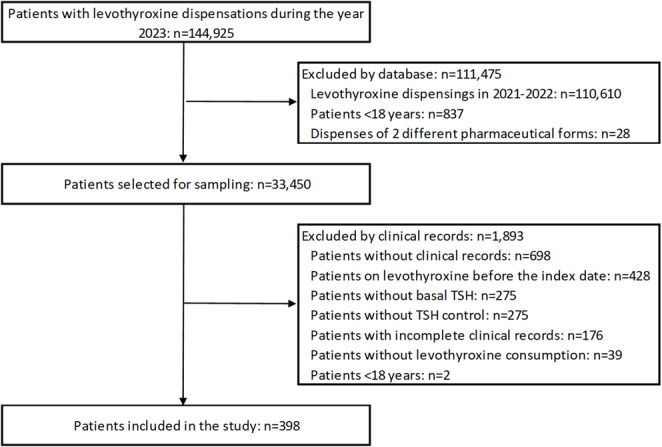 Figure 1
Peer Reviews
No public reviews on file for this paper yet. If you reviewed it on a platform where reviews are public (OpenReview, ICLR, NeurIPS, ICML), you can paste yours below so the community can read it here.
Videos
No videos yet. Explain this paper in a talk, walkthrough, or lecture? Add one.
Taxonomy
TopicsThyroid Disorders and Treatments · Thyroid Cancer Diagnosis and Treatment · Ophthalmology and Eye Disorders