Comparative evaluation of dynamic risk stratification according to ATA 2015 and ATA 2025 in low-risk differentiated thyroid cancer without radioiodine ablation
Pablo Fernández Velasco, Paula Peciña Melgosa, Beatriz Torres Torres, Luis Miguel Torres Morientes, Ana Fernández Rodríguez, Marta Alonso Mesonero, Marta de Uribe Viloria, María Álvarez Quiñones, Jaime Santos Pérez, Daniel de Luis Román, Gonzalo Diaz-Soto

TL;DR
This study compares two risk stratification methods for low-risk thyroid cancer patients not receiving radioiodine treatment, finding that the newer method classifies more patients as having an excellent response.
Contribution
The study evaluates the impact of updated 2025 ATA criteria on risk stratification in low-risk thyroid cancer patients without radioiodine ablation.
Findings
ATA2025 criteria significantly increased excellent response rates compared to ATA2015-M.
An intermediate thyroglobulin cutoff of 1 ng/mL provided a more realistic response classification.
Anti-thyroglobulin antibody negativization was the main driver for reclassification under ATA2025.
Abstract
To compare dynamic risk stratification (DRS) according to the 2015 American Thyroid Association-Momesso et al. 2016 extension (ATA2015-M) and the 2025 ATA update in low-risk differentiated thyroid cancer (DTC) managed without radioactive iodine (I-131), and to explore the role of an intermediate thyroglobulin (Tg) cutoff of 1 ng/mL. We conducted a retrospective analysis of a prospectively collected cohort of 74 low-risk DTC patients treated with total thyroidectomy (n = 55) or hemithyroidectomy (n = 19) between 2020 and 2024. Clinical, histopathological, and biochemical data were collected. DRS was assessed at the first follow-up visit (6 months after surgery) and at the last visit (median follow-up 27 months [IQR 16–41]) using ATA2015-M and ATA2025 criteria. An exploratory analysis applying a Tg cutoff of 1 ng/mL was performed. According to ATA2015-M, excellent response (ER) rates in…
Genes, proteins, chemicals, diseases, species, mutations and cell lines named across the full text — each resolved to its canonical identifier and authoritative record.
Click any figure to enlarge with its caption.
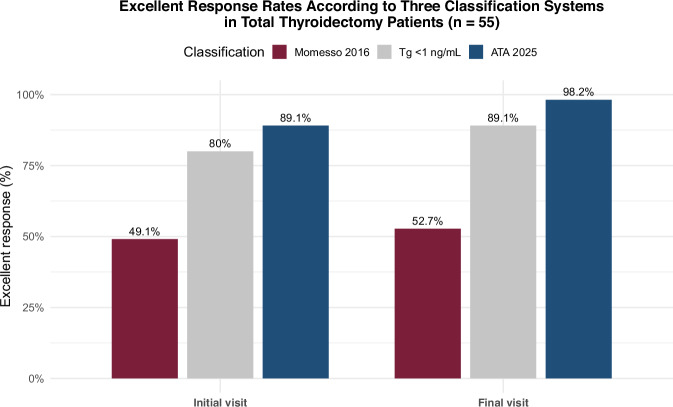 Figure 1
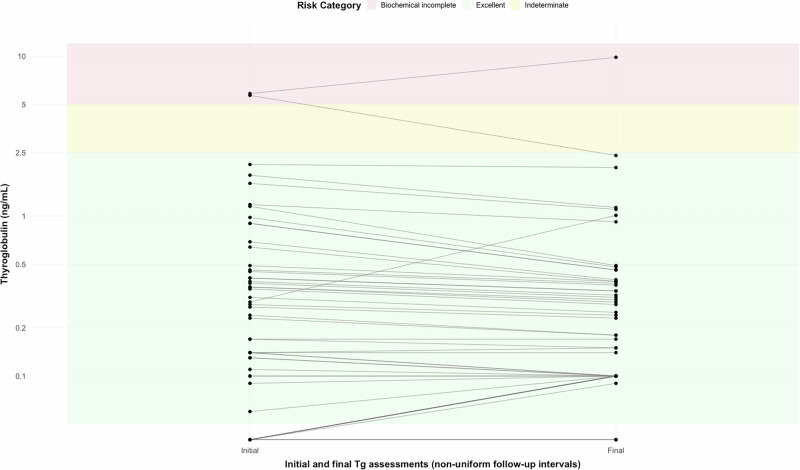 Figure 2
Peer Reviews
No public reviews on file for this paper yet. If you reviewed it on a platform where reviews are public (OpenReview, ICLR, NeurIPS, ICML), you can paste yours below so the community can read it here.
Videos
No videos yet. Explain this paper in a talk, walkthrough, or lecture? Add one.
Taxonomy
TopicsThyroid Cancer Diagnosis and Treatment · Thyroid and Parathyroid Surgery · Thyroid Disorders and Treatments