Long-term patient experience with online MR-guided radiotherapy: adaptive versus non-adaptive workflow
Fabian Weykamp, Charlotte Herder-Wagner, Sebastian Regnery, Jakob Liermann, Eva Meixner, Philipp Hoegen-Saßmannshausen, Laila König, Kristin Lang, C. Katharina Renkamp, Carolin Rippke, Sebastian Klüter, Jürgen Debus, Juliane Hörner-Rieber

TL;DR
This study compares patient experiences and outcomes between adaptive and non-adaptive workflows in MR-guided radiotherapy, finding that while adaptive methods take longer and cause more short-term discomfort, they do not increase toxicity and may offer faster recovery.
Contribution
The study provides new insights into patient-reported outcomes and toxicity of adaptive versus non-adaptive MR-guided radiotherapy workflows.
Findings
Adaptive treatment sessions were significantly longer than non-adaptive ones (71 vs. 36 minutes).
Patients in adaptive treatment reported higher discomfort related to duration, immobility, and sensory effects.
Adaptive therapy showed faster return to baseline post-treatment (6–8 weeks vs. 6–12 months).
Abstract
Magnetic resonance–linear accelerator (MR-Linac) systems enable high-precision radiotherapy through real-time MR guidance and daily online adaptive treatment planning. While online adaptation offers substantial dosimetric advantages, it extends treatment session durations on an already resource-intensive platform. This study aimed to evaluate patient-reported outcome measures (PROMs) and long-term toxicity profiles associated with MR-guided radiotherapy, with a particular focus on the impact of online adaptive workflows. This subgroup analysis of an ongoing prospective observational study comprises patients treated with the MRIdian Linac at the Department of Radiation Oncology at Heidelberg University Hospital between January 2019 and May 2021. Online plan adaptation was implemented in February 2020. A custom-designed in-house questionnaire (PRO-Q) was employed to assess patient…
Genes, proteins, chemicals, diseases, species, mutations and cell lines named across the full text — each resolved to its canonical identifier and authoritative record.
Click any figure to enlarge with its caption.
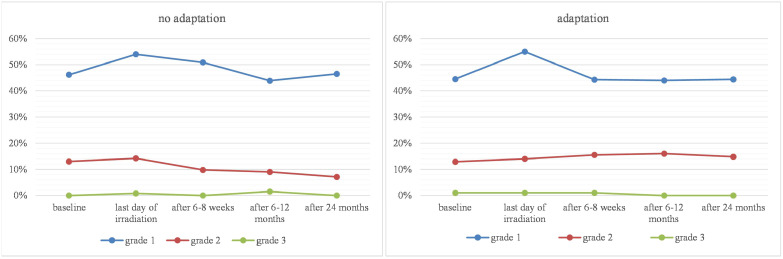 Figure 1
 Figure 2
Peer Reviews
No public reviews on file for this paper yet. If you reviewed it on a platform where reviews are public (OpenReview, ICLR, NeurIPS, ICML), you can paste yours below so the community can read it here.
Videos
No videos yet. Explain this paper in a talk, walkthrough, or lecture? Add one.
Taxonomy
TopicsAdvanced Radiotherapy Techniques · Prostate Cancer Diagnosis and Treatment · Radiation Therapy and Dosimetry