Molecular characteristics and Helicobacter pylori infection rates in patients with gastric cancer in Western Poland: a comparative analysis of gastrectomy specimens across two decades
Jan Majewski, Marta Moszyńska, Kamila Stawczyk-Eder, Aldona Woźniak, Agnieszka Dobrowolska, Elżbieta Kaczmarek, Piotr Eder

TL;DR
This study compared gastric cancer characteristics in Western Poland over two decades and found no significant changes in Helicobacter pylori infection rates or early detection despite technological advances.
Contribution
The study provides a longitudinal analysis of gastric cancer molecular features and H. pylori infection rates in a rapidly developing region.
Findings
Ki-67 proliferation index significantly increased in cancers diagnosed in 2016-2020.
Higher Ki-67 levels correlated with intestinal-type tumors, p53 expression, H. pylori infection, and angiogenesis.
Molecular characteristics and H. pylori-positive tumor rates remained largely unchanged over two decades.
Abstract
Gastric cancer incidence and characteristics vary due to environmental factors, and technical advances facilitate early detection of the disease. This study aimed to assess whether significant socio-economic changes and technological advancements in Poland — one of the most rapidly developing countries worldwide — affected the molecular characteristics and detection rates of early gastric cancer sub-types in Western Poland. Ninety-two patients undergoing gastrectomy for gastric cancer in 1998–2002 and 2016–2020 were studied. Surgical specimens were re-analyzed for histopathological features, including tumor type, grade, and stage (up-dated World Health Organization [WHO] classification). Immunohistochemical markers (Ki-67, p53, E-cadherin, CD10, CD31, bcl-2) and antigens for Helicobacter pylori (H. pylori) and Epstein-Barr virus (EBV) were evaluated. Microsatellite instability (MSI)…
Genes, proteins, chemicals, diseases, species, mutations and cell lines named across the full text — each resolved to its canonical identifier and authoritative record.
Click any figure to enlarge with its caption.
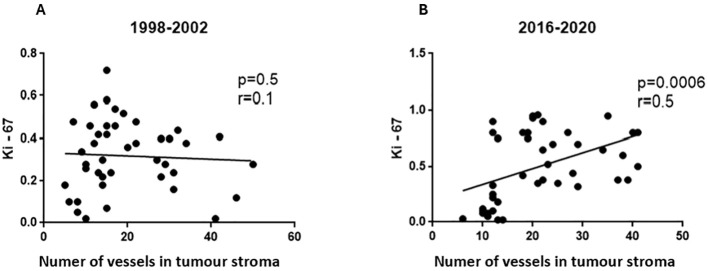 Figure 1
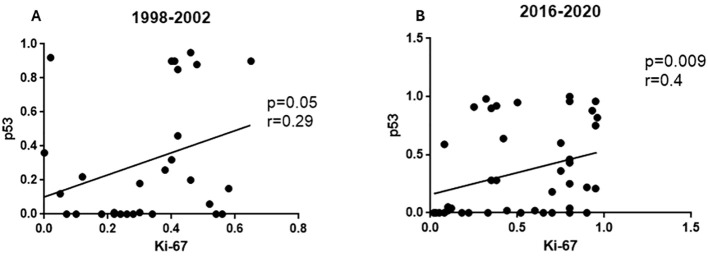 Figure 2
Peer Reviews
No public reviews on file for this paper yet. If you reviewed it on a platform where reviews are public (OpenReview, ICLR, NeurIPS, ICML), you can paste yours below so the community can read it here.
Videos
No videos yet. Explain this paper in a talk, walkthrough, or lecture? Add one.
Taxonomy
TopicsHelicobacter pylori-related gastroenterology studies · Gastric Cancer Management and Outcomes · Esophageal Cancer Research and Treatment