The “ELDERDES” model: how older adults' adoption of digital environment solutions improves residential experiences, health outcomes, and enables independent living
Stephen M. Golant

TL;DR
The ELDERDES model explores how older adults use digital technologies in their homes to improve safety, health, and independence as they age.
Contribution
The ELDERDES model introduces a framework for understanding how older adults adopt digital environment solutions to enhance their living experiences and health outcomes.
Findings
Digital environment solutions can improve safety and health by monitoring risks like falls and dangerous temperatures.
Older adults can maintain independence through virtual access to services and reduced reliance on physical community resources.
Adopting digital technologies in homes may become a more important focus for aging research than traditional physical adaptations.
Abstract
Global increases in longevity have led to a rapidly growing population of older adults entering advanced old age, facing increased risks of chronic illness, mobility limitations, sensory impairments, cognitive decline, poor emotional health, and social losses. These vulnerabilities make it more difficult for them to maintain independent living arrangements and to age optimally in their current homes, neighborhoods, and communities. Routine tasks like climbing stairs, reaching high shelves, or avoiding slippery floors become unsafe. Older people struggle to reach inhospitable community destinations to meet their obligatory and discretionary needs. As their “activity spaces” shrink to the home's confines, they experience new health stressors that further complicate age-related declines. Research and intervention strategies have emphasized making homes age-ready and reducing barriers to…
Genes, proteins, chemicals, diseases, species, mutations and cell lines named across the full text — each resolved to its canonical identifier and authoritative record.
Click any figure to enlarge with its caption.
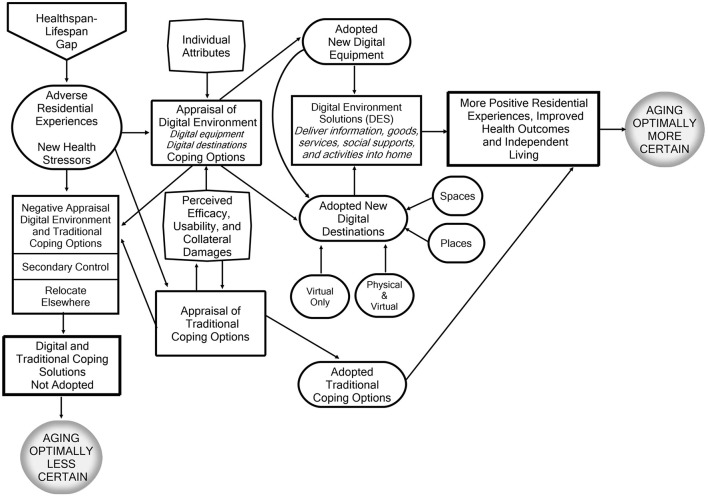 Figure 1
Peer Reviews
No public reviews on file for this paper yet. If you reviewed it on a platform where reviews are public (OpenReview, ICLR, NeurIPS, ICML), you can paste yours below so the community can read it here.
Videos
No videos yet. Explain this paper in a talk, walkthrough, or lecture? Add one.
Taxonomy
TopicsTechnology Use by Older Adults · Context-Aware Activity Recognition Systems · Assistive Technology in Communication and Mobility