Saccade reaction test for the assessment of cognitive readiness
Jun Maruta, Jamshid Ghajar

TL;DR
This study uses saccade reaction times to assess attention and cognitive readiness, showing age-related changes and potential for practical applications.
Contribution
A novel saccade-based test for cognitive readiness with age-related performance trends and retest reliability.
Findings
Saccade reaction speed improves in childhood and young adulthood, then declines with age.
The test showed moderate retest reliability (intraclass correlation 0.60–0.74).
Saccade metrics could help assess attention for task assignment or return-to-duty decisions.
Abstract
Cognitive performance such as rapidly reacting to a target or making correct decisions can directly impact task effectiveness in military, emergency, or athletic settings. Saccades are rapid changes in gaze that support recognition and analysis of objects of potential interest in human vision whose acuity rapidly degrades away from the center. The saccade behavior is highly selective and controlled and thus is an expression of attention. We implemented a two-dimensional reactive saccade task to quantify attention performance. We studied a sample of 169 healthy individuals aged 8–82 years old (39% male), 37 of whom were retested 1–3 months later. Subjects viewed a target presented in a randomized spatiotemporal sequence, and associated timings of saccade initiation and gaze arrival were registered. Individuals’ performance was characterized with the mean and standard deviation of the…
Genes, proteins, chemicals, diseases, species, mutations and cell lines named across the full text — each resolved to its canonical identifier and authoritative record.
Click any figure to enlarge with its caption.
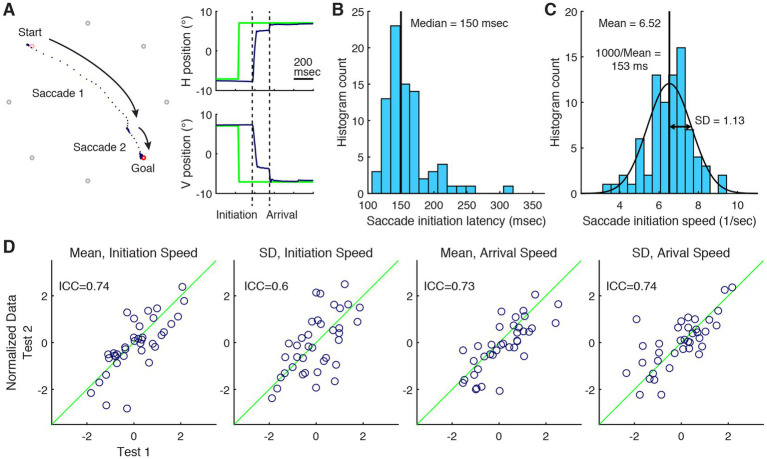 Figure 1
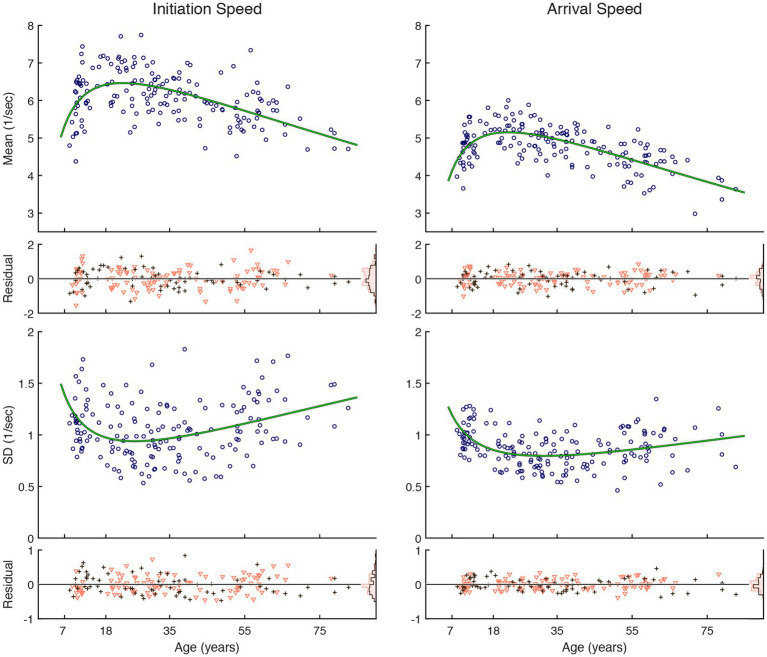 Figure 2
Peer Reviews
No public reviews on file for this paper yet. If you reviewed it on a platform where reviews are public (OpenReview, ICLR, NeurIPS, ICML), you can paste yours below so the community can read it here.
Videos
No videos yet. Explain this paper in a talk, walkthrough, or lecture? Add one.
Taxonomy
TopicsNeural and Behavioral Psychology Studies · Cognitive Functions and Memory · Traumatic Brain Injury Research