Femora from adults with type 1 or type 2 diabetes have lower bone strength and smaller hip geometry
Shannon R Emerzian, Fjola Johannesdottir, David C Lee, I-Hsien Wu, Surya Vishva Teja Jangolla, Marc Gregory Yu, Hetal S Shah, George L King, Tony M Keaveny, Klaus Engelke, Elaine W Yu, Mary L Bouxsein

TL;DR
People with type 1 or type 2 diabetes have weaker hip bones and smaller hip structures, which may explain their higher risk of hip fractures.
Contribution
This study shows that diabetes-related hip fracture risk is linked to bone geometry and strength, not just bone density.
Findings
Femoral strength was lower in both T1D and T2D groups compared to controls.
Diabetic groups had smaller hip geometry, including reduced femoral neck and trochanter cross-sectional areas.
Skeletal fragility in diabetes is greater than what can be explained by bone density alone.
Abstract
The increased hip fracture risk in individuals with type 1 (T1D) and type 2 (T2D) diabetes is not explained by areal BMD (aBMD), indicating that diabetes increases fracture risk through mechanisms independent of aBMD. To investigate, we used QCT to compare femoral strength, volumetric BMD (vBMD), and geometry in cadaveric femora from older adults with T1D (n = 23; 13 female) and T2D (n = 21; 11 female) to controls of similar age, sex, and race (n = 19; 11 female). While aBMD and vBMD measures were similar across groups, femoral strength was lower in the diabetic groups compared to controls. Geometric strength, based on external bone shape, was lower in T1D (−15%, p = .001) and T2D (−12%, p = .014) compared to controls. When combining geometry and density, femoral strength was significantly lower in T1D (−19%, p = .044). The strength-to-density ratio was also lower in T1D and T2D (p ≤…
Genes, proteins, chemicals, diseases, species, mutations and cell lines named across the full text — each resolved to its canonical identifier and authoritative record.
Click any figure to enlarge with its caption.
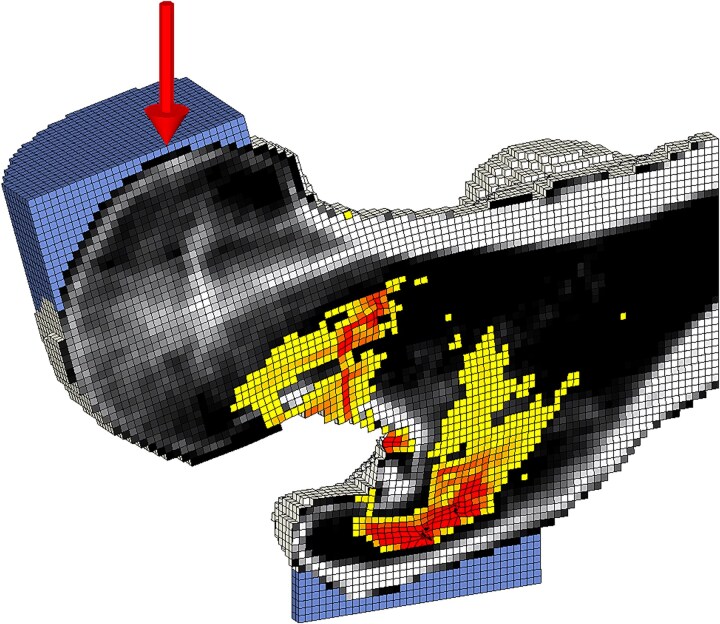 Figure 1
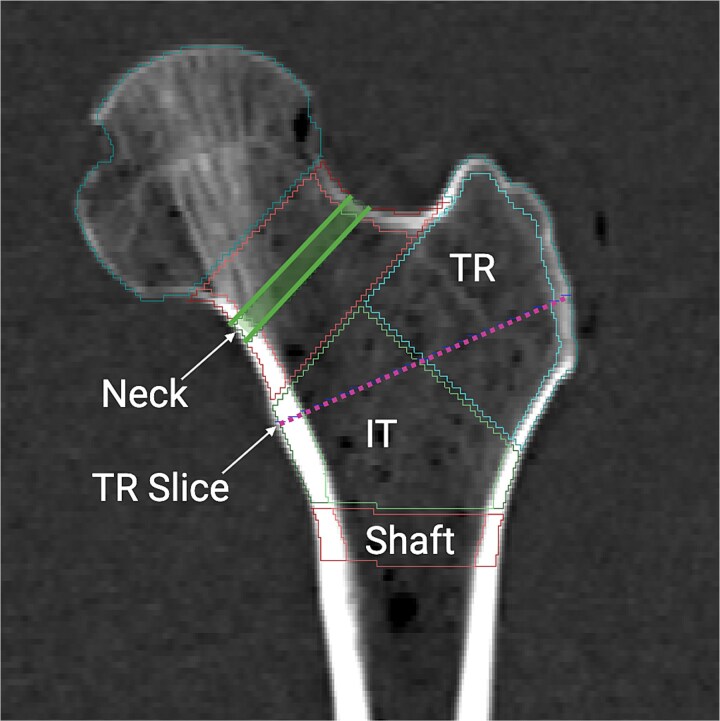 Figure 2
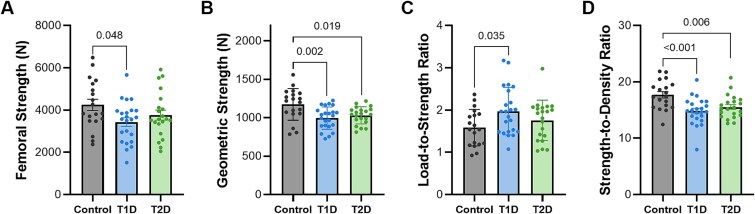 Figure 3
Peer Reviews
No public reviews on file for this paper yet. If you reviewed it on a platform where reviews are public (OpenReview, ICLR, NeurIPS, ICML), you can paste yours below so the community can read it here.
Videos
No videos yet. Explain this paper in a talk, walkthrough, or lecture? Add one.
Taxonomy
TopicsBone health and osteoporosis research · Bone and Joint Diseases · Hip and Femur Fractures