Productivity costs of type 2 diabetes with or without co-occurring substance use disorder and depression
Olli Kurkela, Saara Metso, Leena Forma, Kimmo Suokas, Pekka Rissanen, Jaakko Nevalainen

TL;DR
This study finds that people with type 2 diabetes who also have depression or substance use disorders face significantly higher productivity costs compared to those without these conditions.
Contribution
The study introduces a novel analysis of productivity costs in type 2 diabetes patients with co-occurring mental health and substance use disorders using both human capital and friction cost methods.
Findings
People with T2D and comorbid disorders had over sevenfold higher annual productivity costs at age 45 compared to those without comorbidities.
Productivity costs increased by €180 annually after age 50 and peaked near retirement age.
Diagnoses of T2D, substance use disorder, and depression were associated with additional annual friction cost estimates of €53, €195, and €202, respectively.
Abstract
Depression and substance use disorders are common causes of disability and often co-occur with type 2 diabetes (T2D). This study aimed to assess productivity costs using both human capital (HC) and friction cost (FC) methods and to examine how these costs change with age among people with T2D, with or without co-occurring substance use disorders and depression. The FinDM database was used to identify individuals of working age (age 30 or older) with T2D (N = 377,560) and comorbidities between 1998 and 2017. Individual-level productivity costs were estimated using both the FC and HC methods. The progression of annual mean costs and the associations of T2D and the comorbidities with these costs were analysed using piecewise linear generalized estimating equation models. People with T2D and the comorbidities incurred over sevenfold annual productivity costs at age 45 compared with those…
Genes, proteins, chemicals, diseases, species, mutations and cell lines named across the full text — each resolved to its canonical identifier and authoritative record.
Click any figure to enlarge with its caption.
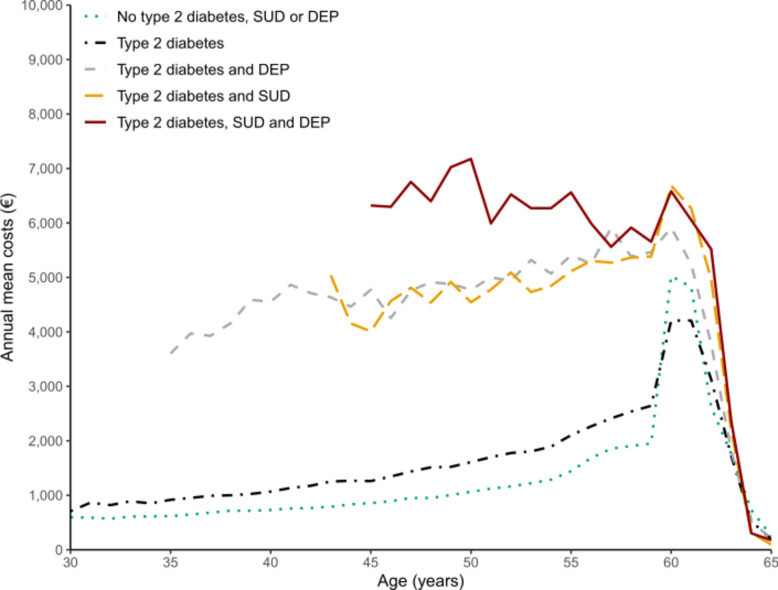 Figure 1
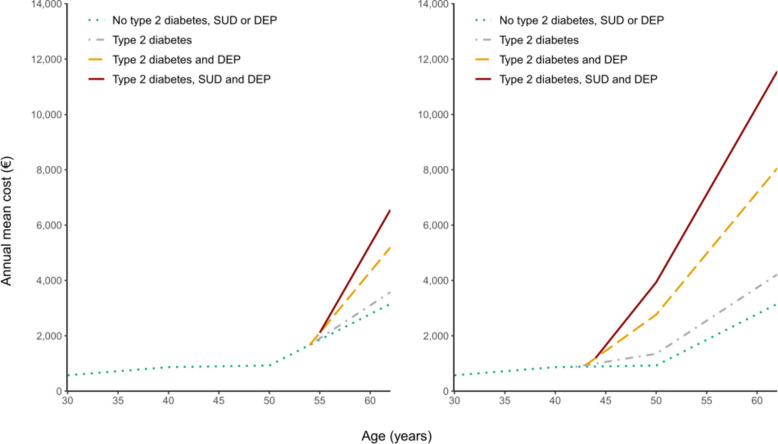 Figure 2
Peer Reviews
No public reviews on file for this paper yet. If you reviewed it on a platform where reviews are public (OpenReview, ICLR, NeurIPS, ICML), you can paste yours below so the community can read it here.
Videos
No videos yet. Explain this paper in a talk, walkthrough, or lecture? Add one.
Taxonomy
TopicsDiabetes Management and Education · Chronic Disease Management Strategies · Substance Abuse Treatment and Outcomes