Barriers and enablers to the utilisation of prison-based voluntary medical male circumcision (VMMC) among incarcerated men: a qualitative study from Maula Prison, Malawi
Nelson Tengamowa Munthali, Adrian Musiige, Jim Mtambo, Thokozire Chirambo, Lot Nyirenda

TL;DR
This study explores why incarcerated men in Malawi use or avoid prison-based HIV prevention surgery, finding that factors like peer support and prison conditions play a big role.
Contribution
The study identifies multilevel barriers and enablers to VMMC use in prisons using a social ecological model.
Findings
Enablers include peer motivation, hygiene improvements, and post-surgery exemptions from labor.
Barriers include fear of pain, stigma, misinformation, and lack of healthcare resources.
VMMC acceptance is high, but utilisation depends on individual, interpersonal, and organisational factors.
Abstract
The prevalence of HIV in Malawi is 7.1% among the general population and 16% among men who are incarcerated, indicating a widespread epidemic. To enhance HIV prevention in the nation, the Ministry of Health has made efforts to offer voluntary medical male circumcision (VMMC) services in prisons as an intervention to strengthen HIV prevention in the country. However, little is known about the barriers and enablers to the utilisation of VMMC among men who are incarcerated. This phenomenological qualitative study aimed to explore the experiences of men who were incarcerated while utilising prison-based VMMC services at Maula Prison in Lilongwe. Data were collected through interviews with 7 men who are incarcerated and 7 prison staff, resulting in a sample of 14 participants. A thematic content analysis approach was used to analyse data from both men who were incarcerated and prison staff,…
Genes, proteins, chemicals, diseases, species, mutations and cell lines named across the full text — each resolved to its canonical identifier and authoritative record.
Click any figure to enlarge with its caption.
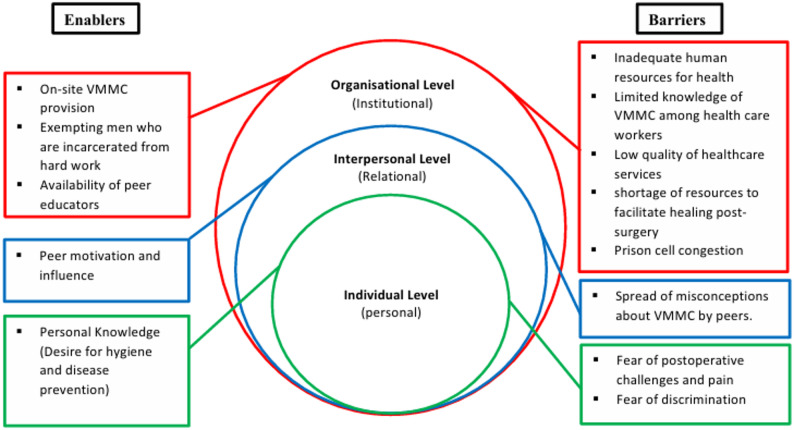 Figure 1
Peer Reviews
No public reviews on file for this paper yet. If you reviewed it on a platform where reviews are public (OpenReview, ICLR, NeurIPS, ICML), you can paste yours below so the community can read it here.
Videos
No videos yet. Explain this paper in a talk, walkthrough, or lecture? Add one.
Taxonomy
TopicsGenital Health and Disease · HIV/AIDS Research and Interventions · Female Genital Mutilation/Cutting Issues