Flipped learning, personality traits, and student outcomes: evidence from a controlled university trial
Tekin Dabaj, Aytekin İşman

TL;DR
A small study found that flipped classrooms improved student performance in cryptography, with some personality traits possibly linked to outcomes.
Contribution
The study provides a transparent methodology and instructional design model for replicating flipped learning experiments.
Findings
Flipped classroom students outperformed traditional classroom students in a cryptography course.
Conscientiousness correlated with performance in flipped classrooms, and neuroticism in traditional ones.
Personality findings are exploratory due to the small sample size.
Abstract
This pilot controlled study (N = 42) compared flipped and traditional classroom instruction in a short university-level cryptography course and examined whether personality traits exhibit preliminary associations with students’ academic performance and engagement. Students in the flipped condition outperformed those in the traditional setting, reinforcing the documented instructional benefits of flipped learning. Although two group-specific correlations (conscientiousness in the flipped group and neuroticism in the traditional group) reached statistical significance, the small sample size limits the stability and generalizability of these effects; therefore, personality findings are interpreted as exploratory. The study contributes transparent methodology, reliable measures, and an instructional design model to support replication. Implications for practice, limitations, and…
Click any figure to enlarge with its caption.
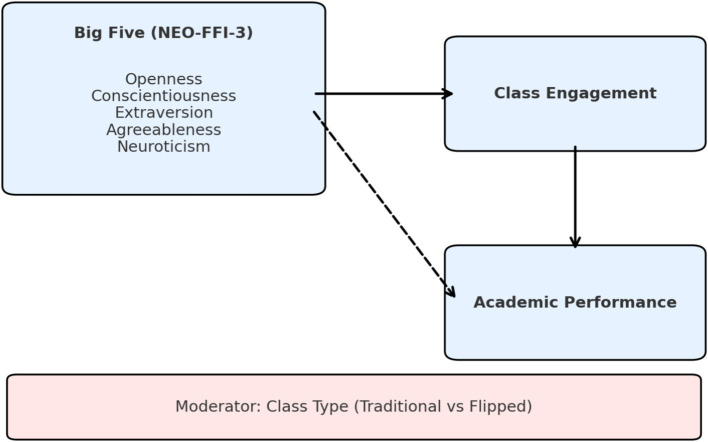 Figure 1
Peer Reviews
No public reviews on file for this paper yet. If you reviewed it on a platform where reviews are public (OpenReview, ICLR, NeurIPS, ICML), you can paste yours below so the community can read it here.
Videos
No videos yet. Explain this paper in a talk, walkthrough, or lecture? Add one.
Taxonomy
TopicsInnovative Teaching Methods · Management and Marketing Education · Student Assessment and Feedback