Self-Assembly of Linear Three-Ring Aromatic Thiols on Au(111)
Verena Müller, Anna-Laurine Gaus, Daniel Hüger, Julian Picker, Christof Neumann, Max von Delius, Andrey Turchanin

TL;DR
This study explores how certain aromatic thiols self-assemble on gold surfaces, forming structured monolayers with specific molecular arrangements.
Contribution
The paper introduces new insights into the self-assembly behavior of linear three-ring aromatic thiols with different terminal groups on Au(111) surfaces.
Findings
TPT, FTPT, CF3TPT, and PyBPT form densely packed SAMs with hexagonal unit cells of 21.55 Ų per molecule.
NTPT SAMs exhibit coexisting hexagonal and squared structures with areas of 21.55 and 42.25 Ų per molecule.
XPS, LEED, and STM techniques were used to determine the structural properties of the SAMs.
Abstract
We report on the self-assembly of linear three-ring aromatic thiols on Au(111)/mica substrates. Our study examines terphenylthiol (TPT) derivatives with distinct terminal groups −F (FTPT), −CF3 (CF3TPT) and −NO2 (NTPT) as well as a pyridinebiphenyl (PyBPT) compound. Using complementary surface science techniquesX-ray photoelectron spectroscopy (XPS), low-energy electron diffraction (LEED), and scanning tunneling microscopy (STM)we elucidate the structural properties of the resulting self-assembled monolayers (SAMs). The TPT, FTPT, CF3TPT and PyBPT molecules form densely packed SAMs with hexagonal unit cells exhibiting an area of 21.55 Å2 per molecule. For the NTPT SAM, two different molecular arrangements were observed to coexist: a hexagonal structure and a squared structure, with areas per molecule of 21.55 and 42.25 Å2, respectively.
Genes, proteins, chemicals, diseases, species, mutations and cell lines named across the full text — each resolved to its canonical identifier and authoritative record.
Click any figure to enlarge with its caption.
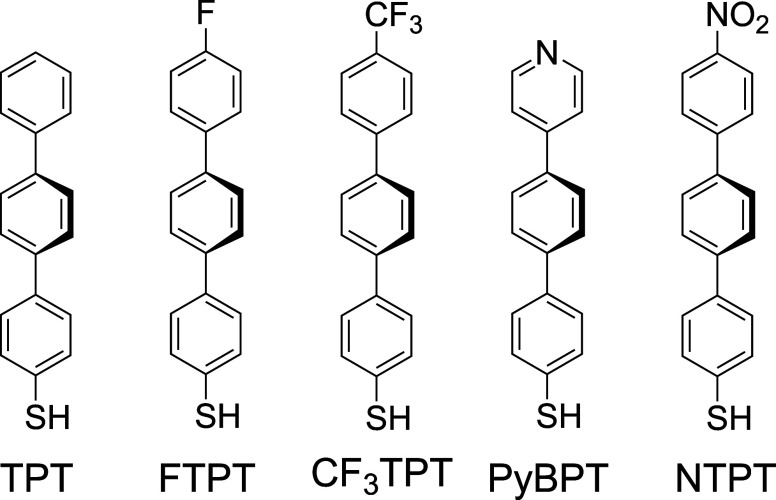 Figure 1
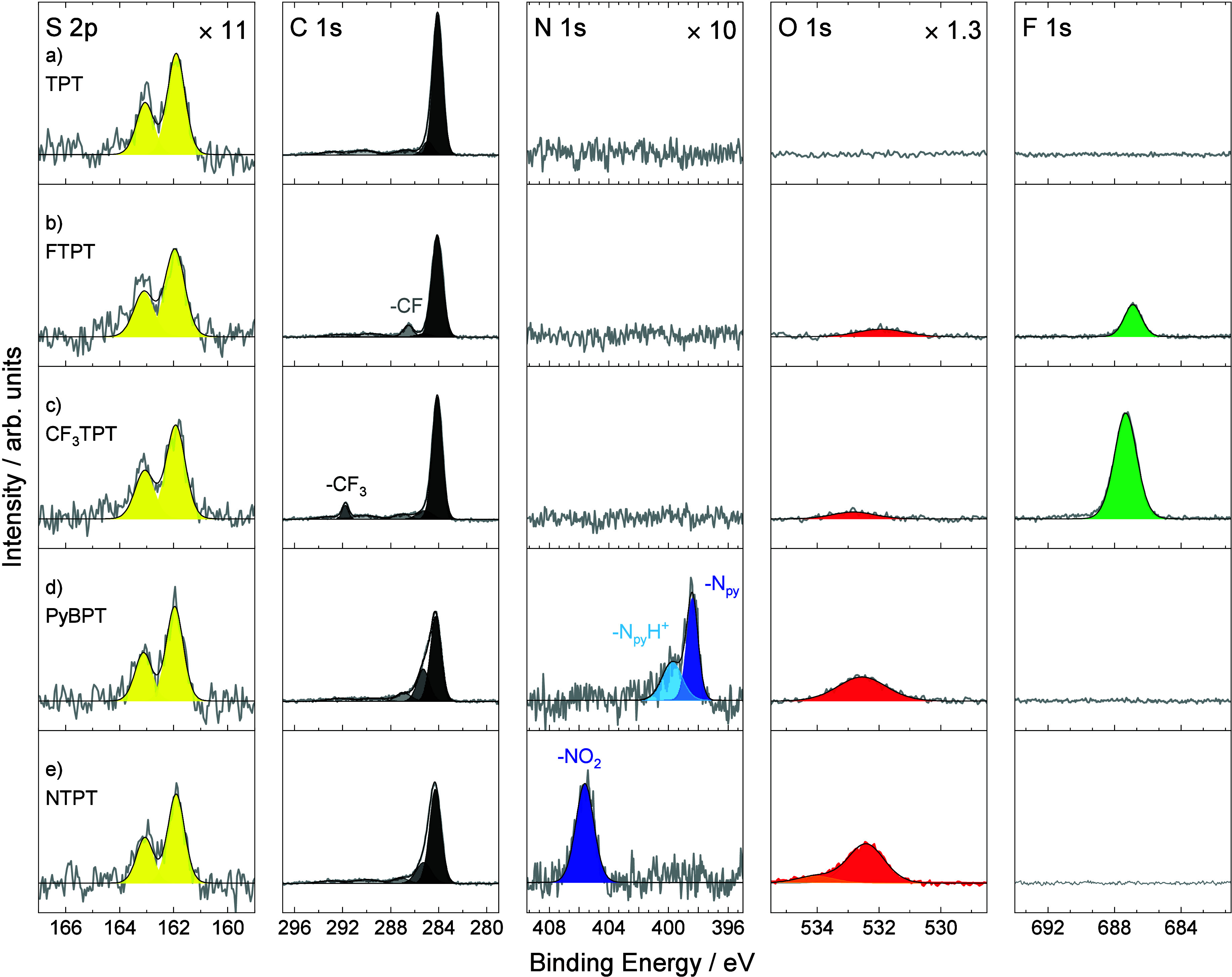 Figure 2
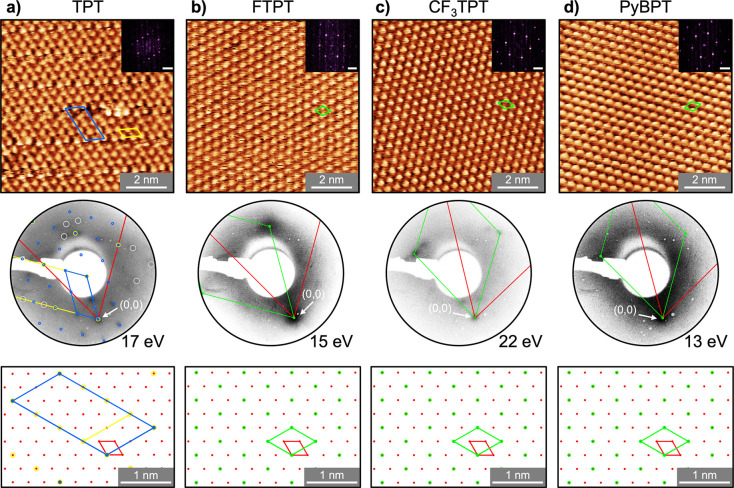 Figure 3
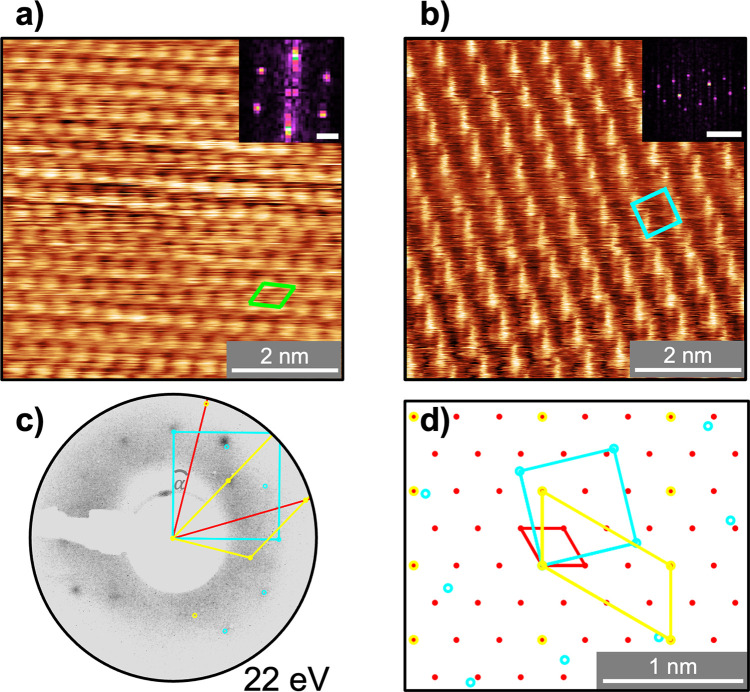 Figure 4
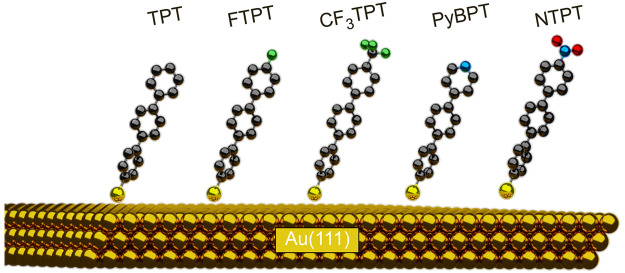 Figure 5
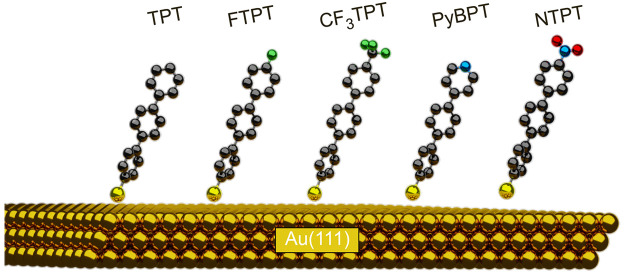 Figure 6
 Figure 7
 Figure 8
 Figure 9
 Figure 10
 Figure 11
 Figure 12
 Figure 13
 Figure 14
 Figure 15
 Figure 16
 Figure 17
 Figure 18
 Figure 19
 Figure 20
 Figure 21
 Figure 22
 Figure 23
 Figure 24
 Figure 25
 Figure 26
 Figure 27
 Figure 28
 Figure 29
 Figure 30
 Figure 31
 Figure 32
 Figure 33
 Figure 34
 Figure 35
 Figure 36
 Figure 37
Peer Reviews
No public reviews on file for this paper yet. If you reviewed it on a platform where reviews are public (OpenReview, ICLR, NeurIPS, ICML), you can paste yours below so the community can read it here.
Videos
No videos yet. Explain this paper in a talk, walkthrough, or lecture? Add one.
Taxonomy
TopicsMolecular Junctions and Nanostructures · Surface Chemistry and Catalysis · Organic Chemistry Cycloaddition Reactions