Rotationally Resolved Predissociation Spectrum of the 15Φ ← X5Δ Rovibronic Band of FeH+
Shan Jin, Marc Reimann, Christian van der Linde, Milan Ončák, Martin K. Beyer

TL;DR
This paper reports the first detailed spectrum of FeH+ in the lab, revealing its structure and how it breaks apart when exposed to light.
Contribution
The first rotationally resolved photodissociation spectrum of FeH+ is presented with theoretical and experimental analysis.
Findings
The rotational structure of the 15Φ ← X5Δ transition in FeH+ is resolved and assigned.
Predissociation broadens FeH+ spectral peaks due to curve crossings with repulsive states.
The photodissociation cross-section of FeH+ does not exceed 5 × 10–20 cm2.
Abstract
The elusive diatomic molecule FeH+ has long been hypothesized to exist in cool interstellar environments, yet its spectral signature has remained unidentified due to the lack of laboratory data. Its neutral counterpart FeH, on the other hand, is a well-known feature in the atmospheres of M-dwarfs, Sunspots, and hot Jupiter. Here we present the first rotationally resolved photodissociation spectrum of gas-phase FeH+, covering the energy range of 18550–18830 cm–1 (5390.8–5310.7 Å). The rotational structure of the 15Φ ← X5Δ electronic transition is resolved and conclusively assigned using state-of-the-art multireference and coupled cluster calculations and rovibrational spectra simulations. FeH+ spectral peaks in this specific band are broadened by predissociation, which arises from curve crossings of the bound 15Φ potential curve with those of repulsive 7Π, 7Δ states. The…
Genes, proteins, chemicals, diseases, species, mutations and cell lines named across the full text — each resolved to its canonical identifier and authoritative record.
Click any figure to enlarge with its caption.
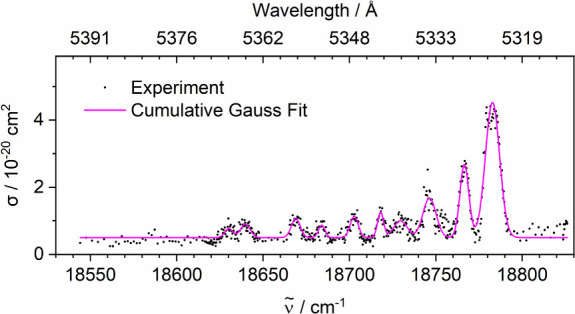 Figure 1
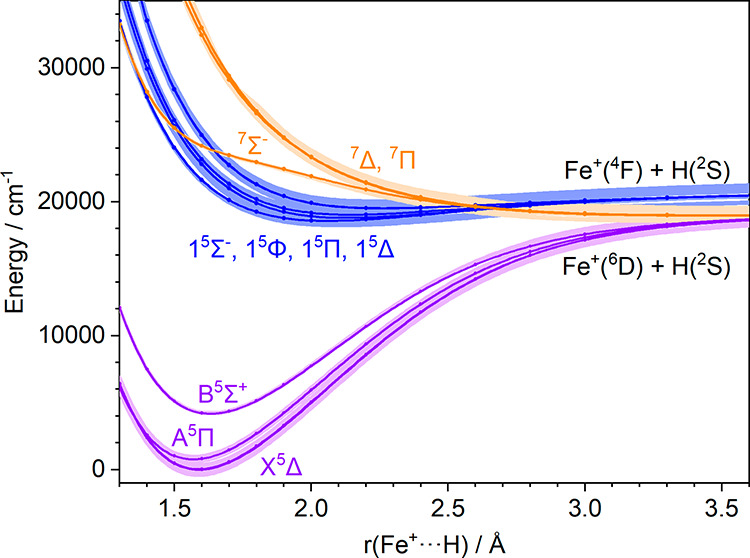 Figure 2
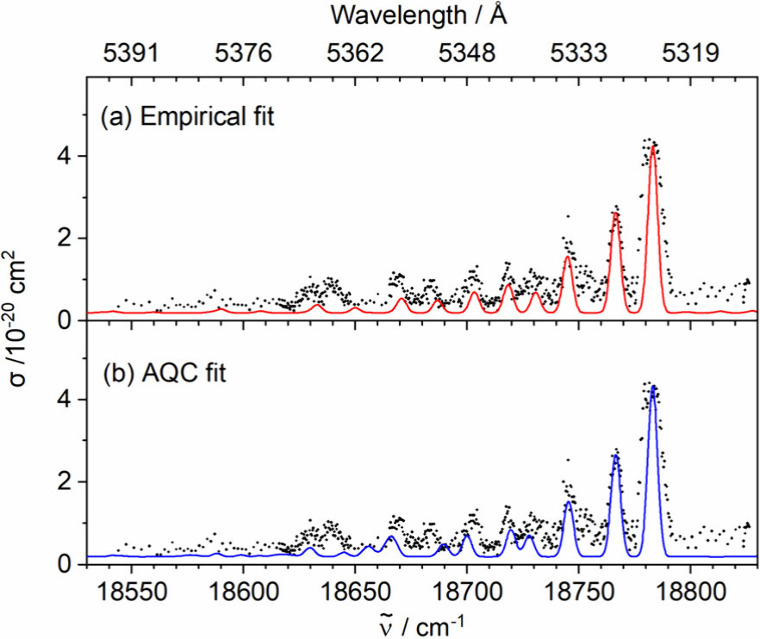 Figure 3
 Figure 4
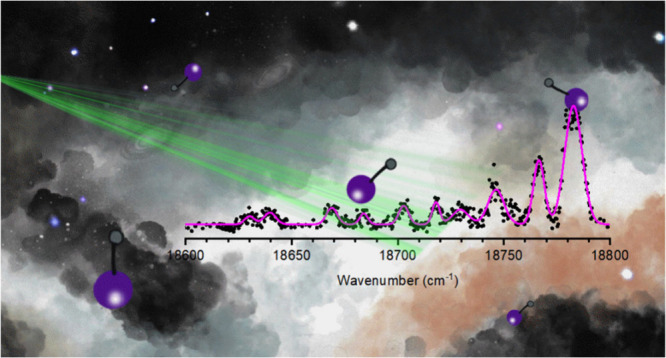 Figure 5
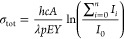 Figure 6
Peer Reviews
No public reviews on file for this paper yet. If you reviewed it on a platform where reviews are public (OpenReview, ICLR, NeurIPS, ICML), you can paste yours below so the community can read it here.
Videos
No videos yet. Explain this paper in a talk, walkthrough, or lecture? Add one.
Taxonomy
TopicsAstrophysics and Star Formation Studies · Stellar, planetary, and galactic studies · Astro and Planetary Science