Modulating halide leaving-group trends through recognition by bisboranes
Tong-Tong Liu, Xiao-Wen Li, Yun-Shu Cui, Zi-Hao Deng, Feng Liu, Dan-Dan Zhai, Zhang-Jie Shi

TL;DR
This paper shows how bisboranes can reverse the usual order of halide leaving-group ability in chemical reactions.
Contribution
The study introduces a bidentate Lewis acid platform that dynamically binds halides and reverses their leaving-group tendency.
Findings
Bisboranes selectively bind halides based on cavity size and ion radius.
Dynamic binding of halides influences nucleophilicity and reaction outcomes.
Halide leaving-group order is reversed in diborane-catalyzed transformations.
Abstract
Modulating the intrinsic leaving-group tendency of halides remains a long-standing challenge in synthetic chemistry. Herein, we reported dynamic anion recognition and demonstrated its application in nucleophilic substitution reactions, enabling an apparent reversal of the halide leaving-group tendency sequence. A bidentate Lewis acid-based platform was developed to selectively bind halide ions, forming host–guest complexes that were characterized by NMR spectroscopy and X-ray crystallography. Competitive experiments with the host molecule have revealed tunable binding affinities for the halides based on the cavity size of the bisboron center. Moreover, anion exchange experiments have demonstrated that the dynamic binding of halides is primarily influenced by their nucleophilicity and ion radius. The recognition of organohalides by diborane hosts induced a reversal of the leaving ability…
Genes, proteins, chemicals, diseases, species, mutations and cell lines named across the full text — each resolved to its canonical identifier and authoritative record.
Click any figure to enlarge with its caption.
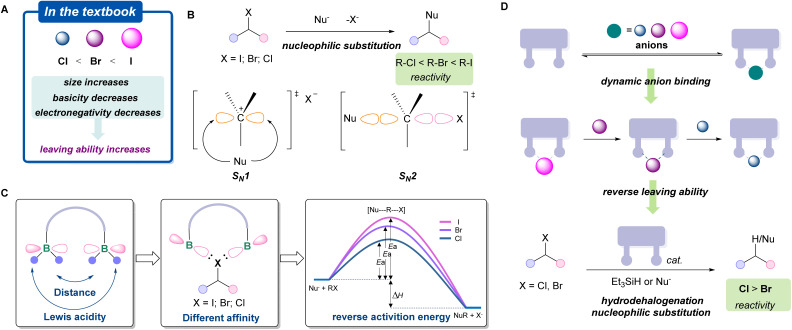 Figure 1
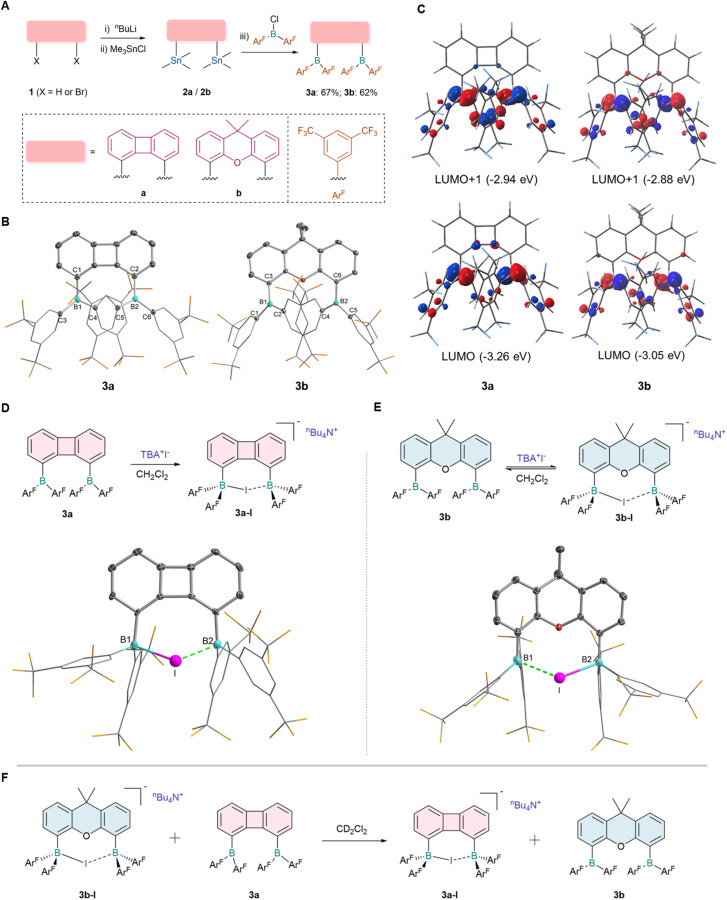 Figure 2
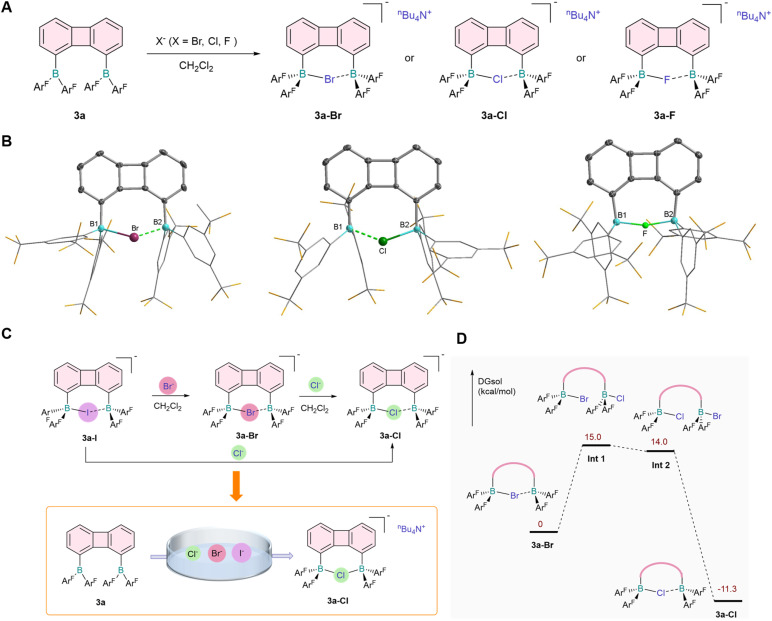 Figure 3
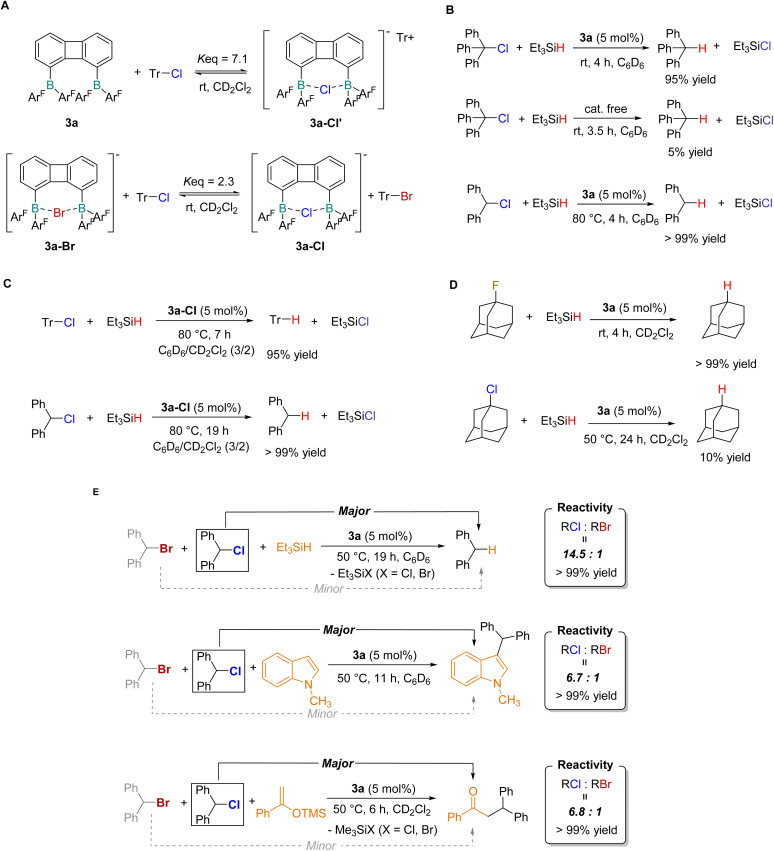 Figure 4
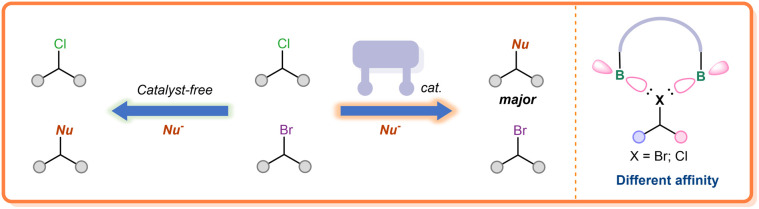 Figure 5
Peer Reviews
No public reviews on file for this paper yet. If you reviewed it on a platform where reviews are public (OpenReview, ICLR, NeurIPS, ICML), you can paste yours below so the community can read it here.
Videos
No videos yet. Explain this paper in a talk, walkthrough, or lecture? Add one.
Taxonomy
TopicsBoron Compounds in Chemistry · Organoboron and organosilicon chemistry · Crystallography and molecular interactions