Heat tolerance classification criteria require population‐specific thresholds for accurate assessment of acclimation state in adults
Jacob S. Bowie, Michael R. Szymanski, Jeb F. Struder, Erica M. Filep, Margaret C. Morrissey‐Basler, Gabrielle J. Brewer, Staci N. Thornton, Kyle J. Mahoney, Yasuki Sekiguchi, Oh Sung Kwon, Ki Chon, Douglas J. Casa, Elaine C. Lee

TL;DR
This study shows that heat tolerance classification criteria need to consider population-specific thresholds, as they can misclassify individuals, especially females, before and after heat acclimation.
Contribution
The study demonstrates that classification criteria for heat tolerance differ in sensitivity and may misclassify more females as heat-intolerant.
Findings
Heat acclimation reduces the rate of heat-intolerant classification across criteria.
Females are more frequently classified as heat-intolerant compared to males in both naïve and acclimated states.
Changes in rectal temperature during the final 60 minutes of the test are sensitive indicators of acclimation.
Abstract
Heat tolerance testing (HTT) assesses responses to heat stress with rectal temperature (Trec) and heart rate (HR) thresholds defining individuals as heat‐tolerant (HT) or heat‐intolerant (HI). To evaluate classification criteria by acclimation state and sex. Forty participants (19M/21F, mean ± SD, 23 ± 4 years) completed an HTT (120 min, 5 km·h−1, 2% grade) before (PreHA) and after (PostHA) 5 days of repeated exercise in (40°C, 40% RH) categorized as isothermal (exercise intensity adjusted to maintain Trec within 38.5°C–39.5°C, 60 min) exercise‐heat acclimation (HA). Females had lower body surface area (vs. males) (1.7 ± 0.1 vs. 2.0 ± 0.2 m2, p < 0.001), mass (59.5 ± 5.4 vs. 79.5 ± 10.1 kg, p < 0.001), height (164.2 ± 5.7 vs. 179.1 ± 7.6 cm, p < 0.001), maximal oxygen consumption (V̇O2max, 44.5 ± 5.1 vs. 51.5 ± 5.7 mL·min−1·kg−1, p < 0.001), and velocity at V̇O2max (12.9 ± 1.5 vs. 15.0…
Genes, proteins, chemicals, diseases, species, mutations and cell lines named across the full text — each resolved to its canonical identifier and authoritative record.
Click any figure to enlarge with its caption.
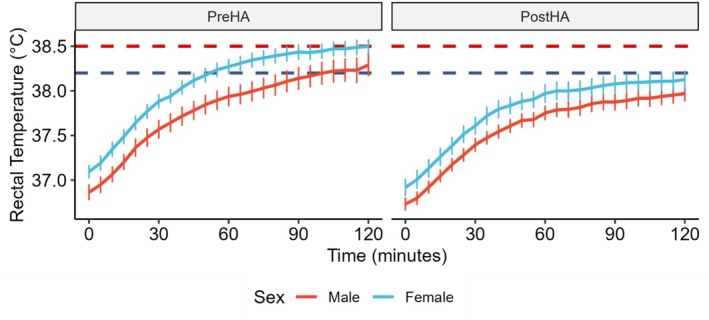 Figure 1
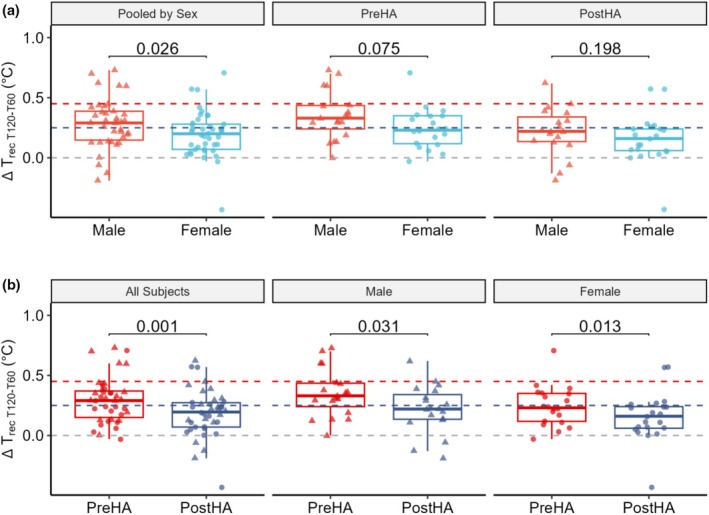 Figure 2
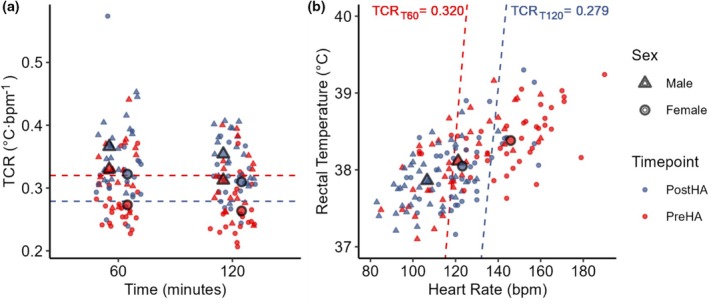 Figure 3
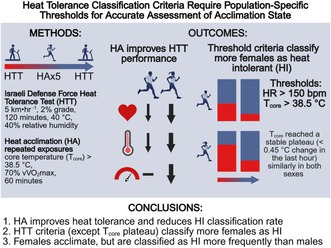 Figure 4
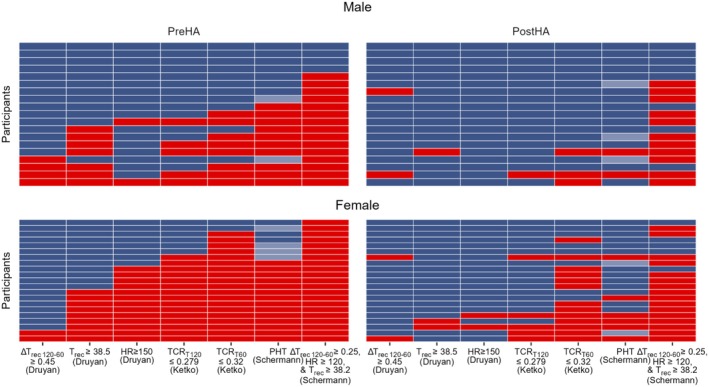 Figure 5
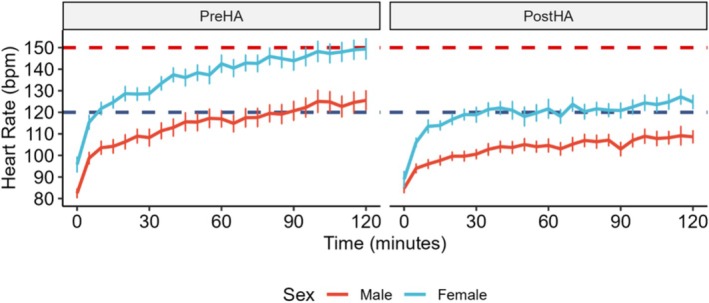 Figure 6
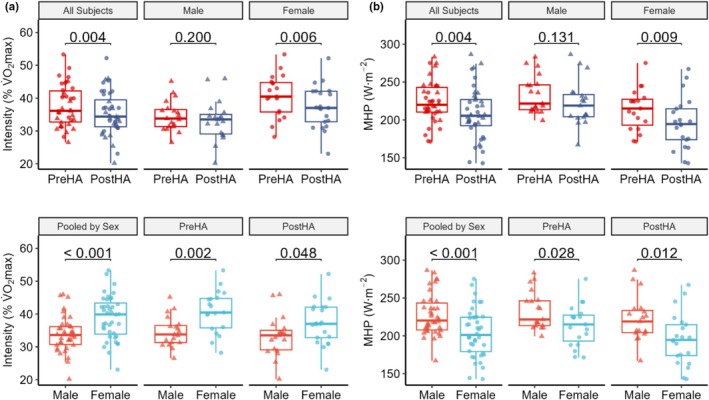 Figure 7
Peer Reviews
No public reviews on file for this paper yet. If you reviewed it on a platform where reviews are public (OpenReview, ICLR, NeurIPS, ICML), you can paste yours below so the community can read it here.
Videos
No videos yet. Explain this paper in a talk, walkthrough, or lecture? Add one.
Taxonomy
TopicsThermoregulation and physiological responses · Infrared Thermography in Medicine · Exercise and Physiological Responses