Calculating pulmonary shunt fraction using standard clinical measurements
John G. Toffaletti, Gerald S. Zavorsky

TL;DR
This tutorial demonstrates how to calculate pulmonary shunt fraction using four methods in a healthy adult during a 100% oxygen test.
Contribution
A practical, single-case educational template for calculating pulmonary shunt using standard clinical measurements.
Findings
Shunt estimates clustered between ~2.8% and 5.2% using four different methods in a healthy adult.
The results highlight the impact of assumptions like dissolved oxygen and estimation of Sv̄O2 on shunt calculations.
The tutorial emphasizes the importance of using multiple methods and clinical context for accurate interpretation.
Abstract
This single‐case pedagogical tutorial features a respiratory therapist who underwent a physiological shunt study for departmental education. Four formulas were used to estimate the shunt. A standardized 100% oxygen shunt test in a healthy male adult (51 years old, 185 cm, 84 kg) was performed to demonstrate how equation choice and assumptions affected the results. After 20 min breathing FiO2 = 1.0 at barometric pressure 752 mmHg, routine blood gas variables (PaO2 587 mmHg, PaCO2 38 mmHg, SaO2 0.993, Hb 15.2 g/dL) were used to compute shunt by four approaches: the classic content equation, Chiang's arterial approximation, a PAO2–PaO2 rule‐of‐thumb, and a simplified saturation method. Across methods, estimates clustered between ~2.8% and 5.2%, illustrating close agreement in health yet revealing how dissolved oxygen, estimation of Sv̄O2, and assumed arterial–venous content shift results.…
Genes, proteins, chemicals, diseases, species, mutations and cell lines named across the full text — each resolved to its canonical identifier and authoritative record.
Click any figure to enlarge with its caption.
 Figure 1
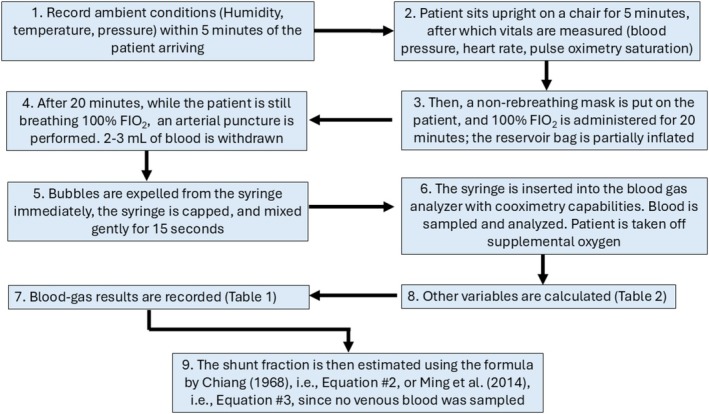 Figure 2
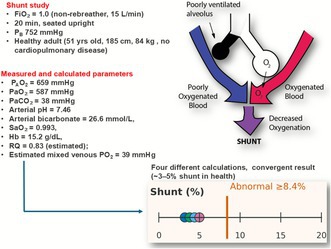 Figure 3
Peer Reviews
No public reviews on file for this paper yet. If you reviewed it on a platform where reviews are public (OpenReview, ICLR, NeurIPS, ICML), you can paste yours below so the community can read it here.
Videos
No videos yet. Explain this paper in a talk, walkthrough, or lecture? Add one.
Taxonomy
TopicsHemodynamic Monitoring and Therapy · Respiratory Support and Mechanisms · Renal function and acid-base balance