From twitch to relaxation: Obesity dysregulates muscle contractile function
L. Cesanelli, H. Degens, P. Minderis, D. Satkunskiene

TL;DR
Obesity impairs muscle function by reducing force generation and slowing muscle contraction and relaxation in both mice and humans.
Contribution
This study shows obesity causes slower muscle contractile kinetics and reduced force generation in both animal and human models.
Findings
Obese mice had lower specific force and slower contraction-relaxation dynamics in EDL and SOL muscles.
Obese men showed slower torque development and prolonged relaxation in plantar flexors during calf raises.
Higher body mass to torque ratio in obese men contributed to slower muscle performance.
Abstract
Obesity has been increasingly recognized not only as a metabolic disorder but also as a condition that impairs neuromuscular function, including strength relative to body mass. This translational study investigated whether obesity affects both force generation and contraction‐relaxation dynamics. In control (CN) and diet‐induced obese (OB) male mice, contractile properties of isolated extensor digitorum longus (EDL) and soleus (SOL) muscles were assessed in vitro. In parallel, plantar flexor performance was assessed in 25 normal‐weight (CN) and 25 class I obese (OB) sedentary men through maximal voluntary isometric contractions and a dynamic calf raise test. OB mice exhibited lower specific force and slower rates of force development and relaxation in both EDL and SOL (p < 0.05). In men, the lower rate of torque development and prolonged relaxation kinetics of the plantar flexors (p <…
Genes, proteins, chemicals, diseases, species, mutations and cell lines named across the full text — each resolved to its canonical identifier and authoritative record.
Click any figure to enlarge with its caption.
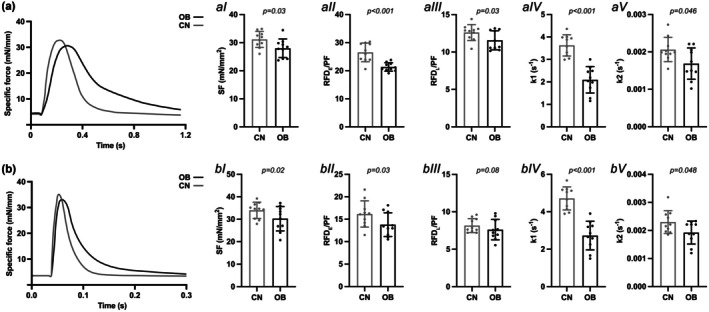 Figure 1
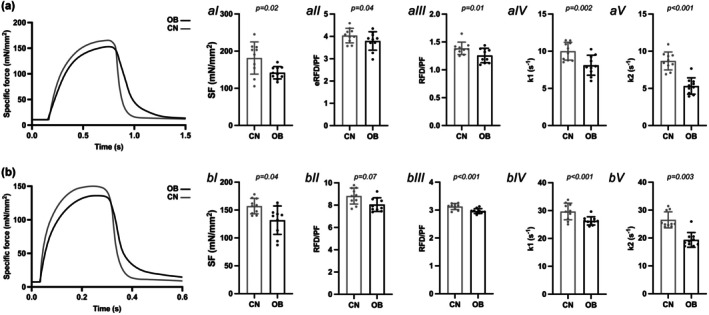 Figure 2
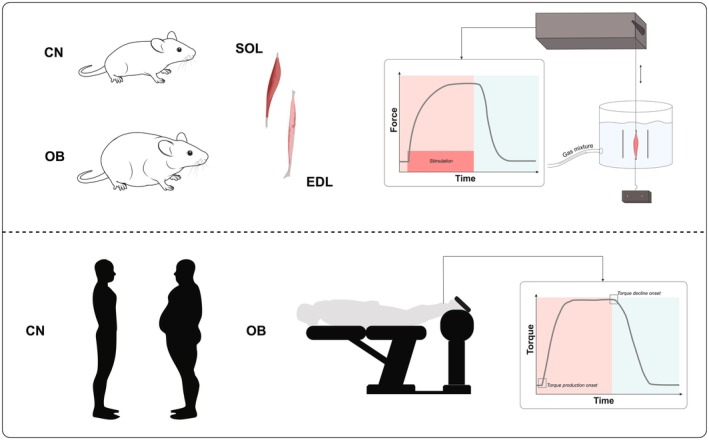 Figure 3
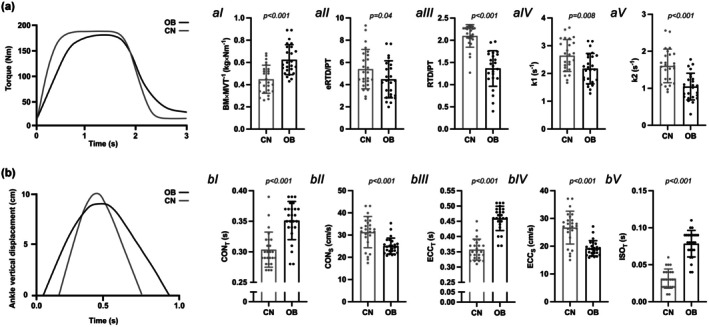 Figure 4
Peer Reviews
No public reviews on file for this paper yet. If you reviewed it on a platform where reviews are public (OpenReview, ICLR, NeurIPS, ICML), you can paste yours below so the community can read it here.
Videos
No videos yet. Explain this paper in a talk, walkthrough, or lecture? Add one.
Taxonomy
TopicsMuscle activation and electromyography studies · Muscle Physiology and Disorders · Cardiomyopathy and Myosin Studies